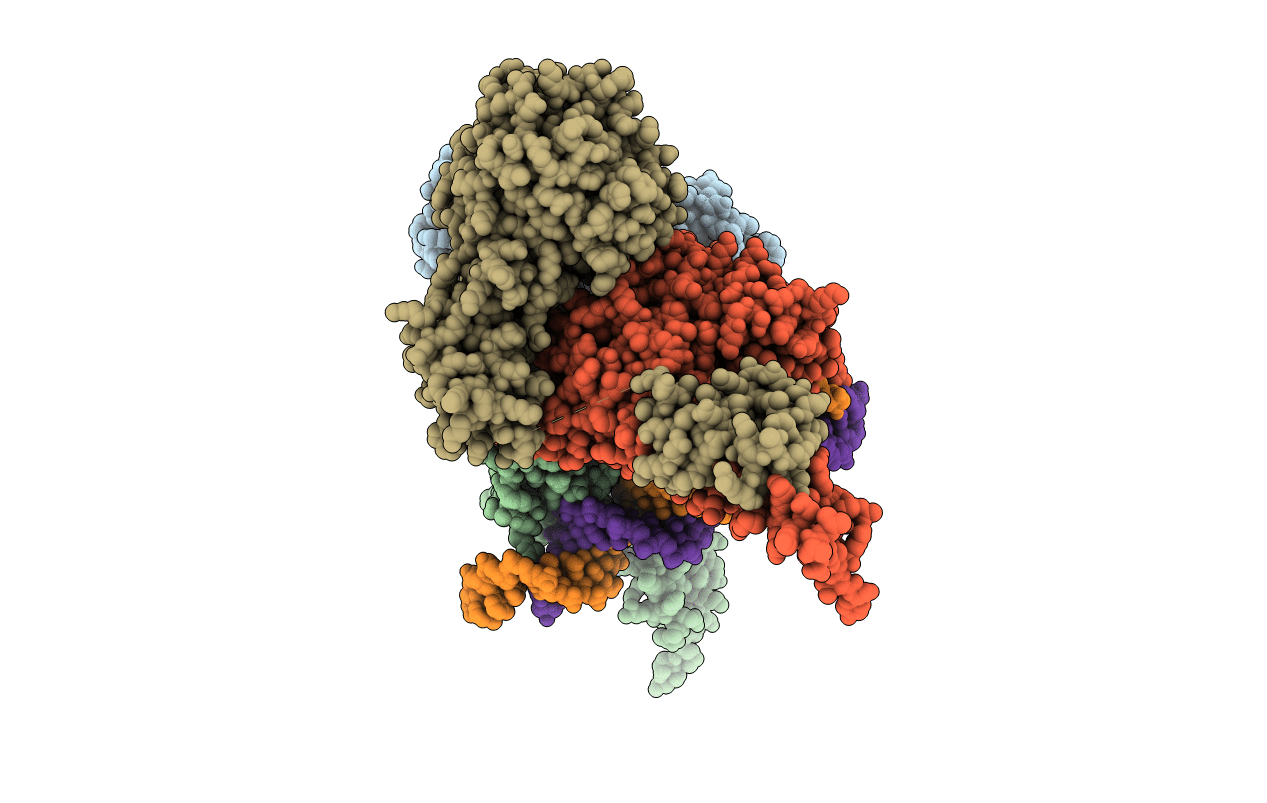
5F3W image
Deposition Date 2015-12-03
Release Date 2016-03-02
Last Version Date 2024-03-20
Entry Detail
PDB ID:
5F3W
Title:
Structure of the ATPrS-Mre11/Rad50-DNA complex
Biological Source:
Host Organism:
Method Details:
Experimental Method:
Resolution:
3.11 Å
R-Value Free:
0.26
R-Value Work:
0.22
R-Value Observed:
0.22
Space Group:
P 21 21 21

Macromolecular Entities
Structures with similar UniProt ID
Protein Blast
Polymer Type:polypeptide(L)
Molecule:DNA double-strand break repair protein Mre11
Gene (Uniprot):mre11
Chain IDs:A, C
Chain Length:386
Number of Molecules:2
Biological Source:Methanocaldococcus jannaschii DSM 2661
Structures with similar UniProt ID
Protein Blast
Polymer Type:polypeptide(L)
Molecule:DNA double-strand break repair Rad50 ATPase,DNA double-strand break repair Rad50 ATPase
Gene (Uniprot):rad50
Chain IDs:B, D
Chain Length:372
Number of Molecules:2
Biological Source:Methanocaldococcus jannaschii DSM 2661
Polymer Type:polydeoxyribonucleotide
Molecule:27-MER DNA
Chain IDs:E
Chain Length:27
Number of Molecules:1
Biological Source:synthetic construct
Polymer Type:polydeoxyribonucleotide
Molecule:27-MER DNA
Chain IDs:F
Chain Length:27
Number of Molecules:1
Biological Source:synthetic construct
Primary Citation
ATP-dependent DNA binding, unwinding, and resection by the Mre11/Rad50 complex
Embo J. 35 743 758 (2016)
PMID: 26717941 DOI: 10.15252/embj.201592462

Abstact

ATP-dependent DNA end recognition and nucleolytic processing are central functions of the Mre11/Rad50 (MR) complex in DNA double-strand break repair. However, it is still unclear how ATP binding and hydrolysis primes the MR function and regulates repair pathway choice in cells. Here,Methanococcus jannaschii MR-ATPγS-DNA structure reveals that the partly deformed DNA runs symmetrically across central groove between two ATPγS-bound Rad50 nucleotide-binding domains. Duplex DNA cannot access the Mre11 active site in the ATP-free full-length MR complex. ATP hydrolysis drives rotation of the nucleotide-binding domain and induces the DNA melting so that the substrate DNA can access Mre11. Our findings suggest that the ATP hydrolysis-driven conformational changes in both DNA and the MR complex coordinate the melting and endonuclease activity.

Legend

Protein

Chemical

Disease

Primary Citation of related structures
Feedback Form
Name
Email
Institute
Feedback