5F28 image
Deposition Date 2015-12-01
Release Date 2016-07-13
Last Version Date 2023-09-27
Entry Detail
PDB ID:
5F28
Title:
Crystal structure of FAT domain of Focal Adhesion Kinase (FAK) bound to the transcription factor MEF2C
Biological Source:
Source Organism:
Mus musculus (Taxon ID: 10090)
Host Organism:
Method Details:
Experimental Method:
Resolution:
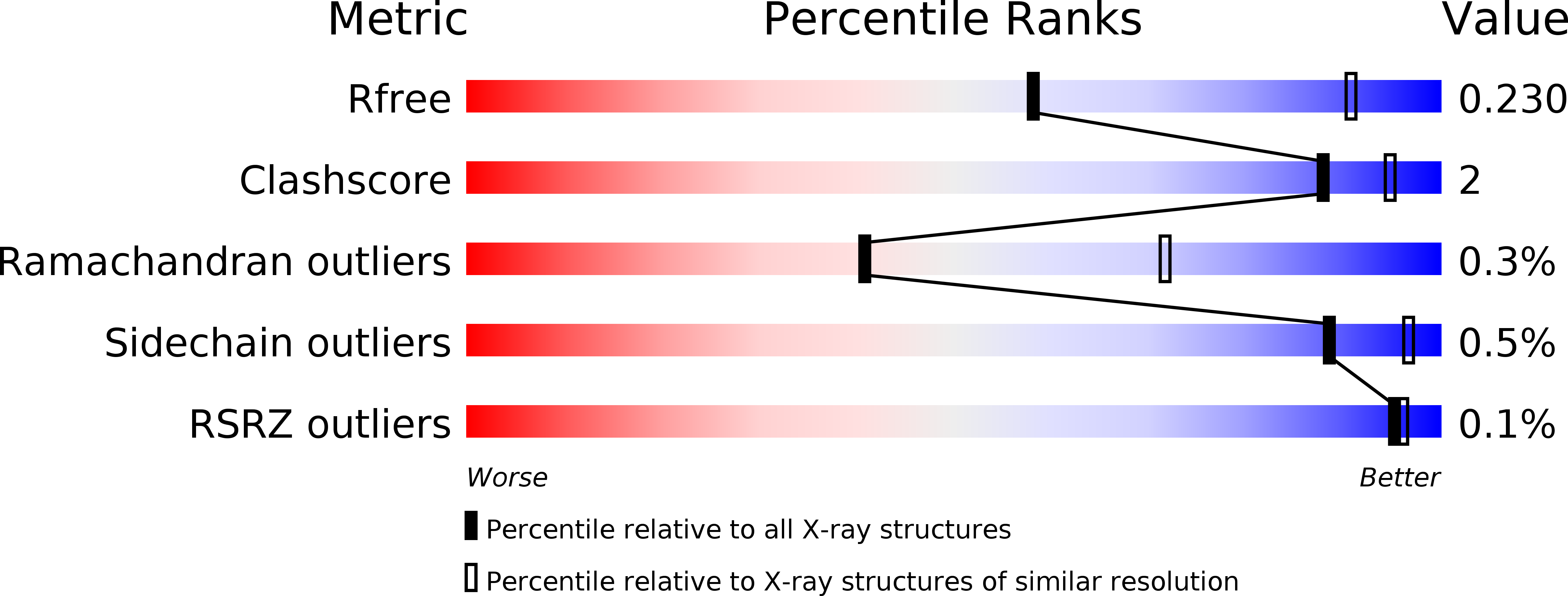
2.90 Å
R-Value Free:
0.23
R-Value Work:
0.20
R-Value Observed:
0.20
Space Group:
P 42 21 2
Macromolecular Entities
Structures with similar UniProt ID
Protein Blast
Polymer Type:polypeptide(L)
Molecule:MEF2C
Gene (Uniprot):Mef2c
Chain IDs:A, B, C, D
Chain Length:95
Number of Molecules:4
Biological Source:Mus musculus
Structures with similar UniProt ID
Protein Blast
Polymer Type:polypeptide(L)
Molecule:Focal adhesion kinase 1
Gene (Uniprot):Ptk2
Chain IDs:E, F, G
Chain Length:149
Number of Molecules:3
Biological Source:Mus musculus
Primary Citation
FAK Forms a Complex with MEF2 to Couple Biomechanical Signaling to Transcription in Cardiomyocytes.
Structure 24 1301 1310 (2016)
PMID: 27427476 DOI: 10.1016/j.str.2016.06.003

Abstact

Focal adhesion kinase (FAK) has emerged as a mediator of mechanotransduction in cardiomyocytes, regulating gene expression during hypertrophic remodeling. However, how FAK signaling is relayed onward to the nucleus is unclear. Here, we show that FAK interacts with and regulates myocyte enhancer factor 2 (MEF2), a master cardiac transcriptional regulator. In cardiomyocytes exposed to biomechanical stimulation, FAK accumulates in the nucleus, binds to and upregulates the transcriptional activity of MEF2 through an interaction with the FAK focal adhesion targeting (FAT) domain. In the crystal structure (2.9 Å resolution), FAT binds to a stably folded groove in the MEF2 dimer, known to interact with regulatory cofactors. FAK cooperates with MEF2 to enhance the expression of Jun in cardiomyocytes, an important component of hypertrophic response to mechanical stress. These findings underscore a connection between the mechanotransduction involving FAK and transcriptional regulation by MEF2, with potential relevance to the pathogenesis of cardiac disease.

Legend

Protein

Chemical

Disease

Primary Citation of related structures
Feedback Form
Name
Email
Institute
Feedback