5EZP image
Deposition Date 2015-11-26
Release Date 2016-01-27
Last Version Date 2024-01-10
Entry Detail
PDB ID:
5EZP
Title:
Human transthyretin (TTR) complexed with 4-hydroxy-chalcone
Biological Source:
Source Organism:
Homo sapiens (Taxon ID: 9606)
Method Details:
Experimental Method:
Resolution:
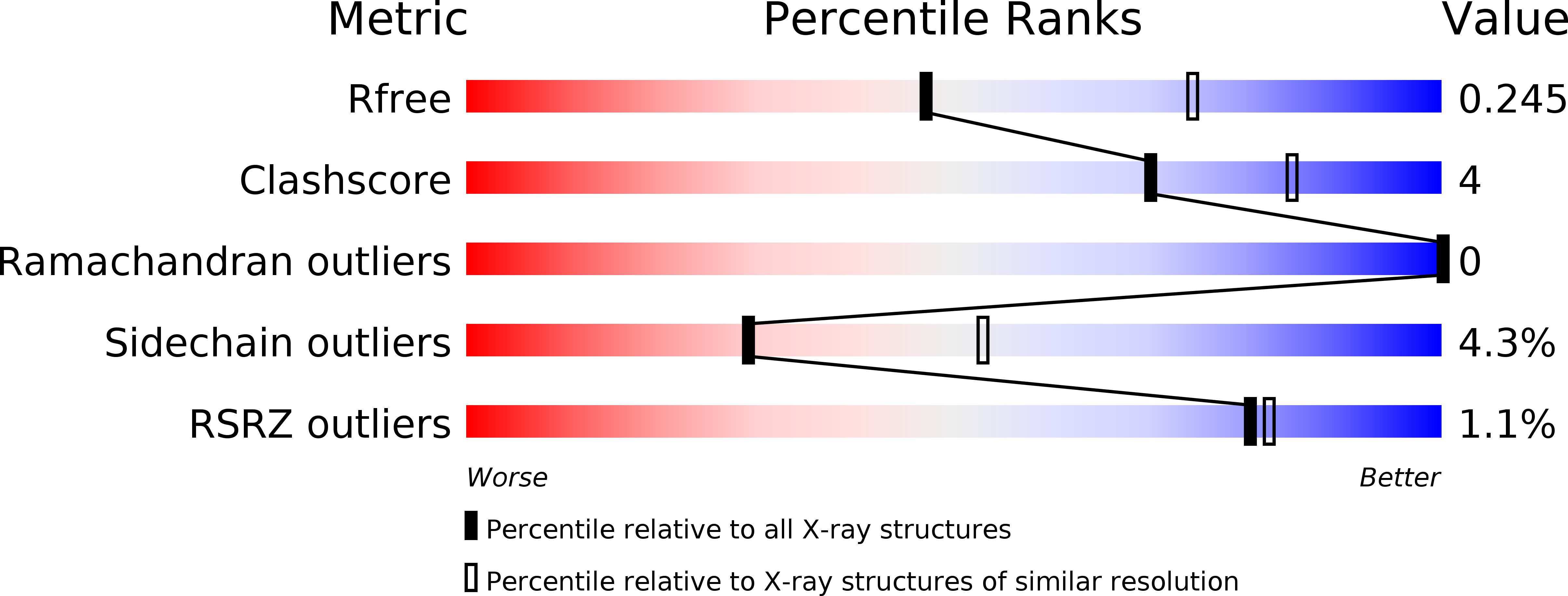
2.50 Å
R-Value Free:
0.24
R-Value Work:
0.20
R-Value Observed:
0.21
Space Group:
P 31
Macromolecular Entities
Structures with similar UniProt ID
Protein Blast
Polymer Type:polypeptide(L)
Molecule:Transthyretin
Gene (Uniprot):TTR
Chain IDs:A, B, C, D, E, F, G, H
Chain Length:122
Number of Molecules:8
Biological Source:Homo sapiens
Primary Citation
A new crystal form of human transthyretin obtained with a curcumin derived ligand.
J.Struct.Biol. 194 8 17 (2016)
PMID: 26796656 DOI: 10.1016/j.jsb.2016.01.007

Abstact

Transthyretin (TTR), a 54kDa homotetrameric protein that transports thyroxine (T4), has been associated with clinical cases of TTR amyloidosis for its tendency to aggregate to form fibrils. Many ligands with a potential to inhibit fibril formation have been studied by X-ray crystallography in complex with TTR. Unfortunately, the ligand is often found in ambiguous electron density that is difficult to interpret. The ligand validation statistics suggest over-interpretation, even for the most active compounds like diflunisal. The primary technical reason is its position on a crystallographic 2-fold axis in the most common crystal form. Further investigations with the use of polyethylene glycol (PEG) to crystallize TTR complexes have resulted in a new trigonal polymorph with two tetramers in the asymmetric unit. The ligand used to obtain this new polymorph, 4-hydroxychalcone, is related to curcumin. Here we evaluate this crystal form to understand the contribution it may bring to the study of TTR ligands complexes, which are often asymmetric.

Legend

Protein

Chemical

Disease

Primary Citation of related structures
Feedback Form
Name
Email
Institute
Feedback