5EHU image
Deposition Date 2015-10-28
Release Date 2015-12-23
Last Version Date 2023-11-15
Entry Detail
PDB ID:
5EHU
Title:
sfGFP mutant with unnatural amino acid 4-azidoethoxy-L-phenylalanine incorporated at the 149 site
Biological Source:
Source Organism:
Host Organism:
Method Details:
Experimental Method:
Resolution:
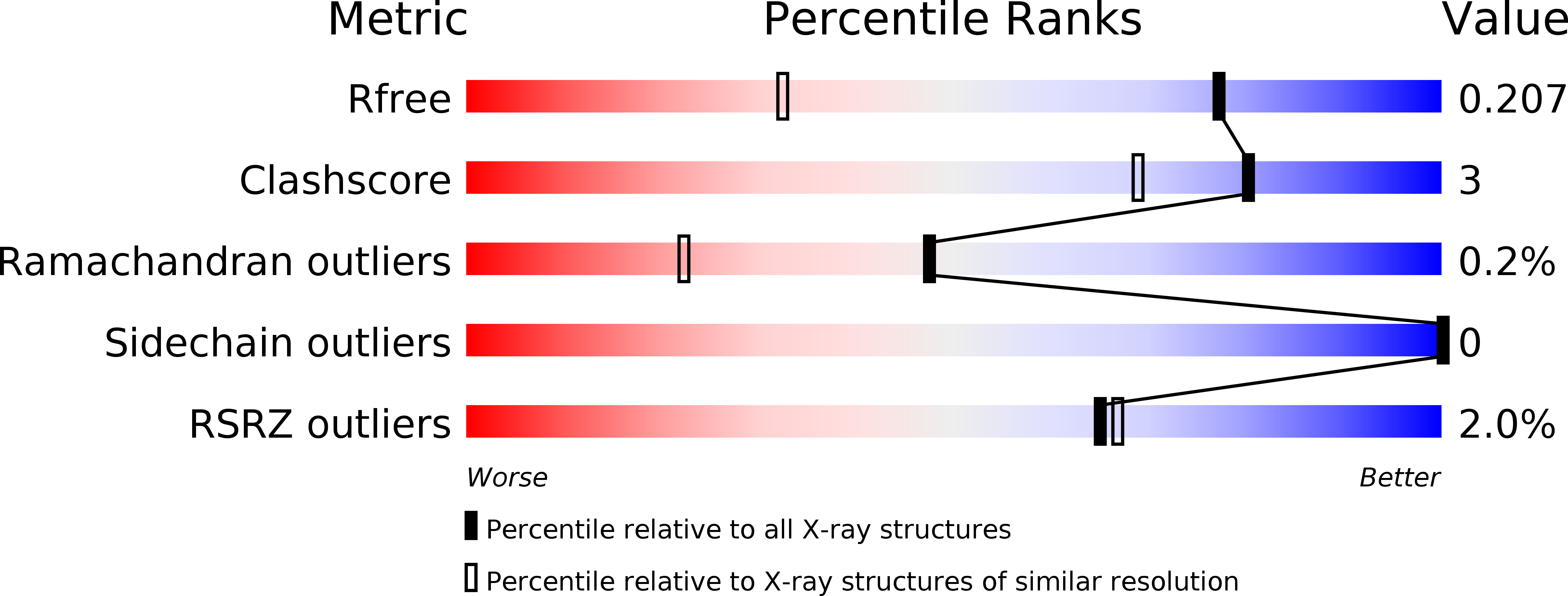
1.45 Å
R-Value Free:
0.20
R-Value Work:
0.17
R-Value Observed:
0.17
Space Group:
C 1 2 1
Macromolecular Entities
Structures with similar UniProt ID
Protein Blast
Polymer Type:polypeptide(L)
Molecule:Green fluorescent protein
Mutagens:S30R, A72S, Q80R, N149(4LZ), A206V
Chain IDs:A, B
Chain Length:239
Number of Molecules:2
Biological Source:Aequorea victoria
Modified Residue
Compound ID Chain ID Parent Comp ID Details 2D Image
CRO A GLY chromophore
Primary Citation
Azidoethoxyphenylalanine as a Vibrational Reporter and Click Chemistry Partner in Proteins.
Chemistry 21 19096 19103 (2015)
PMID: 26608683 DOI: 10.1002/chem.201503908

Abstact

An unnatural amino acid, 4-(2-azidoethoxy)-L-phenylalanine (AePhe, 1), was designed and synthesized in three steps from known compounds in 54% overall yield. The sensitivity of the IR absorption of the azide of AePhe was established by comparison of the frequency of the azide asymmetric stretch vibration in water and dimethyl sulfoxide. AePhe was successfully incorporated into superfolder green fluorescent protein (sfGFP) at the 133 and 149 sites by using the amber codon suppression method. The IR spectra of these sfGFP constructs indicated that the azide group at the 149 site was not fully solvated despite the location in sfGFP and the three-atom linker between the azido group and the aromatic ring of AePhe. An X-ray crystal structure of sfGFP-149-AePhe was solved at 1.45 Å resolution and provides an explanation for the IR data as the flexible linker adopts a conformation which partially buries the azide on the protein surface. Both sfGFP-AePhe constructs efficiently undergo a bioorthogonal strain-promoted click cycloaddition with a dibenzocyclooctyne derivative.

Legend

Protein

Chemical

Disease

Primary Citation of related structures
Feedback Form
Name
Email
Institute
Feedback