5ECJ image
Deposition Date 2015-10-20
Release Date 2015-12-02
Last Version Date 2024-03-06
Entry Detail
PDB ID:
5ECJ
Title:
Crystal structure of monobody Mb(S4) bound to Prdm14 in complex with Mtgr1
Biological Source:
Source Organism:
Mus musculus (Taxon ID: 10090)
Homo sapiens (Taxon ID: 9606)
Host Organism:
Method Details:
Experimental Method:
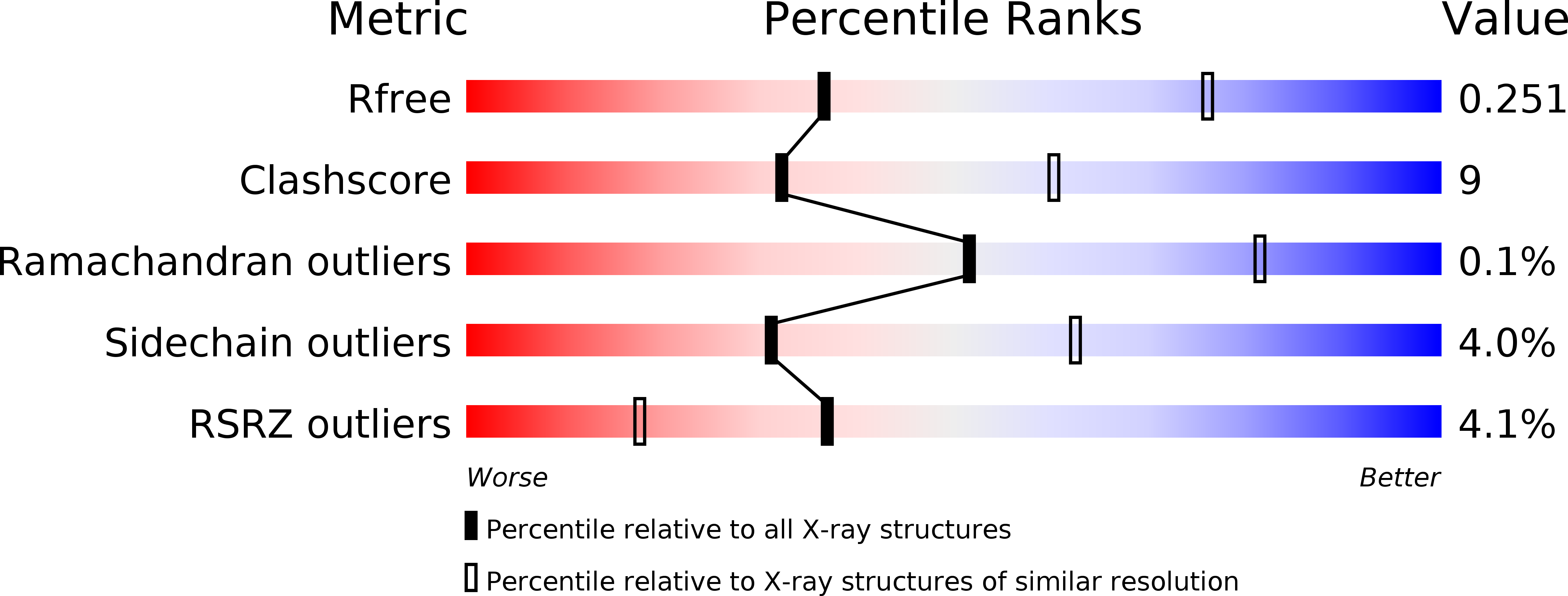
Resolution:
3.05 Å
R-Value Free:
0.24
R-Value Work:
0.18
R-Value Observed:
0.19
Space Group:
P 43 21 2
Macromolecular Entities
Protein Blast
Polymer Type:polypeptide(L)
Molecule:PR domain zinc finger protein 14,Protein CBFA2T2
Gene (Uniprot):Prdm14, Cbfa2t2
Mutagens:L200H,L200H
Chain IDs:A, C (auth: B)
Chain Length:309
Number of Molecules:2
Biological Source:Mus musculus
Polymer Type:polypeptide(L)
Molecule:Monobody Mb(S4)
Chain IDs:B (auth: F), D (auth: E)
Chain Length:95
Number of Molecules:2
Biological Source:Homo sapiens
Ligand Molecules
Primary Citation
ETO family protein Mtgr1 mediates Prdm14 functions in stem cell maintenance and primordial germ cell formation.
Elife 4 e10150 e10150 (2015)
PMID: 26523391 DOI: 10.7554/eLife.10150

Abstact

Prdm14 is a sequence-specific transcriptional regulator of embryonic stem cell (ESC) pluripotency and primordial germ cell (PGC) formation. It exerts its function, at least in part, through repressing genes associated with epigenetic modification and cell differentiation. Here, we show that this repressive function is mediated through an ETO-family co-repressor Mtgr1, which tightly binds to the pre-SET/SET domains of Prdm14 and co-occupies its genomic targets in mouse ESCs. We generated two monobodies, synthetic binding proteins, targeting the Prdm14 SET domain and demonstrate their utility, respectively, in facilitating crystallization and structure determination of the Prdm14-Mtgr1 complex, or as genetically encoded inhibitor of the Prdm14-Mtgr1 interaction. Structure-guided point mutants and the monobody abrogated the Prdm14-Mtgr1 association and disrupted Prdm14's function in mESC gene expression and PGC formation in vitro. Altogether, our work uncovers the molecular mechanism underlying Prdm14-mediated repression and provides renewable reagents for studying and controlling Prdm14 functions.

Legend

Protein

Chemical

Disease

Primary Citation of related structures
Feedback Form
Name
Email
Institute
Feedback