5DYO image
Deposition Date 2015-09-25
Release Date 2016-01-27
Last Version Date 2024-10-30
Entry Detail
PDB ID:
5DYO
Keywords:
Title:
Fab43.1 complex with flourescein
Biological Source:
Source Organism:
Mus musculus (Taxon ID: 10090)
Host Organism:
Method Details:
Experimental Method:
Resolution:
2.36 Å
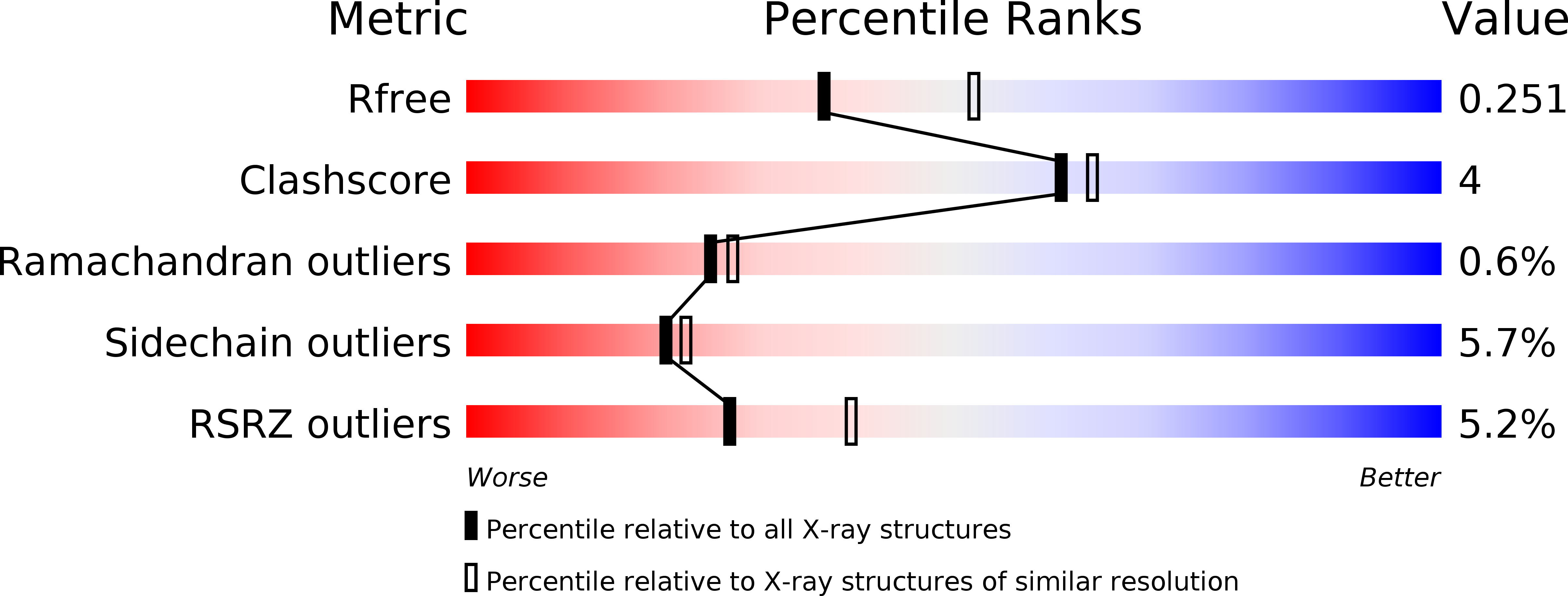
R-Value Free:
0.23
R-Value Work:
0.19
R-Value Observed:
0.19
Space Group:
P 1 21 1
Macromolecular Entities
Polymer Type:polypeptide(L)
Molecule:Fab 43.1 Heavy Chain
Chain IDs:A, C (auth: H)
Chain Length:212
Number of Molecules:2
Biological Source:Mus musculus
Polymer Type:polypeptide(L)
Molecule:Fab 43.1 Light Chain
Chain IDs:B, D (auth: L)
Chain Length:218
Number of Molecules:2
Biological Source:Mus musculus
Primary Citation
Three-dimensional structure, binding, and spectroscopic characteristics of the monoclonal antibody 43.1 directed to the carboxyphenyl moiety of fluorescein.
Biopolymers 105 234 243 (2016)
PMID: 26756394 DOI: 10.1002/bip.22801

Abstact

Unlike other known anti-fluorescein antibodies, the monoclonal antibody 43.1 is directed toward the fluorescein's carboxyl phenyl moiety. It demonstrates a very high affinity (KD ∼ 70 pM) and a fast association rate (kon ∼ 2 × 10(7) M(-1) s(-1)). The three-dimensional structure of the Fab 43.1-fluorescein complex was resolved at 2.4 Å resolution. The antibody binding site is exclusively assembled by the CDR loops. It is comprised of a 14 Å groove-shaped entrance leading to a 9 Å by 7 Å binding pocket. The highly polar binding pocket complementary encloses the fluorescein's carboxyphenyl moiety and tightly fixes it by multiple hydrogen bonds. The fluorescein's xanthene ring is embedded in the more hydrophobic groove and stacked between the side chains of Tyr37L and of Arg99H providing conditions for an excited state electron transfer process. In comparison to fluorescein, the absorption spectrum of the complex in the visible region is shifted to the "red" by 23 nm. The complex demonstrates a very weak fluorescence (Φc  = 0.0018) with two short lifetime components: 0.03 ns (47%) and 0.8 ns (24%), which reflects a 99.8% fluorescein emission quenching effect upon complex formation. The antibody 43.1 binds fluorescein with remarkable affinity, fast association rate, and strongly quenches its emission. Therefore, it may present a practical interest in applications such as molecular sensors and switches.

Legend

Protein

Chemical

Disease

Primary Citation of related structures
Feedback Form
Name
Email
Institute
Feedback