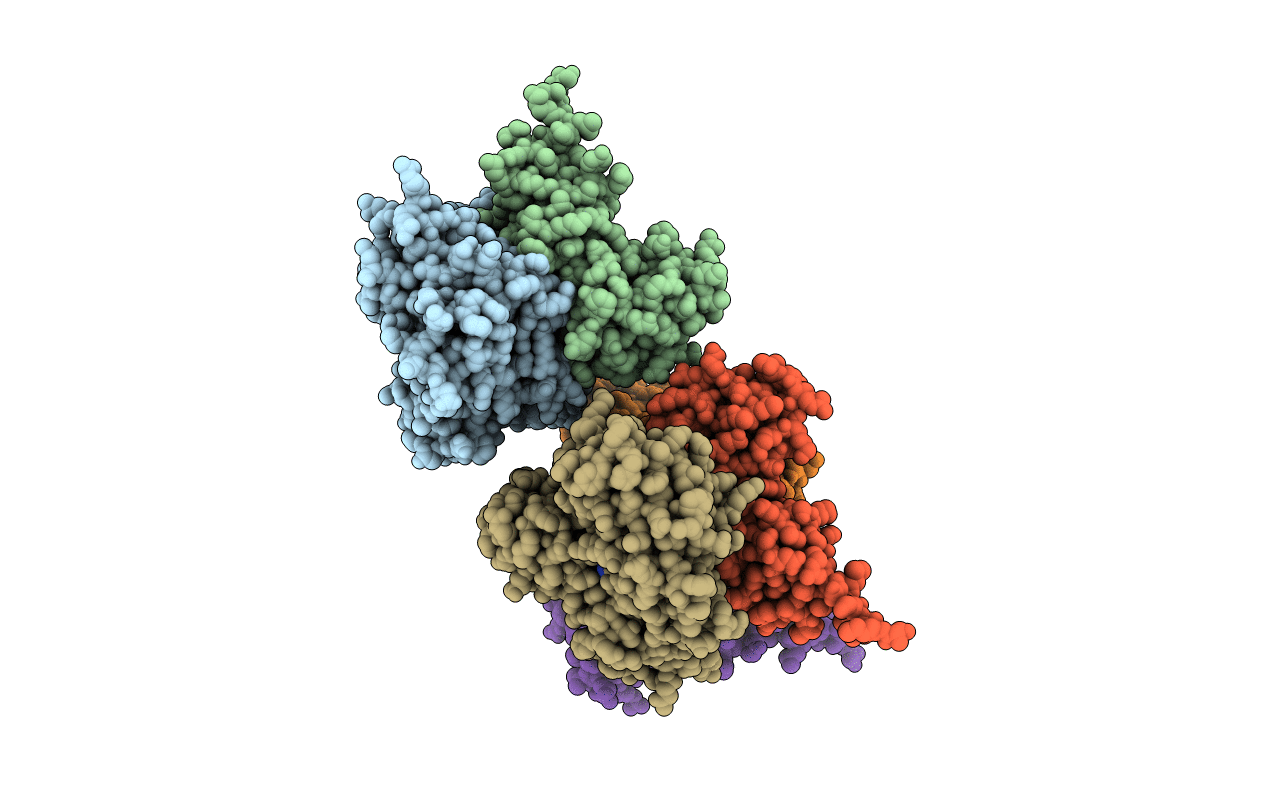
5DO9 image
Deposition Date 2015-09-10
Release Date 2016-01-20
Last Version Date 2024-03-06
Entry Detail
PDB ID:
5DO9
Keywords:
Title:
Structure of regulator of G protein signaling 8 (RGS8) in complex with AlF4-activated Galpha-q
Biological Source:
Source Organism:
Mus musculus (Taxon ID: 10090)
Homo sapiens (Taxon ID: 9606)
Host Organism:
Method Details:
Experimental Method:
Resolution:
2.60 Å
R-Value Free:
0.22
R-Value Work:
0.17
R-Value Observed:
0.18
Space Group:
C 1 2 1
Macromolecular Entities
Structures with similar UniProt ID
Protein Blast
Polymer Type:polypeptide(L)
Molecule:Guanine nucleotide-binding protein G(q) subunit alpha
Gene (Uniprot):Gnaq
Chain IDs:A, C, E
Chain Length:314
Number of Molecules:3
Biological Source:Mus musculus
Structures with similar UniProt ID
Protein Blast
Polymer Type:polypeptide(L)
Molecule:Regulator of G-protein signaling 8
Gene (Uniprot):RGS8
Chain IDs:B, D, F
Chain Length:134
Number of Molecules:3
Biological Source:Homo sapiens
Primary Citation
Structure of the Regulator of G Protein Signaling 8 (RGS8)-G alpha q Complex: MOLECULAR BASIS FOR G alpha SELECTIVITY.
J.Biol.Chem. 291 5138 5145 (2016)
PMID: 26755720 DOI: 10.1074/jbc.M115.712075

Abstact

Regulator of G protein signaling (RGS) proteins interact with activated Gα subunits via their RGS domains and accelerate the hydrolysis of GTP. Although the R4 subfamily of RGS proteins generally accepts both Gαi/o and Gαq/11 subunits as substrates, the R7 and R12 subfamilies select against Gαq/11. In contrast, only one RGS protein, RGS2, is known to be selective for Gαq/11. The molecular basis for this selectivity is not clear. Previously, the crystal structure of RGS2 in complex with Gαq revealed a non-canonical interaction that could be due to interfacial differences imposed by RGS2, the Gα subunit, or both. To resolve this ambiguity, the 2.6 Å crystal structure of RGS8, an R4 subfamily member, was determined in complex with Gαq. RGS8 adopts the same pose on Gαq as it does when bound to Gαi3, indicating that the non-canonical interaction of RGS2 with Gαq is due to unique features of RGS2. Based on the RGS8-Gαq structure, residues in RGS8 that contact a unique α-helical domain loop of Gαq were converted to those typically found in R12 subfamily members, and the reverse substitutions were introduced into RGS10, an R12 subfamily member. Although these substitutions perturbed their ability to stimulate GTP hydrolysis, they did not reverse selectivity. Instead, selectivity for Gαq seems more likely determined by whether strong contacts can be maintained between α6 of the RGS domain and Switch III of Gαq, regions of high sequence and conformational diversity in both protein families.

Legend

Protein

Chemical

Disease

Primary Citation of related structures
Feedback Form
Name
Email
Institute
Feedback