5DI9 image
Deposition Date 2015-08-31
Release Date 2015-09-16
Last Version Date 2024-11-20
Entry Detail
PDB ID:
5DI9
Title:
Crystal Structure of hRio2 NES Reverse Mutant Peptide in complex with CRM1-Ran-RanBP1
Biological Source:
Source Organism(s):
Expression System(s):
Method Details:
Experimental Method:
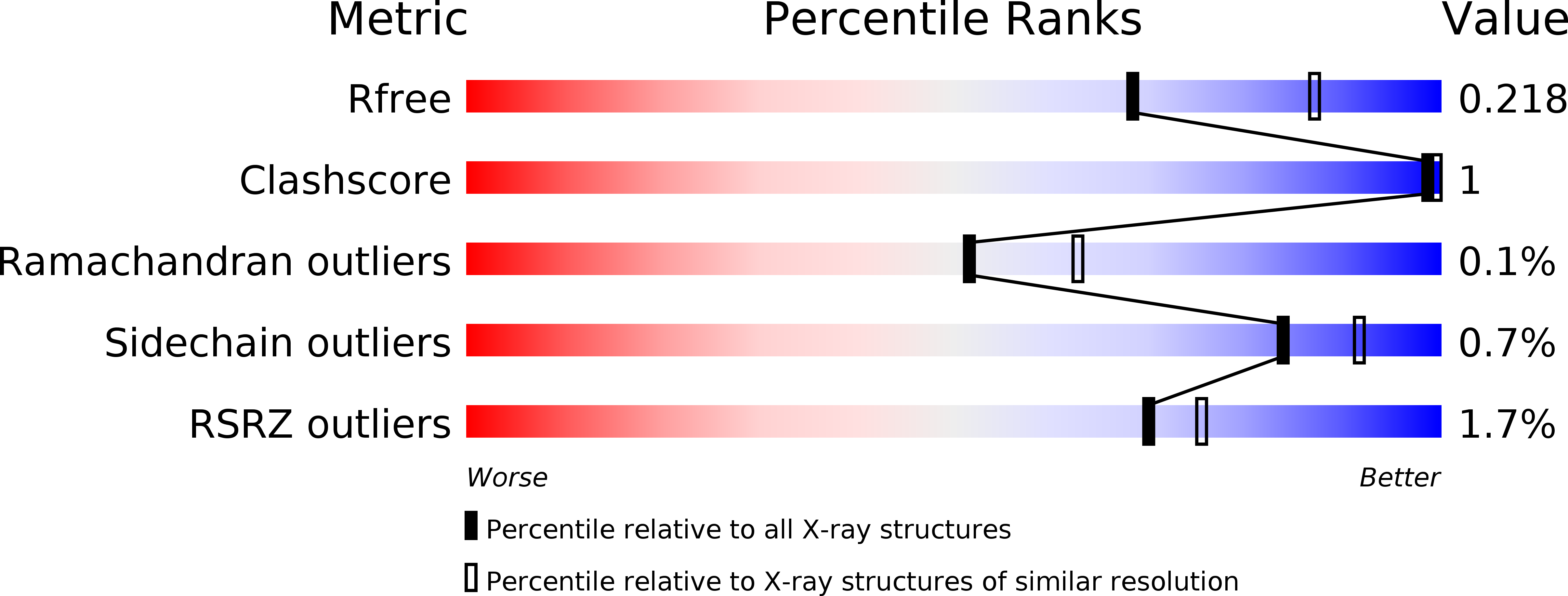
Resolution:
2.28 Å
R-Value Free:
0.21
R-Value Work:
0.16
R-Value Observed:
0.16
Space Group:
P 43 21 2
Macromolecular Entities
Structures with similar UniProt ID
Protein Blast
Polymer Type:polypeptide(L)
Molecule:GTP-binding nuclear protein Ran
Gene (Uniprot):RAN
Chain IDs:A
Chain Length:237
Number of Molecules:1
Biological Source:Homo sapiens
Structures with similar UniProt ID
Protein Blast
Polymer Type:polypeptide(L)
Molecule:Ran-specific GTPase-activating protein 1
Gene (Uniprot):YRB1
Chain IDs:B
Chain Length:143
Number of Molecules:1
Biological Source:Saccharomyces cerevisiae
Structures with similar UniProt ID
Protein Blast
Polymer Type:polypeptide(L)
Molecule:Exportin-1
Gene (Uniprot):CRM1
Mutagens:V441D,D536G,T539C,V540E,K541Q,Y1022C, delta 377-413
Chain IDs:C
Chain Length:1024
Number of Molecules:1
Biological Source:Saccharomyces cerevisiae (strain ATCC 204508 / S288c)
Polymer Type:polypeptide(L)
Molecule:Engineered Nuclear Export Signal Peptide (hRio2 NES reverse mutant)
Chain IDs:D
Chain Length:21
Number of Molecules:1
Biological Source:Homo sapiens
Primary Citation
Structural determinants of nuclear export signal orientation in binding to exportin CRM1.
Elife 4 ? ? (2015)
PMID: 26349033 DOI: 10.7554/eLife.10034

Abstact

The Chromosome Region of Maintenance 1 (CRM1) protein mediates nuclear export of hundreds of proteins through recognition of their nuclear export signals (NESs), which are highly variable in sequence and structure. The plasticity of the CRM1-NES interaction is not well understood, as there are many NES sequences that seem incompatible with structures of the NES-bound CRM1 groove. Crystal structures of CRM1 bound to two different NESs with unusual sequences showed the NES peptides binding the CRM1 groove in the opposite orientation (minus) to that of previously studied NESs (plus). Comparison of minus and plus NESs identified structural and sequence determinants for NES orientation. The binding of NESs to CRM1 in both orientations results in a large expansion in NES consensus patterns and therefore a corresponding expansion of potential NESs in the proteome.

Legend

Protein

Chemical

Disease

Primary Citation of related structures
Feedback Form
Name
Email
Institute
Feedback