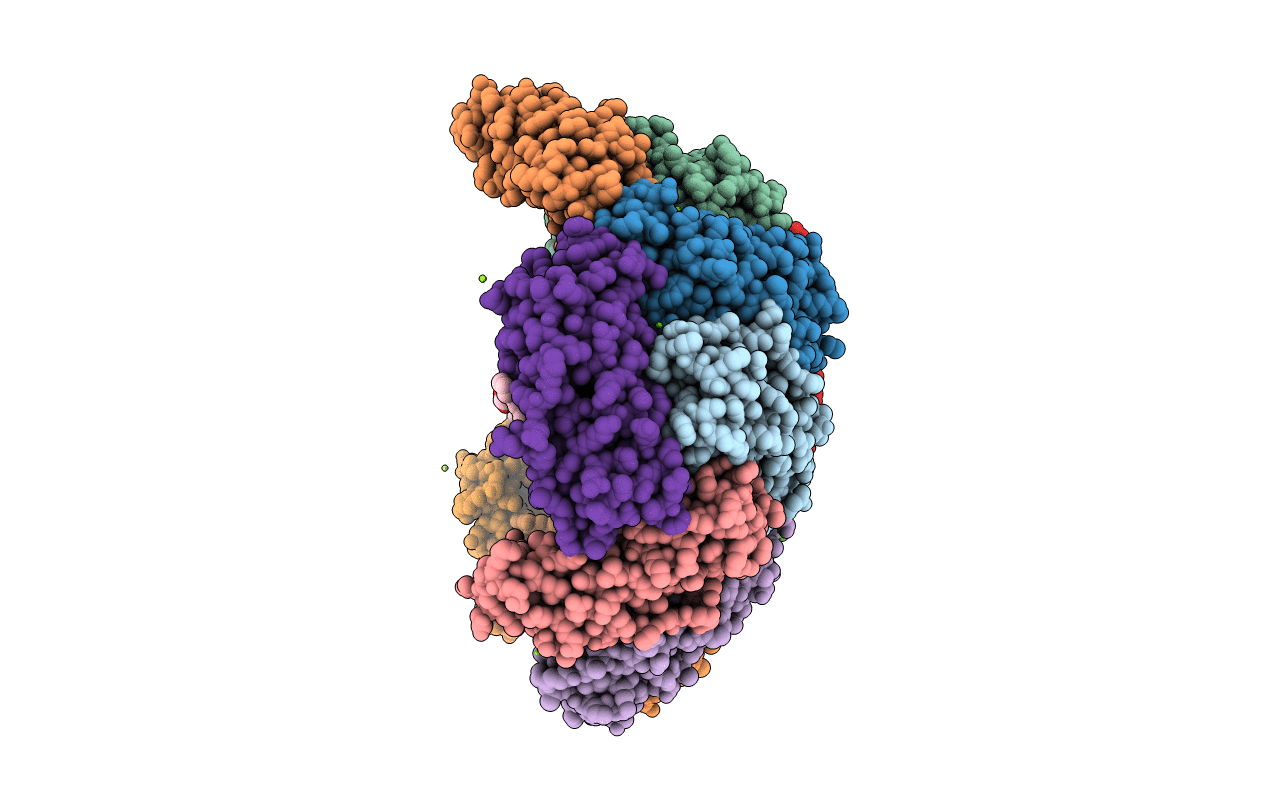
5D8Q image
Deposition Date 2015-08-17
Release Date 2015-09-23
Last Version Date 2023-09-27
Entry Detail
PDB ID:
5D8Q
Keywords:
Title:
2.20A resolution structure of BfrB (L68A) from Pseudomonas aeruginosa
Biological Source:
Method Details:
Experimental Method:
Resolution:
2.20 Å
R-Value Free:
0.26
R-Value Work:
0.20
R-Value Observed:
0.20
Space Group:
P 21 21 2
Macromolecular Entities
Structures with similar UniProt ID
Protein Blast
Polymer Type:polypeptide(L)
Molecule:Ferroxidase
Gene (Uniprot):bfrB
Mutagens:L68A
Chain IDs:A, B, C, D, E, F, G, H, I, J, K, L
Chain Length:158
Number of Molecules:12
Biological Source:Pseudomonas aeruginosa (strain ATCC 15692 / PAO1 / 1C / PRS 101 / LMG 12228)
Primary Citation
Characterization of the Bacterioferritin/Bacterioferritin Associated Ferredoxin Protein-Protein Interaction in Solution and Determination of Binding Energy Hot Spots.
Biochemistry 54 6162 6175 (2015)
PMID: 26368531 DOI: 10.1021/acs.biochem.5b00937

Abstact

Mobilization of iron stored in the interior cavity of BfrB requires electron transfer from the [2Fe−2S] cluster in Bfd to the core iron in BfrB. A crystal structure of the Pseudomonas aeruginosa BfrB:Bfd complex revealed that BfrB can bind up to 12 Bfd molecules at 12 structurally identical binding sites, placing the [2Fe−2S] cluster of each Bfd immediately above a heme group in BfrB [Yao, H., et al. (2012) J. Am. Chem. Soc., 134, 13470−13481]. We report here study aimed at characterizing the strength of the P. aeruginosa BfrB:Bfd association using surface plasmon resonance and isothermal titration calorimetry as well as determining the binding energy hot spots at the protein−protein interaction interface. The results show that the 12 Bfd-binding sites on BfrB are equivalent and independent and that the protein−protein association at each of these sites is driven entropically and is characterized by a dissociation constant (Kd) of approximately 3 μM. Determination of the binding energy hot spots was carried out by replacing certain residues that comprise the protein−protein interface with alanine and by evaluating the effect of the mutation on Kd and on the efficiency of core iron mobilization from BfrB. The results identified hot spot residues in both proteins [LB 68, EA 81, and EA 85 in BfrB (superscript for residue number and subscript for chain) and Y2 and L5 in Bfd] that network at the interface to produce a highly complementary hot region for the interaction. The hot spot residues are conserved in the amino acid sequences of Bfr and Bfd proteins from a number of Gram-negative pathogens, indicating that the BfrB:Bfd interaction is of widespread significance in bacterial iron metabolism.

Legend

Protein

Chemical

Disease

Primary Citation of related structures
Feedback Form
Name
Email
Institute
Feedback