5D23 image
Deposition Date 2015-08-05
Release Date 2016-03-23
Last Version Date 2024-11-20
Entry Detail
PDB ID:
5D23
Title:
The crystal structure of STPR from Bombyx mori in complex with 13-bp DNA derived from the +290 site of fibroin gene
Biological Source:
Source Organism:
Bombyx mori (Taxon ID: 7091)
synthetic construct (Taxon ID: 32630)
Host Organism:
Method Details:
Experimental Method:
Resolution:
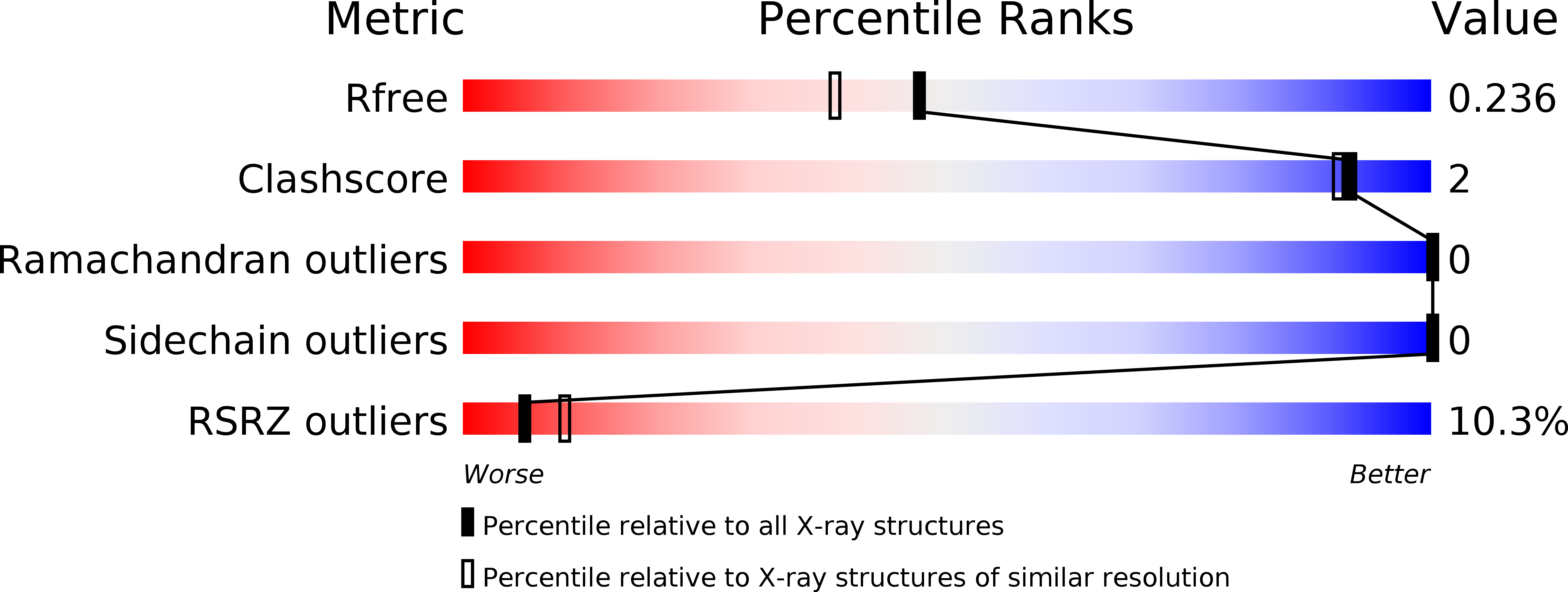
1.95 Å
R-Value Free:
0.23
R-Value Work:
0.20
R-Value Observed:
0.20
Space Group:
H 3 2
Macromolecular Entities
Structures with similar UniProt ID
Protein Blast
Polymer Type:polypeptide(L)
Molecule:Fibroin-modulator-binding protein-1
Gene (Uniprot):fmbp-1
Chain IDs:A
Chain Length:102
Number of Molecules:1
Biological Source:Bombyx mori
Polymer Type:polydeoxyribonucleotide
Molecule:DNA (26-MER)
Chain IDs:B
Chain Length:26
Number of Molecules:1
Biological Source:synthetic construct
Modified Residue
Compound ID Chain ID Parent Comp ID Details 2D Image
MSE A MET modified residue
Primary Citation
Structures of an all-alpha protein running along the DNA major groove.
Nucleic Acids Res. ? ? ? (2016)
PMID: 26939889 DOI: 10.1093/nar/gkw133

Abstact

Despite over 3300 protein-DNA complex structures have been reported in the past decades, there remain some unknown recognition patterns between protein and target DNA. The silkgland-specific transcription factor FMBP-1 from the silkworm Bombyx mori contains a unique DNA-binding domain of four tandem STPRs, namely the score and three amino acid peptide repeats. Here we report three structures of this STPR domain (termed BmSTPR) in complex with DNA of various lengths. In the presence of target DNA, BmSTPR adopts a zig-zag structure of three or four tandem α-helices that run along the major groove of DNA. Structural analyses combined with binding assays indicate BmSTPR prefers the AT-rich sequences, with each α-helix covering a DNA sequence of 4 bp. The successive AT-rich DNAs adopt a wider major groove, which is in complementary in shape and size to the tandem α-helices of BmSTPR. Substitutions of DNA sequences and affinity comparison further prove that BmSTPR recognizes the major groove mainly via shape readout. Multiple-sequence alignment suggests this unique DNA-binding pattern should be highly conserved for the STPR domain containing proteins which are widespread in animals. Together, our findings provide structural insights into the specific interactions between a novel DNA-binding protein and a unique deformed B-DNA.

Legend

Protein

Chemical

Disease

Primary Citation of related structures
Feedback Form
Name
Email
Institute
Feedback