5CXT image
Deposition Date 2015-07-29
Release Date 2015-10-14
Last Version Date 2023-09-27
Entry Detail
PDB ID:
5CXT
Title:
Crystal structure of a RNA-binding protein 39 (RBM39) in complex with fragment of splicing factor (U2AF) from Unknown at 2.20 A resolution
Biological Source:
Source Organism:
Mus musculus (Taxon ID: 10090)
Host Organism:
Method Details:
Experimental Method:
Resolution:
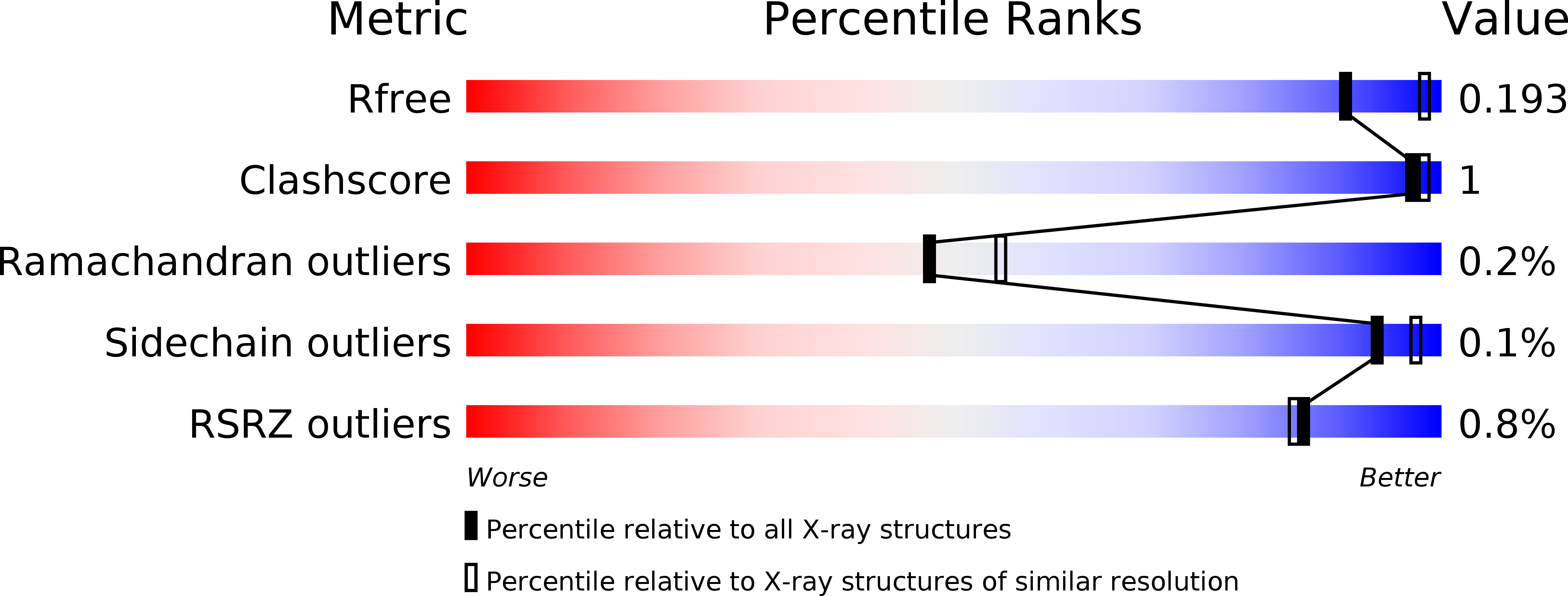
2.20 Å
R-Value Free:
0.18
R-Value Work:
0.17
R-Value Observed:
0.17
Space Group:
P 32
Macromolecular Entities
Structures with similar UniProt ID
Protein Blast
Polymer Type:polypeptide(L)
Molecule:RNA-binding protein 39
Gene (Uniprot):Rbm39
Mutagens:N468Y
Chain IDs:A, C, E, G, I, K, M, O, Q
Chain Length:114
Number of Molecules:9
Biological Source:Mus musculus
Structures with similar UniProt ID
Protein Blast
Polymer Type:polypeptide(L)
Molecule:Splicing factor U2AF 65 kDa subunit
Gene (Uniprot):U2af2
Chain IDs:B, D, F, H, J, L, N, P, R
Chain Length:29
Number of Molecules:9
Biological Source:Mus musculus
Primary Citation
UHM-ULM interactions in the RBM39-U2AF65 splicing-factor complex.
Acta Crystallogr D Struct Biol 72 497 511 (2016)
PMID: 27050129 DOI: 10.1107/S2059798316001248

Abstact

RNA-binding protein 39 (RBM39) is a splicing factor and a transcriptional co-activator of estrogen receptors and Jun/AP-1, and its function has been associated with malignant progression in a number of cancers. The C-terminal RRM domain of RBM39 belongs to the U2AF homology motif family (UHM), which mediate protein-protein interactions through a short tryptophan-containing peptide known as the UHM-ligand motif (ULM). Here, crystal and solution NMR structures of the RBM39-UHM domain, and the crystal structure of its complex with U2AF65-ULM, are reported. The RBM39-U2AF65 interaction was confirmed by co-immunoprecipitation from human cell extracts, by isothermal titration calorimetry and by NMR chemical shift perturbation experiments with the purified proteins. When compared with related complexes, such as U2AF35-U2AF65 and RBM39-SF3b155, the RBM39-UHM-U2AF65-ULM complex reveals both common and discriminating recognition elements in the UHM-ULM binding interface, providing a rationale for the known specificity of UHM-ULM interactions. This study therefore establishes a structural basis for specific UHM-ULM interactions by splicing factors such as U2AF35, U2AF65, RBM39 and SF3b155, and a platform for continued studies of intermolecular interactions governing disease-related alternative splicing in eukaryotic cells.

Legend

Protein

Chemical

Disease

Primary Citation of related structures
Feedback Form
Name
Email
Institute
Feedback