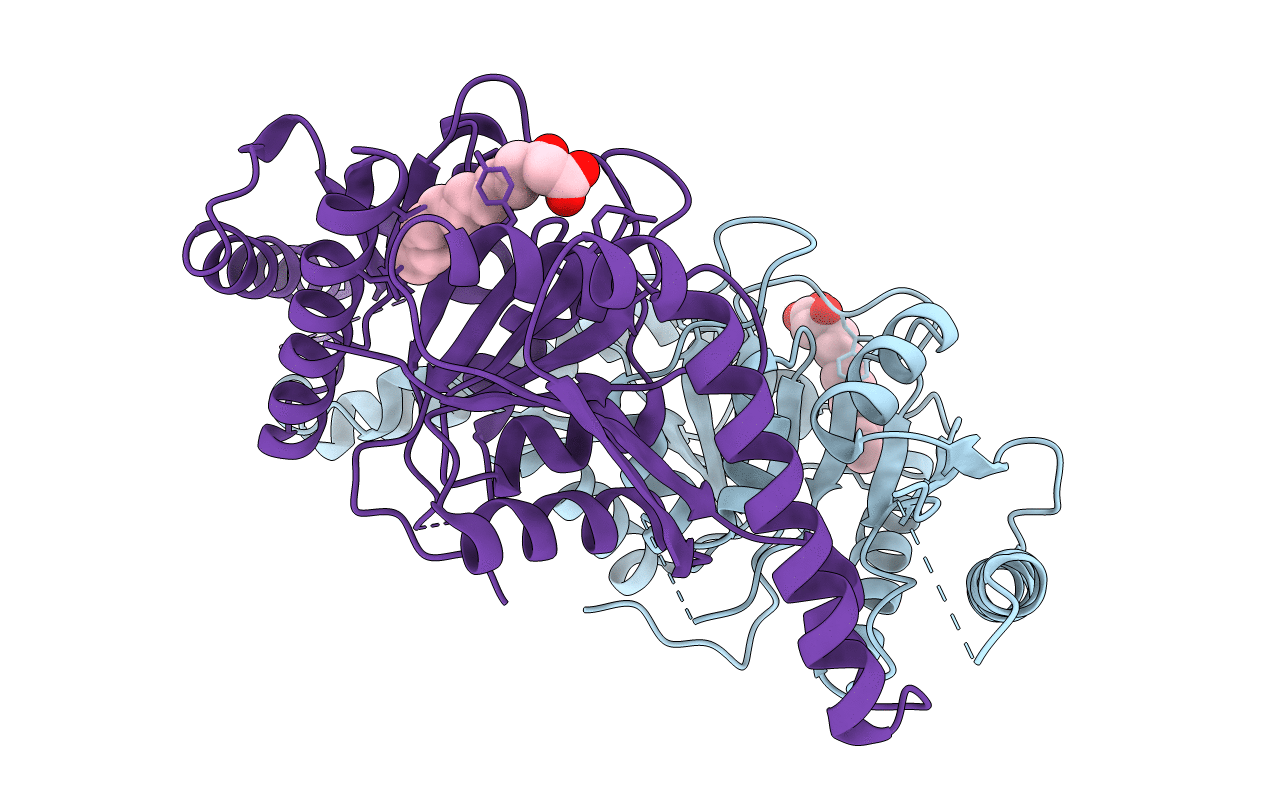
5CB0 image
Deposition Date 2015-06-30
Release Date 2016-02-10
Last Version Date 2023-11-08
Entry Detail
PDB ID:
5CB0
Title:
Crystal structure and functional implications of the tandem-type universal stress protein UspE from Escherichia coli
Biological Source:
Source Organism:
Host Organism:
Method Details:
Experimental Method:
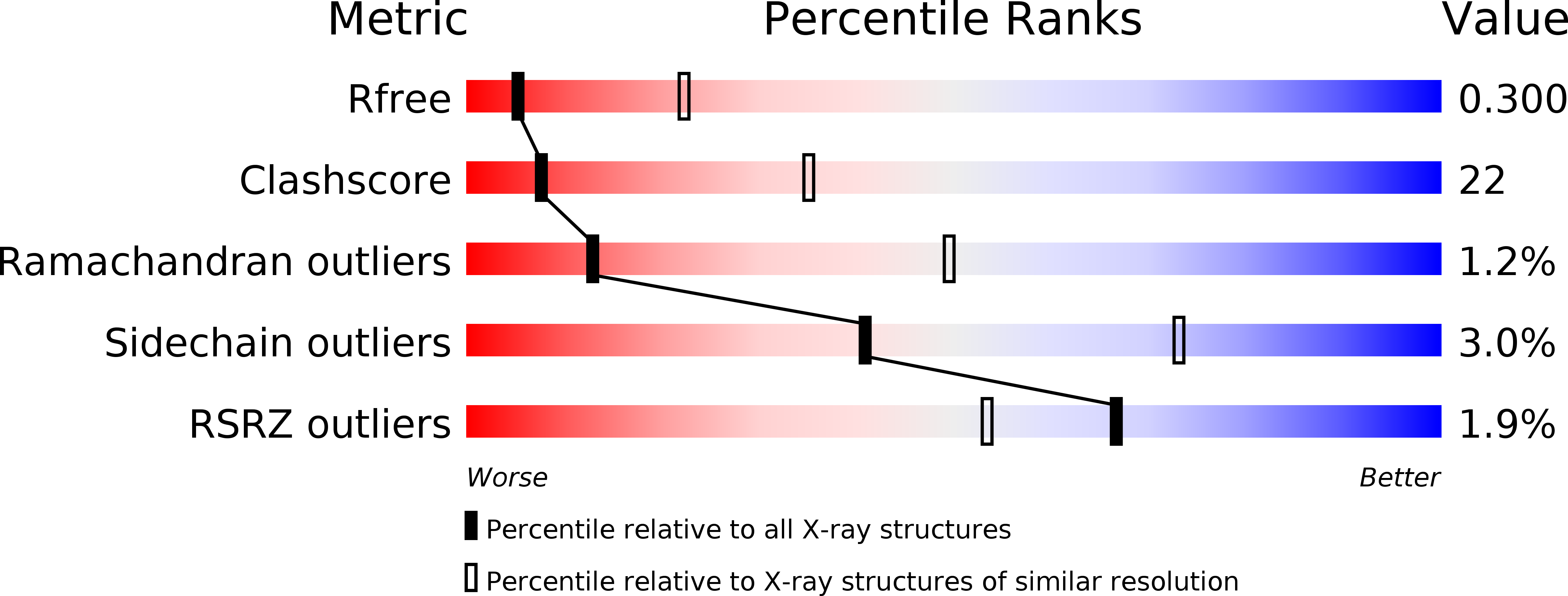
Resolution:
3.21 Å
R-Value Free:
0.30
R-Value Work:
0.24
R-Value Observed:
0.24
Space Group:
I 41 2 2
Macromolecular Entities
Structures with similar UniProt ID
Protein Blast
Polymer Type:polypeptide(L)
Molecule:Universal stress protein E
Gene (Uniprot):uspE
Chain IDs:A, B
Chain Length:316
Number of Molecules:2
Biological Source:Escherichia coli
Ligand Molecules
Primary Citation
Crystal structure and functional implications of the tandem-type universal stress protein UspE from Escherichia coli.
Bmc Struct.Biol. 16 3 3 (2016)
PMID: 26865045 DOI: 10.1186/s12900-016-0053-9

Abstact

BACKGROUND The universal stress proteins (USP) family member UspE is a tandem-type USP that consists of two Usp domains. The UspE expression levels of the Escherichia coli (E. coli) become elevated in response to oxidative stress and DNA damaging agents, including exposure to mitomycin C, cadmium, and hydrogen peroxide. It has been shown that UspA family members are survival factors during cellular growth arrest. The structures and functions of the UspA family members control the growth of E. coli in animal hosts. While several UspA family members have known structures, the structure of E. coli UspE remains to be elucidated. RESULTS To understand the biochemical function of UspE, we have determined the crystal structure of E. coli UspE at 3.2 Å resolution. The asymmetric unit contains two protomers related by a non-crystallographic symmetry, and each protomer contains two tandem Usp domains. The crystal structure shows that UspE is folded into a fan-shaped structure similar to that of the tandem-type Usp protein PMI1202 from Proteus mirabilis, and it has a hydrophobic cavity that binds its ligand. Structural analysis revealed that E. coli UspE has two metal ion binding sites, and isothermal titration calorimetry suggested the presence of two Cd(2+) binding sites with a Kd value of 38.3-242.7 μM. Structural analysis suggested that E. coli UspE has two Cd(2+) binding sites (Site I: His117, His 119; Site II: His193, His244). CONCLUSION The results show that the UspE structure has a hydrophobic pocket. This pocket is strongly bound to an unidentified ligand. Combined with a previous study, the ligand is probably related to an intermediate in lipid A biosynthesis. Subsequently, sequence analysis found that UspE has an ATP binding motif (Gly(269)- X2-Gly(272)-X9-Gly(282)-Asn) in its C-terminal domain, which was confirmed by in vitro ATPase activity monitored using Kinase-Glo® Luminescent Kinase Assay. However, the residues constituting this motif were disordered in the crystal structure, reflecting their intrinsic flexibility. ITC experiments revealed that the UspE probably has two Cd(2+) binding sites. The His117, His 119, His193, and His244 residues within the β-barrel domain are necessary for Cd(2+) binding to UspE protein. As mentioned above, USPs are associated with several functions, such as cadmium binding, ATPase function, and involvement in lipid A biosynthesis by some unknown way.

Legend

Protein

Chemical

Disease

Primary Citation of related structures
Feedback Form
Name
Email
Institute
Feedback