5C6G image
Deposition Date 2015-06-23
Release Date 2015-08-05
Last Version Date 2024-05-08
Entry Detail
PDB ID:
5C6G
Keywords:
Title:
Structural Insights into the Scc2-Scc4 Cohesin Loader
Biological Source:
Source Organism:
Host Organism:
Method Details:
Experimental Method:
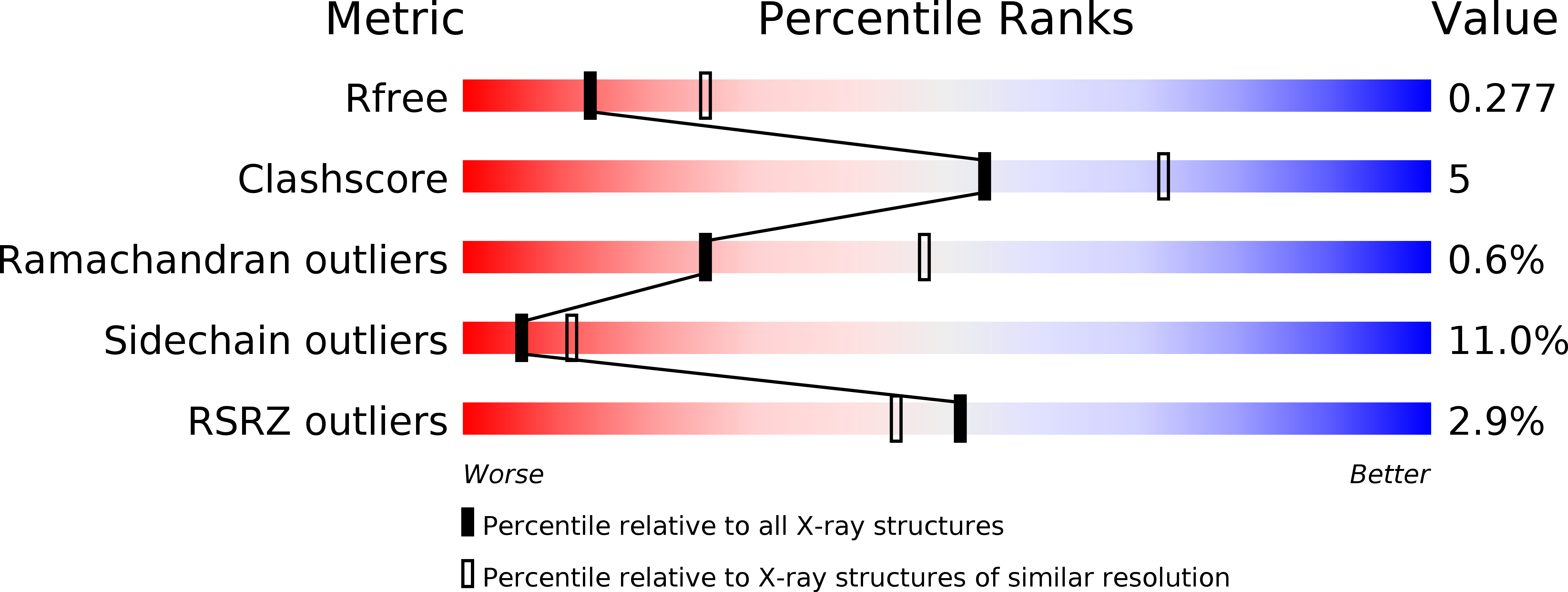
Resolution:
2.60 Å
R-Value Free:
0.27
R-Value Work:
0.22
R-Value Observed:
0.22
Space Group:
P 1 21 1
Macromolecular Entities
Structures with similar UniProt ID
Protein Blast
Polymer Type:polypeptide(L)
Molecule:AGR133Cp
Gene (Uniprot):AGOS_AGR133C
Chain IDs:A, C
Chain Length:620
Number of Molecules:2
Biological Source:Ashbya gossypii
Structures with similar UniProt ID
Protein Blast
Polymer Type:polypeptide(L)
Molecule:Sister chromatid cohesion protein 2
Gene (Uniprot):SCC2
Chain IDs:B, D
Chain Length:218
Number of Molecules:2
Biological Source:Ashbya gossypii (strain ATCC 10895 / CBS 109.51 / FGSC 9923 / NRRL Y-1056)
Primary Citation
Structural Studies Reveal the Functional Modularity of the Scc2-Scc4 Cohesin Loader.
Cell Rep 12 719 725 (2015)
PMID: 26212329 DOI: 10.1016/j.celrep.2015.06.071

Abstact

The remarkable accuracy of eukaryotic cell division is partly maintained by the cohesin complex acting as a molecular glue to prevent premature sister chromatid separation. The loading of cohesin onto chromosomes is catalyzed by the Scc2-Scc4 loader complex. Here, we report the crystal structure of Scc4 bound to the N terminus of Scc2 and show that Scc4 is a tetratricopeptide repeat (TPR) superhelix. The Scc2 N terminus adopts an extended conformation and is entrapped by the core of the Scc4 superhelix. Electron microscopy (EM) analysis reveals that the Scc2-Scc4 loader complex comprises three domains: a head, body, and hook. Deletion studies unambiguously assign the Scc2N-Scc4 as the globular head domain, whereas in vitro cohesin loading assays show that the central body and the hook domains are sufficient to catalyze cohesin loading onto circular DNA, but not chromatinized DNA in vivo, suggesting a possible role for Scc4 as a chromatin adaptor.

Legend

Protein

Chemical

Disease

Primary Citation of related structures
Feedback Form
Name
Email
Institute
Feedback