5C67 image
Deposition Date 2015-06-22
Release Date 2016-05-04
Last Version Date 2024-10-23
Entry Detail
PDB ID:
5C67
Title:
Human Mesotrypsin in complex with amyloid precursor protein inhibitor variant APPI-M17G/I18F/F34V
Biological Source:
Source Organism:
Homo sapiens (Taxon ID: 9606)
Host Organism:
Method Details:
Experimental Method:
Resolution:
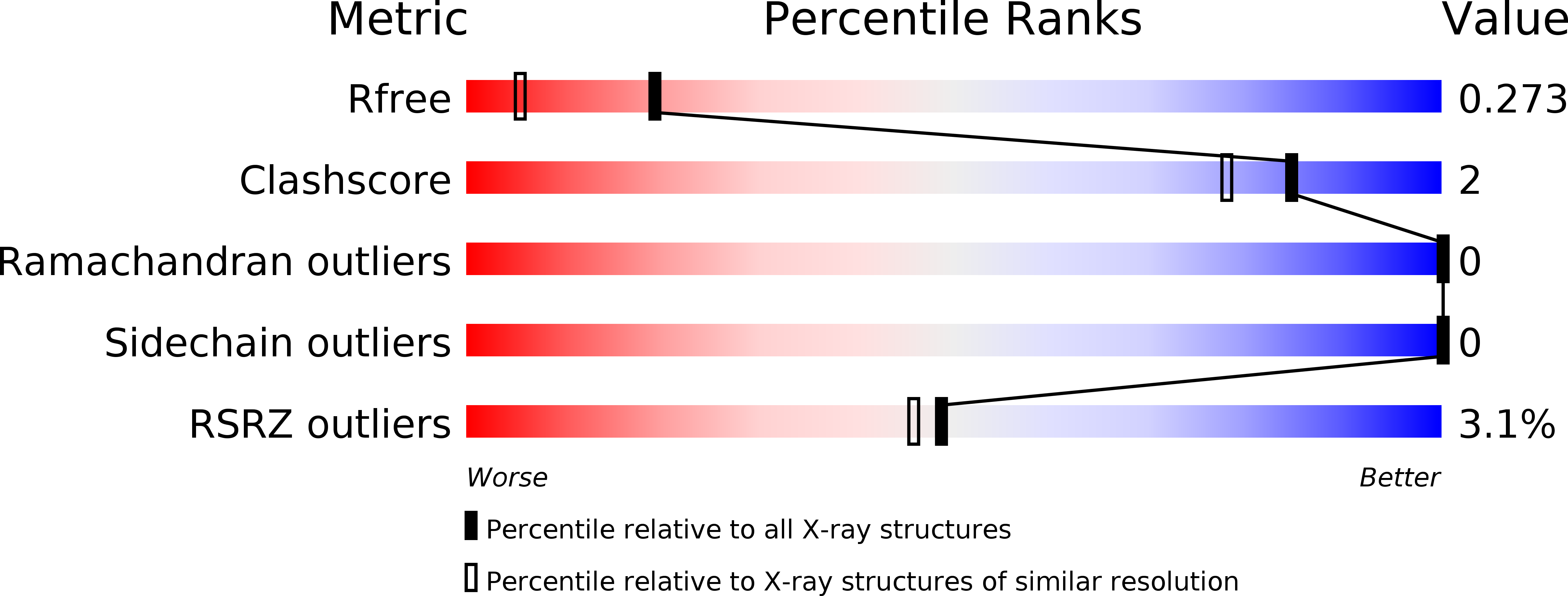
1.83 Å
R-Value Free:
0.26
R-Value Work:
0.22
R-Value Observed:
0.22
Space Group:
P 41 21 2
Macromolecular Entities
Structures with similar UniProt ID
Protein Blast
Polymer Type:polypeptide(L)
Molecule:Trypsin-3
Gene (Uniprot):PRSS3
Mutagens:S257A
Chain IDs:A, C (auth: B)
Chain Length:224
Number of Molecules:2
Biological Source:Homo sapiens
Structures with similar UniProt ID
Protein Blast
Polymer Type:polypeptide(L)
Molecule:Amyloid beta A4 protein
Gene (Uniprot):APP
Mutagens:M15G, I16F, F32V
Chain IDs:B (auth: E), D (auth: C)
Chain Length:81
Number of Molecules:2
Biological Source:Homo sapiens
Primary Citation
Combinatorial protein engineering of proteolytically resistant mesotrypsin inhibitors as candidates for cancer therapy.
Biochem.J. 473 1329 1341 (2016)
PMID: 26957636 DOI: 10.1042/BJ20151410

Abstact

Engineered protein therapeutics offer advantages, including strong target affinity, selectivity and low toxicity, but like natural proteins can be susceptible to proteolytic degradation, thereby limiting their effectiveness. A compelling therapeutic target is mesotrypsin, a protease up-regulated with tumour progression, associated with poor prognosis, and implicated in tumour growth and progression of many cancers. However, with its unique capability for cleavage and inactivation of proteinaceous inhibitors, mesotrypsin presents a formidable challenge to the development of biological inhibitors. We used a powerful yeast display platform for directed evolution, employing a novel multi-modal library screening strategy, to engineer the human amyloid precursor protein Kunitz protease inhibitor domain (APPI) simultaneously for increased proteolytic stability, stronger binding affinity and improved selectivity for mesotrypsin inhibition. We identified a triple mutant APPIM17G/I18F/F34V, with a mesotrypsin inhibition constant (Ki) of 89 pM, as the strongest mesotrypsin inhibitor yet reported; this variant displays 1459-fold improved affinity, up to 350 000-fold greater specificity and 83-fold improved proteolytic stability compared with wild-type APPI. We demonstrated that APPIM17G/I18F/F34V acts as a functional inhibitor in cell-based models of mesotrypsin-dependent prostate cancer cellular invasiveness. Additionally, by solving the crystal structure of the APPIM17G/I18F/F34V-mesotrypsin complex, we obtained new insights into the structural and mechanistic basis for improved binding and proteolytic resistance. Our study identifies a promising mesotrypsin inhibitor as a starting point for development of anticancer protein therapeutics and establishes proof-of-principle for a novel library screening approach that will be widely applicable for simultaneously evolving proteolytic stability in tandem with desired functionality for diverse protein scaffolds.

Legend

Protein

Chemical

Disease

Primary Citation of related structures
Feedback Form
Name
Email
Institute
Feedback