5C0O image
Deposition Date 2015-06-12
Release Date 2015-07-08
Last Version Date 2024-01-10
Entry Detail
PDB ID:
5C0O
Keywords:
Title:
m1A58 tRNA methyltransferase mutant - Y78A
Biological Source:
Method Details:
Experimental Method:
Resolution:
2.62 Å
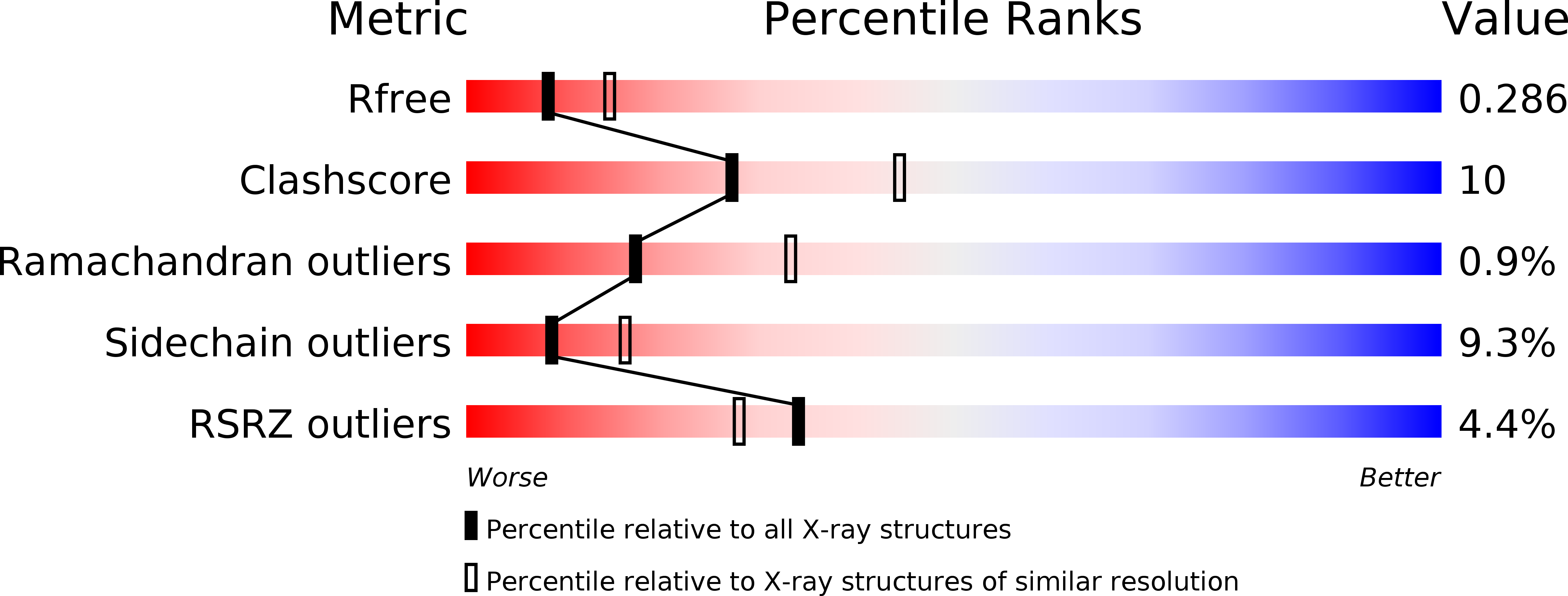
R-Value Free:
0.28
R-Value Work:
0.23
Space Group:
P 21 21 21
Macromolecular Entities
Structures with similar UniProt ID
Protein Blast
Polymer Type:polypeptide(L)
Molecule:tRNA (adenine(58)-N(1))-methyltransferase TrmI
Gene (Uniprot):trmI
Mutagens:Y78A
Chain IDs:A (auth: E), B (auth: F), C (auth: G), D (auth: H)
Chain Length:255
Number of Molecules:4
Biological Source:Thermus thermophilus (strain HB27 / ATCC BAA-163 / DSM 7039)
Primary Citation
The m1A58 modification in eubacterial tRNA: An overview of tRNA recognition and mechanism of catalysis by TrmI.
Biophys.Chem. 210 27 34 (2016)
PMID: 26189113 DOI: 10.1016/j.bpc.2015.06.012

Abstact

The enzymes of the TrmI family catalyze the formation of the m(1)A58 modification in tRNA. We previously solved the crystal structure of the Thermus thermophilus enzyme and conducted a biophysical study to characterize the interaction between TrmI and tRNA. TrmI enzymes are active as a tetramer and up to two tRNAs can bind to TrmI simultaneously. In this paper, we present the structures of two TrmI mutants (D170A and Y78A). These residues are conserved in the active site of TrmIs and their mutations result in a dramatic alteration of TrmI activity. Both structures of TrmI mutants revealed the flexibility of the N-terminal domain that is probably important to bind tRNA. The structure of TrmI Y78A catalytic domain is unmodified regarding the binding of the SAM co-factor and the conformation of residues potentially interacting with the substrate adenine. This structure reinforces the previously proposed role of Y78, i.e. stabilize the conformation of the A58 ribose needed to hold the adenosine in the active site. The structure of the D170A mutant shows a flexible active site with one loop occupying in part the place of the co-factor and the second loop moving at the entrance to the active site. This structure and recent data confirms the central role of D170 residue binding the amino moiety of SAM and the exocyclic amino group of adenine. Possible mechanisms for methyl transfer are then discussed.

Legend

Protein

Chemical

Disease

Primary Citation of related structures
Feedback Form
Name
Email
Institute
Feedback