5BNI image
Deposition Date 2015-05-26
Release Date 2016-05-25
Last Version Date 2025-09-17
Entry Detail
PDB ID:
5BNI
Keywords:
Title:
Porcine CD38 complexed with complexed with a covalent intermediate, ribo-F-ribose-5'-phosphate
Biological Source:
Source Organism:
Sus scrofa (Taxon ID: 9823)
Host Organism:
Method Details:
Experimental Method:
Resolution:
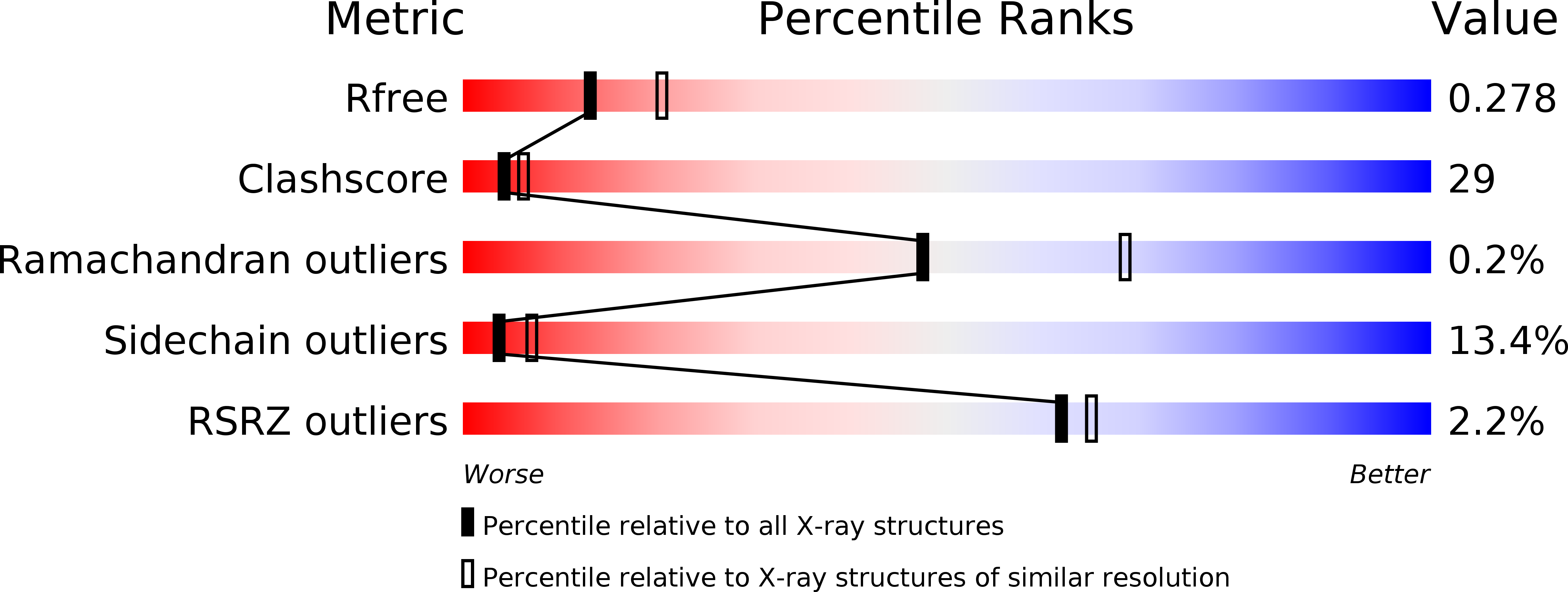
2.50 Å
R-Value Free:
0.27
R-Value Work:
0.18
R-Value Observed:
0.19
Space Group:
P 21 21 2
Macromolecular Entities
Polymer Type:polypeptide(L)
Molecule:Uncharacterized protein
Chain IDs:A, B
Chain Length:232
Number of Molecules:2
Biological Source:Sus scrofa
Ligand Molecules
Primary Citation
Porcine CD38 exhibits prominent secondary NAD(+) cyclase activity.
Protein Sci. 25 650 661 (2016)
PMID: 26660500 DOI: 10.1002/pro.2859

Abstact

Cyclic ADP-ribose (cADPR) mobilizes intracellular Ca(2+) stores and activates Ca(2+) influx to regulate a wide range of physiological processes. It is one of the products produced from the catalysis of NAD(+) by the multifunctional CD38/ADP-ribosyl cyclase superfamily. After elimination of the nicotinamide ring by the enzyme, the reaction intermediate of NAD(+) can either be hydrolyzed to form linear ADPR or cyclized to form cADPR. We have previously shown that human CD38 exhibits a higher preference towards the hydrolysis of NAD(+) to form linear ADPR while Aplysia ADP-ribosyl cyclase prefers cyclizing NAD(+) to form cADPR. In this study, we characterized the enzymatic properties of porcine CD38 and revealed that it has a prominent secondary NAD(+) cyclase activity producing cADPR. We also determined the X-ray crystallographic structures of porcine CD38 and were able to observe conformational flexibility at the base of the active site of the enzyme which allow the NAD(+) reaction intermediate to adopt conformations resulting in both hydrolysis and cyclization forming linear ADPR and cADPR respectively.

Legend

Protein

Chemical

Disease

Primary Citation of related structures
Feedback Form
Name
Email
Institute
Feedback