5AZG image
Deposition Date 2015-10-05
Release Date 2015-12-30
Last Version Date 2023-11-08
Entry Detail
PDB ID:
5AZG
Keywords:
Title:
Crystal structure of LGG-1 complexed with a UNC-51 peptide
Biological Source:
Source Organism:
Host Organism:
Method Details:
Experimental Method:
Resolution:
1.81 Å
R-Value Free:
0.24
R-Value Work:
0.21
R-Value Observed:
0.21
Space Group:
C 2 2 21
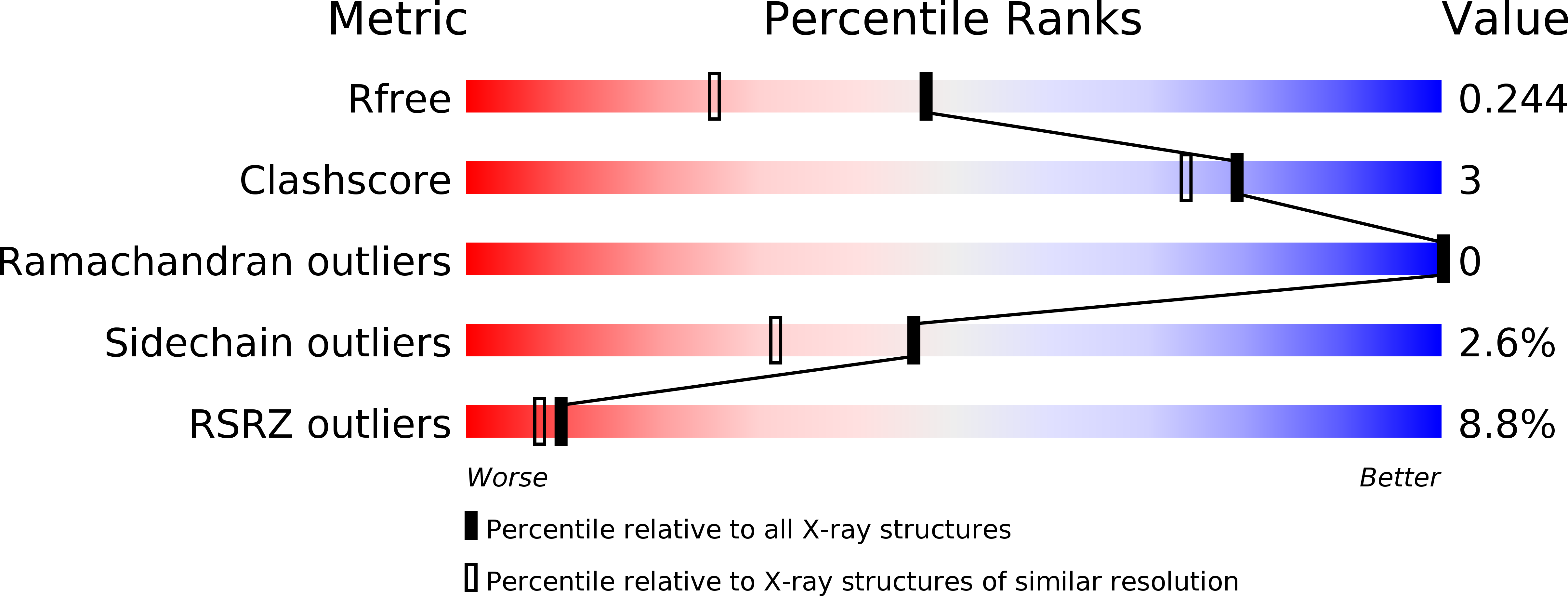
Macromolecular Entities
Structures with similar UniProt ID
Protein Blast
Polymer Type:polypeptide(L)
Molecule:Protein lgg-1
Gene (Uniprot):lgg-1
Chain IDs:A, B
Chain Length:119
Number of Molecules:2
Biological Source:Caenorhabditis elegans
Structures with similar UniProt ID
Protein Blast
Polymer Type:polypeptide(L)
Molecule:Serine/threonine-protein kinase unc-51
Gene (Uniprot):unc-51
Chain IDs:C, D
Chain Length:10
Number of Molecules:2
Biological Source:Caenorhabditis elegans
Ligand Molecules
Primary Citation
Structural Basis of the Differential Function of the Two C. elegans Atg8 Homologs, LGG-1 and LGG-2, in Autophagy.
Mol.Cell 60 914 929 (2015)
PMID: 26687600 DOI: 10.1016/j.molcel.2015.11.019

Abstact

Multicellular organisms have multiple homologs of the yeast ATG8 gene, but the differential roles of these homologs in autophagy during development remain largely unknown. Here we investigated structure/function relationships in the two C. elegans Atg8 homologs, LGG-1 and LGG-2. lgg-1 is essential for degradation of protein aggregates, while lgg-2 has cargo-specific and developmental-stage-specific roles in aggregate degradation. Crystallography revealed that the N-terminal tails of LGG-1 and LGG-2 adopt the closed and open form, respectively. LGG-1 and LGG-2 interact differentially with autophagy substrates and Atg proteins, many of which carry a LIR motif. LGG-1 and LGG-2 have structurally distinct substrate binding pockets that prefer different residues in the interacting LIR motif, thus influencing binding specificity. Lipidated LGG-1 and LGG-2 possess distinct membrane tethering and fusion activities, which may result from the N-terminal differences. Our study reveals the differential function of two ATG8 homologs in autophagy during C. elegans development.

Legend

Protein

Chemical

Disease

Primary Citation of related structures
Feedback Form
Name
Email
Institute
Feedback