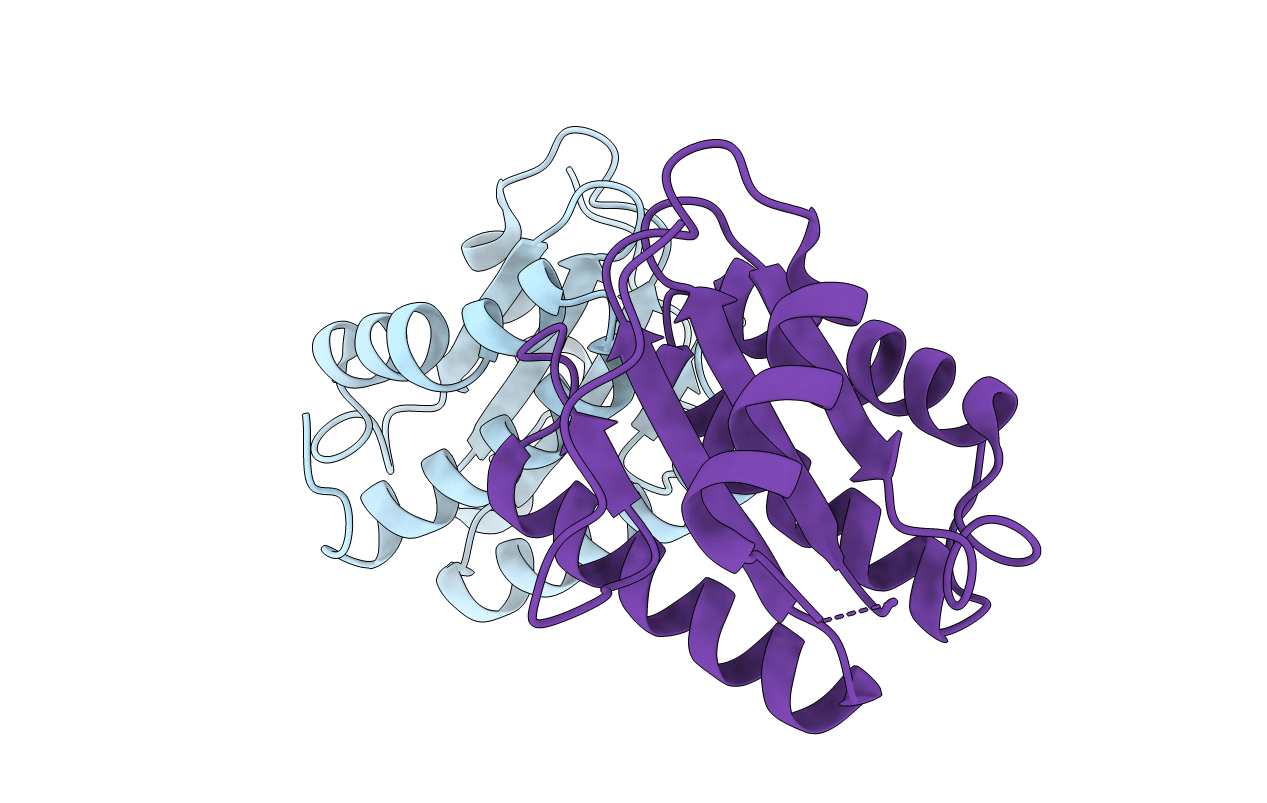
5ANP image
Deposition Date 2015-09-07
Release Date 2016-11-16
Last Version Date 2024-01-10
Entry Detail
PDB ID:
5ANP
Title:
CRYSTAL STRUCTURE OF THE BA41 PROTEIN FROM BIZIONIA ARGENTINENSIS
Biological Source:
Source Organism:
Host Organism:
Method Details:
Experimental Method:
Resolution:
1.40 Å
R-Value Free:
0.18
R-Value Work:
0.17
R-Value Observed:
0.17
Space Group:
P 1 21 1

Macromolecular Entities
Structures with similar UniProt ID
Protein Blast
Polymer Type:polypeptide(L)
Molecule:BA41
Gene (Uniprot):BZARG_1550
Chain IDs:A, B
Chain Length:277
Number of Molecules:2
Biological Source:BIZIONIA ARGENTINENSIS
Primary Citation
Structural and functional characterization of a cold adapted TPM-domain with ATPase/ADPase activity.
J. Struct. Biol. 197 201 209 (2017)
PMID: 27810564 DOI: 10.1016/j.jsb.2016.10.010

Abstact

The Pfam PF04536 TPM_phosphatase family is a broadly conserved family of domains found across prokaryotes, plants and invertebrates. Despite having a similar protein fold, members of this family have been implicated in diverse cellular processes and found in varied subcellular localizations. Very recently, the biochemical characterization of two evolutionary divergent TPM domains has shown that they are able to hydrolyze phosphate groups from different substrates. However, there are still incorrect functional annotations and uncertain relationships between the structure and function of this family of domains. BA41 is an uncharacterized single-pass transmembrane protein from the Antarctic psychrotolerant bacterium Bizionia argentinensis with a predicted compact extracytoplasmic TPM domain and a C-terminal cytoplasmic low complexity region. To shed light on the structural properties that enable TPM domains to adopt divergent roles, we here accomplish a comprehensive structural and functional characterization of the central TPM domain of BA41 (BA41-TPM). Contrary to its predicted function as a beta-propeller methanol dehydrogenase, light scattering and crystallographic studies showed that BA41-TPM behaves as a globular monomeric protein and adopts a conserved Rossmann fold, typically observed in other TPM domain structures. Although the crystal structure reveals the conservation of residues involved in substrate binding, no putative catalytic or intramolecular metal ions were detected. Most important, however, extensive biochemical studies demonstrated that BA41-TPM has hydrolase activity against ADP, ATP, and other di- and triphosphate nucleotides and shares properties of cold-adapted enzymes. The role of BA41 in extracellular ATP-mediated signaling pathways and its occurrence in environmental and pathogenic microorganisms is discussed.

Legend

Protein

Chemical

Disease

Primary Citation of related structures
Feedback Form
Name
Email
Institute
Feedback