5AJD image
Deposition Date 2015-02-23
Release Date 2015-04-29
Last Version Date 2024-01-10
Entry Detail
PDB ID:
5AJD
Keywords:
Title:
Not1 C-terminal domain in complex with Not4
Biological Source:
Source Organism:
Host Organism:
Method Details:
Experimental Method:
Resolution:
3.62 Å
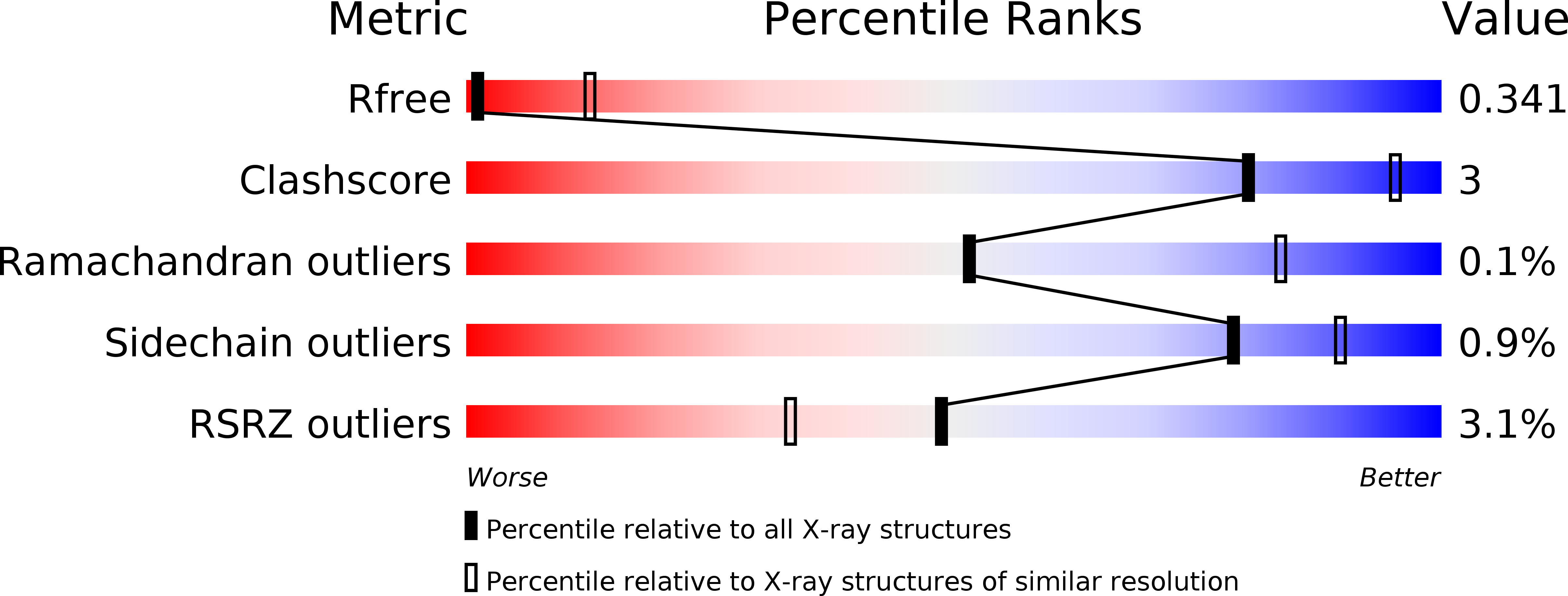
R-Value Free:
0.31
R-Value Work:
0.26
R-Value Observed:
0.26
Space Group:
P 32 2 1
Macromolecular Entities
Structures with similar UniProt ID
Protein Blast
Polymer Type:polypeptide(L)
Molecule:CDC39P
Chain IDs:A, C, E, G, I, K
Chain Length:556
Number of Molecules:6
Biological Source:SACCHAROMYCES CEREVISIAE
Structures with similar UniProt ID
Protein Blast
Polymer Type:polypeptide(L)
Molecule:GENERAL NEGATIVE REGULATOR OF TRANSCRIPTION SUBUNIT 4
Gene (Uniprot):MOT2
Chain IDs:B, D, F, H, J, L
Chain Length:65
Number of Molecules:6
Biological Source:SACCHAROMYCES CEREVISIAE
Ligand Molecules
Primary Citation
Architecture of the Ubiquitylation Module of the Yeast Ccr4-not Complex.
Structure 23 921 ? (2015)
PMID: 25914052 DOI: 10.1016/J.STR.2015.03.011

Abstact

The Ccr4-Not complex regulates eukaryotic gene expression at multiple levels, including mRNA turnover, translational repression, and transcription. We have studied the ubiquitylation module of the yeast Ccr4-Not complex and addressed how E3 ligase binds cognate E2 and how it is tethered to the complex. The 2.8-Å resolution crystal structure of the N-terminal RING domain of Not4 in complex with Ubc4 shows the detailed interactions of this E3-E2 complex. The 3.6-Å resolution crystal structure of the C-terminal domain of the yeast Not4 in complex with the C-terminal domain of Not1 reveals how a largely extended region at the C-terminus of Not4 wraps around a HEAT-repeat region of Not1. This C-terminal region of Not4 is only partly conserved in metazoans, rationalizing its weaker Not1-binding properties. The structural and biochemical data show how Not1 can incorporate both the ubiquitylation module and the Not2-Not3/5 module concomitantly in the Ccr4-Not complex.

Legend

Protein

Chemical

Disease

Primary Citation of related structures
Feedback Form
Name
Email
Institute
Feedback