5A2R image
Deposition Date 2015-05-22
Release Date 2015-08-26
Last Version Date 2024-11-13
Entry Detail
PDB ID:
5A2R
Keywords:
Title:
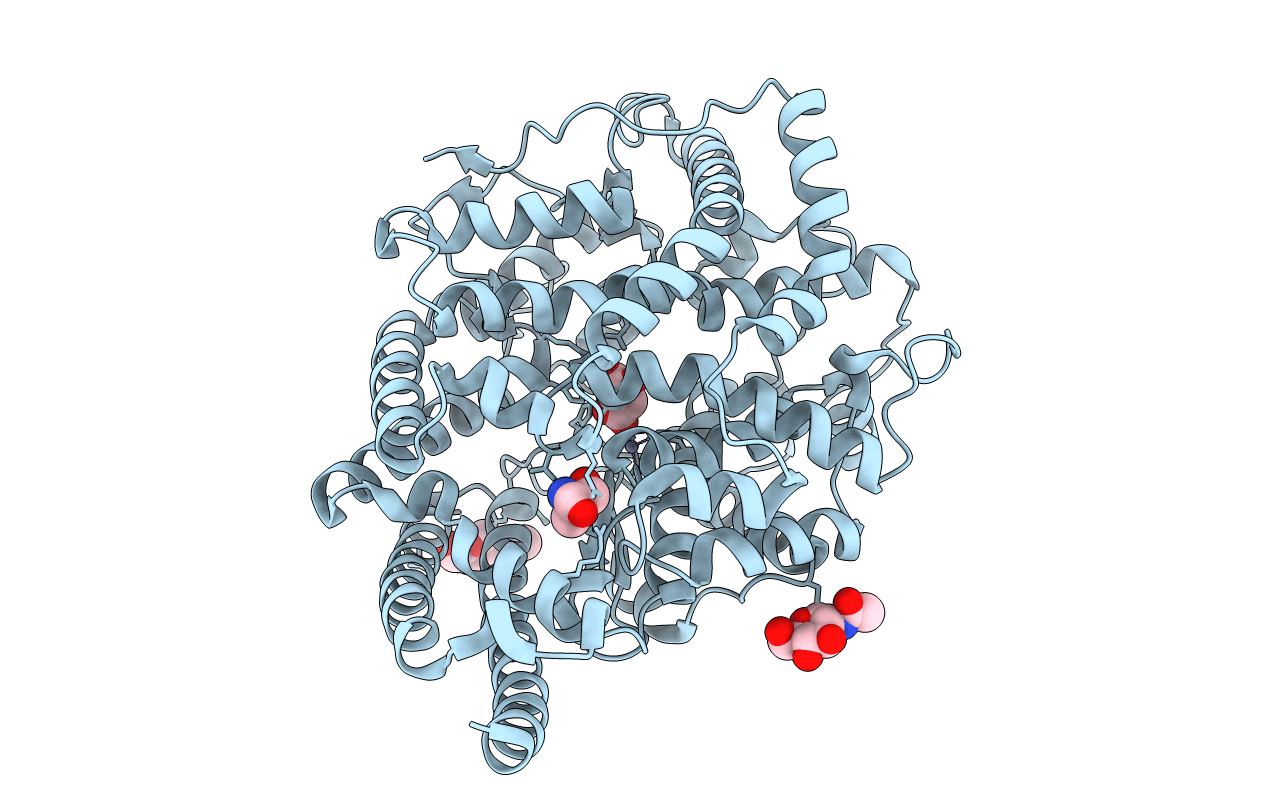
A New Crystal Structure of the Drosophila melanogaster Angiotensin Converting Enzyme Homologue AnCE.
Biological Source:
Source Organism:
Method Details:
Experimental Method:
Resolution:
1.85 Å
R-Value Free:
0.18
R-Value Work:
0.16
R-Value Observed:
0.16
Space Group:
P 21 21 21

Macromolecular Entities
Structures with similar UniProt ID
Protein Blast
Polymer Type:polypeptide(L)
Molecule:ANGIOTENSIN-CONVERTING ENZYME
Gene (Uniprot):Ance
Chain IDs:A
Chain Length:598
Number of Molecules:1
Biological Source:DROSOPHILA MELANOGASTER
Modified Residue
Compound ID Chain ID Parent Comp ID Details 2D Image
ASN A ASN GLYCOSYLATION SITE
Primary Citation
A New High-Resolution Crystal Structure of the Drosophila Melanogaster Angiotensin Converting Enzyme Homologue, Ance.
FEBS Open Bio 5 661 ? (2015)
PMID: 26380810 DOI: 10.1016/J.FOB.2015.08.004

Abstact

Angiotensin converting enzyme (ACE) is a zinc-dependent dipeptidyl carboxypeptidase with an essential role in blood pressure homeostasis in mammals. ACE has long been targeted in the treatment of hypertension through ACE inhibitors, however current inhibitors are known to cause severe side effects. Therefore, there is a requirement for a new generation of ACE inhibitors and structural information will be invaluable in their development. ACE is a challenging enzyme to work with due to its extensive glycosylation. As such, the Drosophila melanogaster ACE homologue, AnCE, which shares ∼60% sequence similarity with human ACE, can be used as a model for studying inhibitor binding. The presence of ligands originating from the crystallisation condition at the AnCE active site has proved an obstacle to studying the binding of new inhibitor precursors. Here we present the crystal structure of AnCE (in a new crystal form) at 1.85 Å resolution, using crystals grown under different conditions. This new structure may be more suitable for studying the binding of new compounds, with the potential of developing a new generation of improved ACE inhibitors.

Legend

Protein

Chemical

Disease

Primary Citation of related structures
Feedback Form
Name
Email
Institute
Feedback