4sdh image
Deposition Date 1993-06-23
Release Date 1993-10-31
Last Version Date 2024-02-28
Entry Detail
PDB ID:
4SDH
Title:
HIGH RESOLUTION CRYSTALLOGRAPHIC ANALYSIS OF A COOPERATIVE DIMERIC HEMOGLOBIN
Biological Source:
Source Organism:
Method Details:
Experimental Method:
Resolution:
1.60 Å
R-Value Work:
0.15
R-Value Observed:
0.15
Space Group:
C 2 2 21
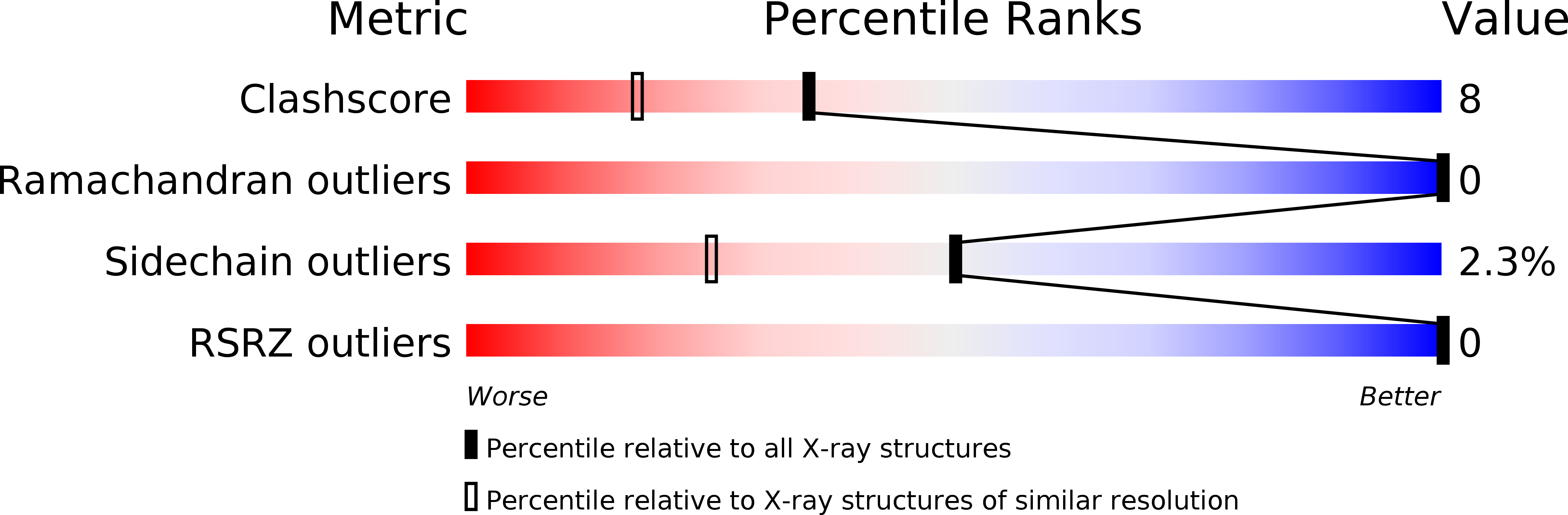
Macromolecular Entities
Structures with similar UniProt ID
Protein Blast
Polymer Type:polypeptide(L)
Molecule:HEMOGLOBIN I (DEOXY)
Chain IDs:A, B
Chain Length:146
Number of Molecules:2
Biological Source:Scapharca inaequivalvis
Ligand Molecules
Primary Citation
High-resolution crystallographic analysis of a co-operative dimeric hemoglobin.
J.Mol.Biol. 235 657 681 (1994)
PMID: 8289287 DOI: 10.1006/jmbi.1994.1019

Abstact

High-resolution crystal structures of the co-operative dimeric hemoglobin from the blood clam Scapharca inaequivalvis have been determined in the unliganded (deoxy) and carbon monoxide (CO) liganded states. The deoxy structure has been refined at 1.6 A resolution to an R-factor of 0.158 and the CO structure has been refined at 1.4 A resolution to an R-factor of 0.159. These structures reveal details of the structural transitions involved in co-operative ligand binding that involve only a minor rotation of subunits but very striking tertiary changes at the interface. A small number of residues in the F-helix appear to mediate co-operativity in this simple hemoglobin. The oxygen affinity of each subunit appears to be largely dictated by the disposition of phenylalanine 97, whose side-chain packs in the heme pocket in the deoxy state but is extruded towards the interface in the CO-liganded structure. Direct involvement of the ligand-binding heme group is a novel feature of the subunit interface and appears important for intersubunit communication. Ligation alters the conformation of the heme propionate groups along with two interacting residues from the symmetry-related subunit. These two residues, lysine 96 and asparagine 100, link the heme of one subunit with the F-helix of the second subunit in such a way as to influence the ligand affinity of that subunit. The interface is highly hydrated by well-ordered water molecules that are likely to be important in the stabilization of the two structures.

Legend

Protein

Chemical

Disease

Primary Citation of related structures
Feedback Form
Name
Email
Institute
Feedback