4ZQW image
Deposition Date 2015-05-11
Release Date 2015-10-28
Last Version Date 2023-12-27
Entry Detail
PDB ID:
4ZQW
Keywords:
Title:
CdiI from Escherichia coli EC869 in complex with a macrocyclic peptide
Biological Source:
Source Organism:
Method Details:
Experimental Method:
Resolution:
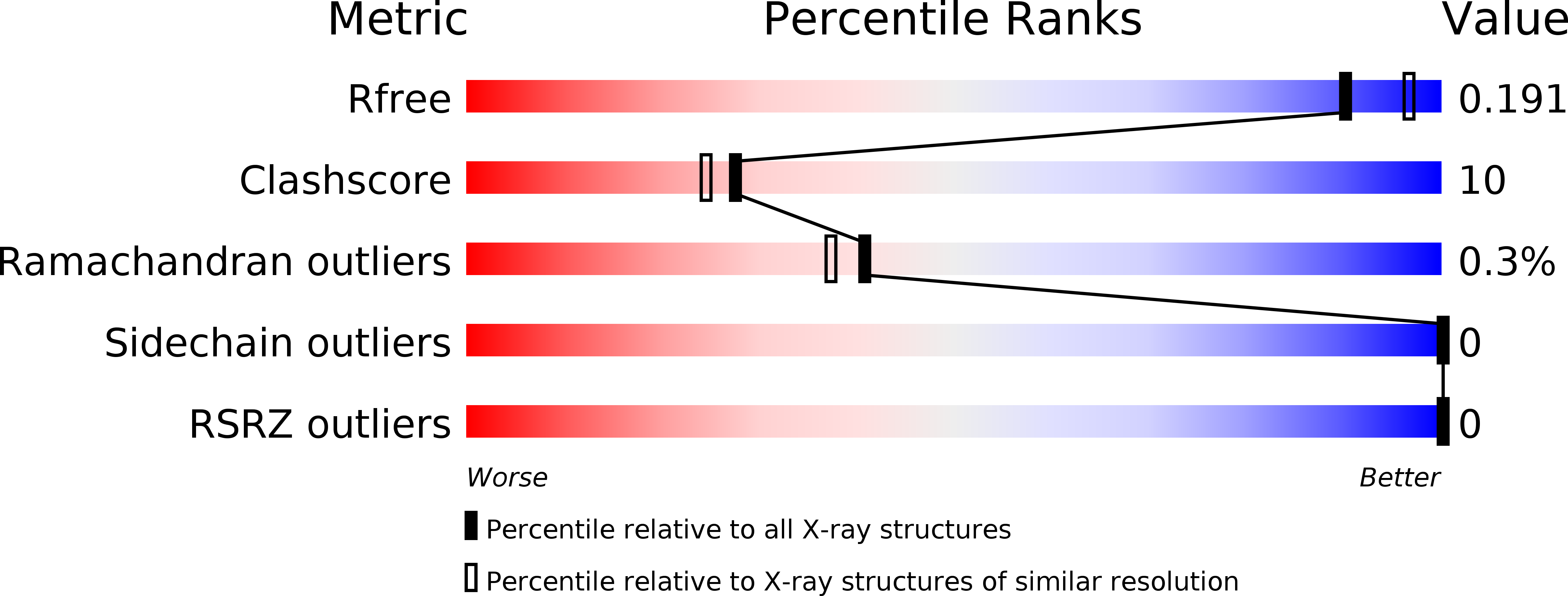
2.00 Å
R-Value Free:
0.23
R-Value Work:
0.18
R-Value Observed:
0.18
Space Group:
P 1 21 1
Macromolecular Entities
Structures with similar UniProt ID
Protein Blast
Polymer Type:polypeptide(L)
Molecule:macrocyclic peptide
Chain IDs:B (auth: A), D (auth: C)
Chain Length:13
Number of Molecules:2
Biological Source:Escherichia coli
Structures with similar UniProt ID
Protein Blast
Polymer Type:polypeptide(L)
Molecule:Immunity protein CdiI-o11
Gene (Uniprot):cdiI4
Chain IDs:A (auth: B), C (auth: D)
Chain Length:177
Number of Molecules:2
Biological Source:Escherichia coli O157:H7 (strain EC869)
Ligand Molecules
Peptide-like Molecules
PRD_002182
Primary Citation
Diversification of beta-Augmentation Interactions between CDI Toxin/Immunity Proteins.
J.Mol.Biol. 427 3766 3784 (2015)
PMID: 26449640 DOI: 10.1016/j.jmb.2015.09.020

Abstact

Contact-dependent growth inhibition (CDI) is a widespread mechanism of inter-bacterial competition mediated by the CdiB/CdiA family of two-partner secretion proteins. CdiA effectors carry diverse C-terminal toxin domains (CdiA-CT), which are delivered into neighboring target cells to inhibit growth. CDI(+) bacteria also produce CdiI immunity proteins that bind specifically to cognate CdiA-CT toxins and protect the cell from auto-inhibition. Here, we compare the structures of homologous CdiA-CT/CdiI complexes from Escherichia coli EC869 and Yersinia pseudotuberculosis YPIII to explore the evolution of CDI toxin/immunity protein interactions. Both complexes share an unusual β-augmentation interaction, in which the toxin domain extends a β-hairpin into the immunity protein to complete a six-stranded anti-parallel sheet. However, the specific contacts differ substantially between the two complexes. The EC869 β-hairpin interacts mainly through direct H-bond and ion-pair interactions, whereas the YPIII β-hairpin pocket contains more hydrophobic contacts and a network of bridging water molecules. In accord with these differences, we find that each CdiI protein only protects target bacteria from its cognate CdiA-CT toxin. The compact β-hairpin binding pocket within the immunity protein represents a tractable system for the rationale design of small molecules to block CdiA-CT/CdiI complex formation. We synthesized a macrocyclic peptide mimic of the β-hairpin from EC869 toxin and solved its structure in complex with cognate immunity protein. These latter studies suggest that small molecules could potentially be used to disrupt CDI toxin/immunity complexes.

Legend

Protein

Chemical

Disease

Primary Citation of related structures
Feedback Form
Name
Email
Institute
Feedback