4ZO1 image
Deposition Date 2015-05-05
Release Date 2015-09-02
Last Version Date 2023-11-15
Entry Detail
PDB ID:
4ZO1
Keywords:
Title:
Crystal Structure of the T3-bound TR-beta Ligand-binding Domain in complex with RXR-alpha
Biological Source:
Source Organism:
Homo sapiens (Taxon ID: 9606)
Host Organism:
Method Details:
Experimental Method:
Resolution:
3.22 Å
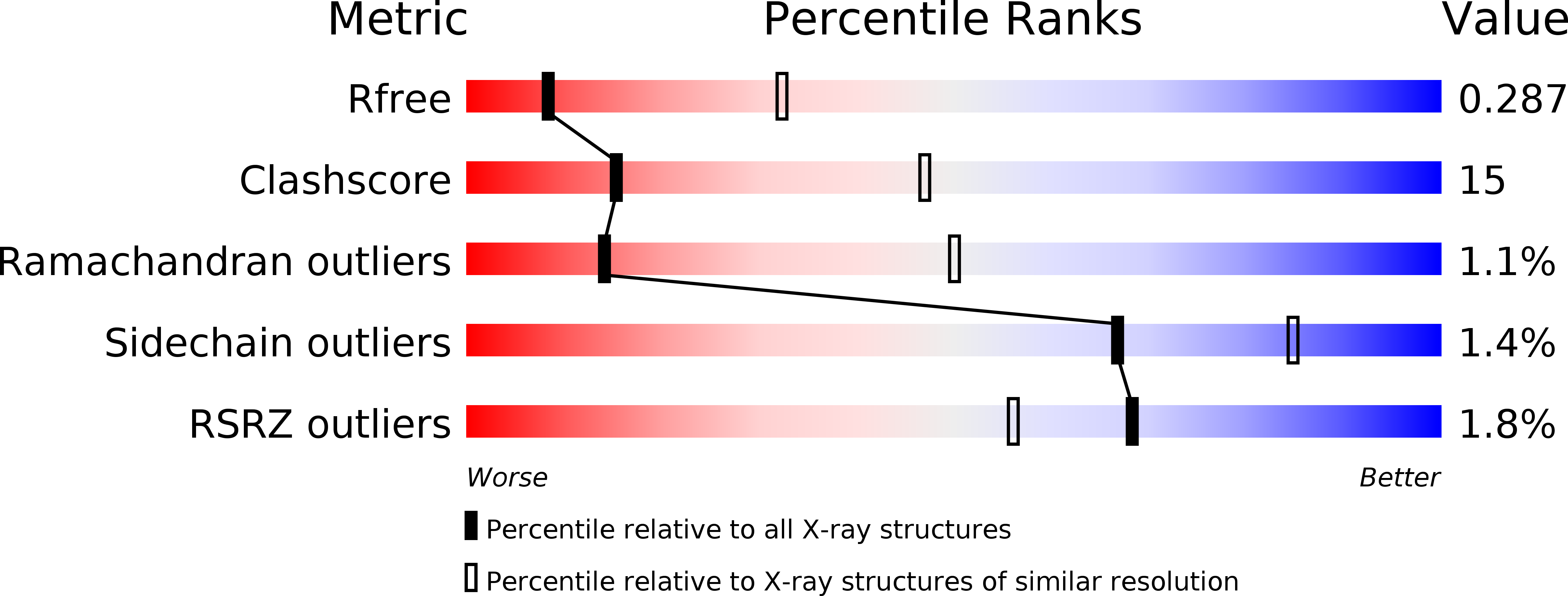
R-Value Free:
0.28
R-Value Work:
0.23
R-Value Observed:
0.23
Space Group:
P 31 2 1
Macromolecular Entities
Structures with similar UniProt ID
Protein Blast
Polymer Type:polypeptide(L)
Molecule:Nuclear receptor coactivator 2
Chain IDs:B (auth: A)
Chain Length:9
Number of Molecules:1
Biological Source:Homo sapiens
Structures with similar UniProt ID
Protein Blast
Polymer Type:polypeptide(L)
Molecule:Retinoic acid receptor RXR-alpha
Gene (Uniprot):RXRA
Chain IDs:C (auth: B)
Chain Length:225
Number of Molecules:1
Biological Source:Homo sapiens
Structures with similar UniProt ID
Protein Blast
Polymer Type:polypeptide(L)
Molecule:Thyroid hormone receptor beta
Gene (Uniprot):THRB
Chain IDs:A (auth: X)
Chain Length:252
Number of Molecules:1
Biological Source:Homo sapiens
Ligand Molecules
Primary Citation
Structural mechanism for signal transduction in RXR nuclear receptor heterodimers.
Nat Commun 6 8013 8013 (2015)
PMID: 26289479 DOI: 10.1038/ncomms9013

Abstact

A subset of nuclear receptors (NRs) function as obligate heterodimers with retinoid X receptor (RXR), allowing integration of ligand-dependent signals across the dimer interface via an unknown structural mechanism. Using nuclear magnetic resonance (NMR) spectroscopy, x-ray crystallography and hydrogen/deuterium exchange (HDX) mass spectrometry, here we show an allosteric mechanism through which RXR co-operates with a permissive dimer partner, peroxisome proliferator-activated receptor (PPAR)-γ, while rendered generally unresponsive by a non-permissive dimer partner, thyroid hormone (TR) receptor. Amino acid residues that mediate this allosteric mechanism comprise an evolutionarily conserved network discovered by statistical coupling analysis (SCA). This SCA network acts as a signalling rheostat to integrate signals between dimer partners, ligands and coregulator-binding sites, thereby affecting signal transmission in RXR heterodimers. These findings define rules guiding how NRs integrate two ligand-dependent signalling pathways into RXR heterodimer-specific responses.

Legend

Protein

Chemical

Disease

Primary Citation of related structures
Feedback Form
Name
Email
Institute
Feedback