4ZO0 image
Deposition Date 2015-05-05
Release Date 2015-10-07
Last Version Date 2023-09-27
Entry Detail
PDB ID:
4ZO0
Title:
X-ray Structure of AAV-2 Origin Binding Domain
Biological Source:
Method Details:
Experimental Method:
Resolution:
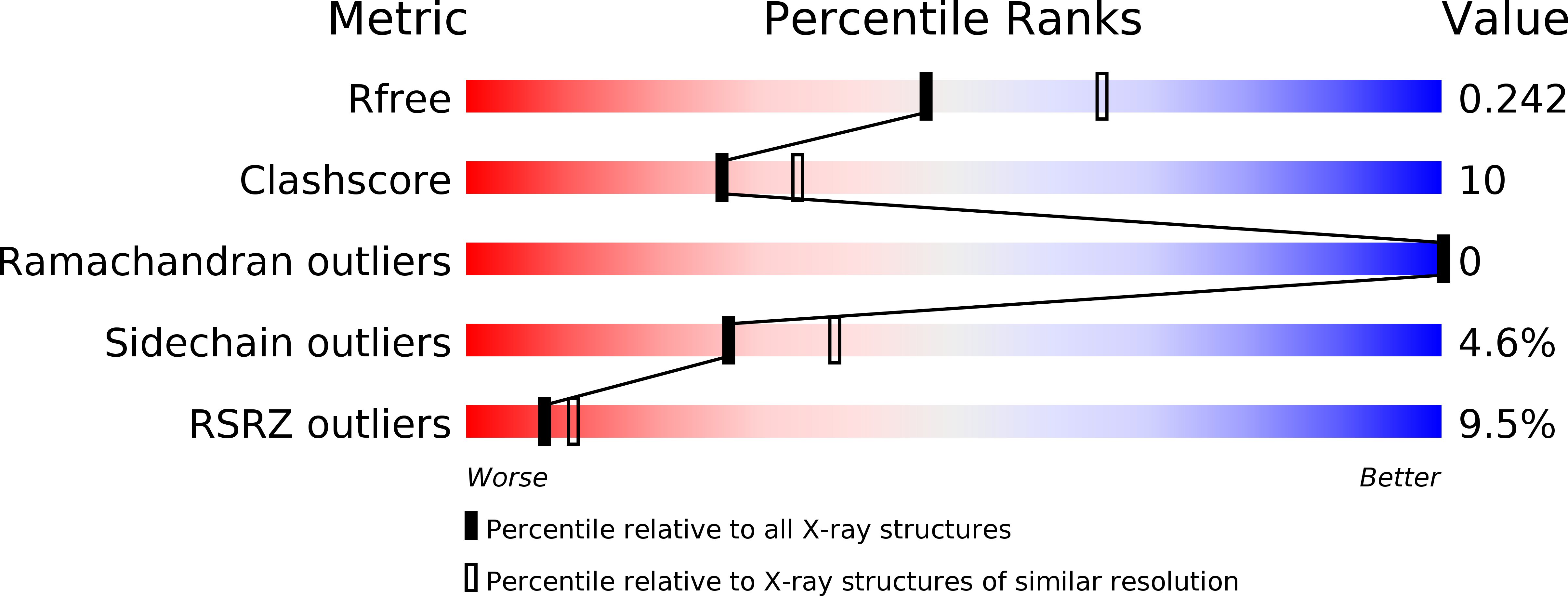
2.30 Å
R-Value Free:
0.24
R-Value Work:
0.22
R-Value Observed:
0.22
Space Group:
P 21 21 2
Macromolecular Entities
Structures with similar UniProt ID
Protein Blast
Polymer Type:polypeptide(L)
Molecule:Protein Rep68
Gene (Uniprot):Rep68
Chain IDs:A, B, C
Chain Length:209
Number of Molecules:3
Biological Source:Adeno-associated virus 2 (isolate Srivastava/1982)
Primary Citation
Structural Studies of AAV2 Rep68 Reveal a Partially Structured Linker and Compact Domain Conformation.
Biochemistry 54 5907 5919 (2015)
PMID: 26314310 DOI: 10.1021/acs.biochem.5b00610

Abstact

Adeno-associated virus (AAV) nonstructural proteins Rep78 and Rep68 carry out all DNA transactions that regulate the AAV life cycle. They share two multifunctional domains: an N-terminal origin binding/nicking domain (OBD) from the HUH superfamily and a SF3 helicase domain. A short linker of ∼20 amino acids that is critical for oligomerization and function connects the two domains. Although X-ray structures of the AAV5 OBD and AAV2 helicase domains have been determined, information about the full-length protein and linker conformation is not known. This article presents the solution structure of AAV2 Rep68 using small-angle X-ray scattering (SAXS). We first determined the X-ray structures of the minimal AAV2 Rep68 OBD and of the OBD with the linker region. These X-ray structures reveal novel features that include a long C-terminal α-helix that protrudes from the core of the protein at a 45° angle and a partially structured linker. SAXS studies corroborate that the linker is not extended, and we show that a proline residue in the linker is critical for Rep68 oligomerization and function. SAXS-based rigid-body modeling of Rep68 confirms these observations, showing a compact arrangement of the two domains in which they acquire a conformation that positions key residues in all domains on one face of the protein, poised to interact with DNA.

Legend

Protein

Chemical

Disease

Primary Citation of related structures
Feedback Form
Name
Email
Institute
Feedback