4Z9G image
Deposition Date 2015-04-10
Release Date 2016-06-29
Last Version Date 2024-11-13
Entry Detail
PDB ID:
4Z9G
Title:
Crystal structure of human corticotropin-releasing factor receptor 1 (CRF1R) in complex with the antagonist CP-376395 in a hexagonal setting with translational non-crystallographic symmetry
Biological Source:
Source Organism:
Host Organism:
Method Details:
Experimental Method:
Resolution:
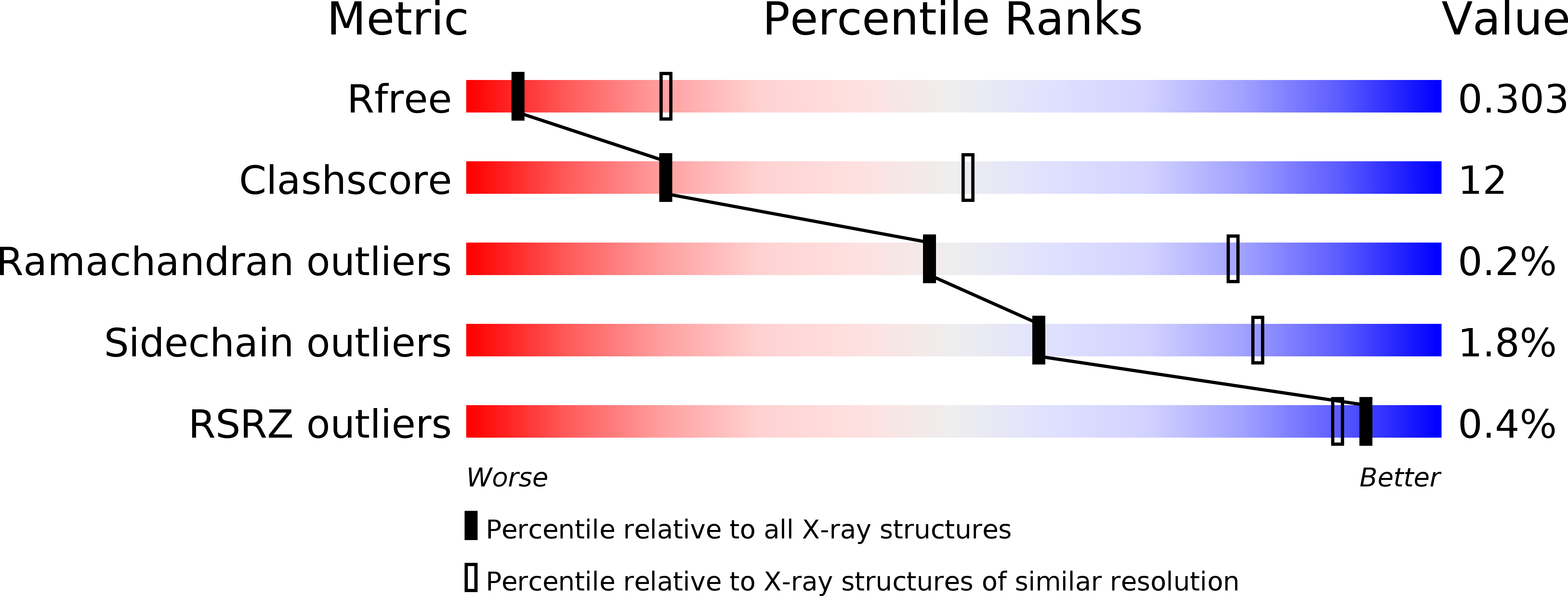
3.18 Å
R-Value Free:
0.28
R-Value Work:
0.24
R-Value Observed:
0.24
Space Group:
P 6
Macromolecular Entities
Protein Blast
Polymer Type:polypeptide(L)
Molecule:Corticotropin-releasing factor receptor 1,Lysozyme,Corticotropin-releasing factor receptor 1
Gene (Uniprot):e, CRHR1
Mutagens:V120A, L144A, W156A, S160A, N1040S, A1041V, C1054S, C1097S, T1151A, S222L, K228A, F260A, I277A, Y309A, F330A, S349A, Y363A,V120A, L144A, W156A, S160A, N1040S, A1041V, C1054S, C1097S, T1151A, S222L, K228A, F260A, I277A, Y309A, F330A, S349A, Y363A,V120A, L144A, W156A, S160A, N1040S, A1041V, C1054S, C1097S, T1151A, S222L, K228A, F260A, I277A, Y309A, F330A, S349A, Y363A
Chain IDs:A, B, C
Chain Length:443
Number of Molecules:3
Biological Source:Homo sapiens, Enterobacteria phage RB51
Primary Citation
Decoding Corticotropin-Releasing Factor Receptor Type 1 Crystal Structures.
Curr Mol Pharmacol 10 334 344 (2017)
PMID: 28183242 DOI: 10.2174/1874467210666170110114727

Abstact

The structural analysis of class B G protein-coupled receptors (GPCR), cell surface proteins responding to peptide hormones, has until recently been restricted to the extracellular domain (ECD). Corticotropin-releasing factor receptor type 1 (CRF1R) is a class B receptor mediating stress response and also considered a drug target for depression and anxiety. Here we report the crystal structure of the transmembrane domain of human CRF1R in complex with the small-molecule antagonist CP-376395 in a hexagonal setting with translational non-crystallographic symmetry. Molecular dynamics and metadynamics simulations on this novel structure and the existing TMD structure for CRF1R provides insight as to how the small molecule ligand gains access to the induced-fit allosteric binding site with implications for the observed selectivity against CRF2R. Furthermore, molecular dynamics simulations performed using a full-length receptor model point to key interactions between the ECD and extracellular loop 3 of the TMD providing insight into the full inactive state of multidomain class B GPCRs.

Legend

Protein

Chemical

Disease

Primary Citation of related structures
Feedback Form
Name
Email
Institute
Feedback