4Z68 image
Deposition Date 2015-04-04
Release Date 2015-12-30
Last Version Date 2024-01-10
Entry Detail
PDB ID:
4Z68
Keywords:
Title:
Hybrid structural analysis of the Arp2/3 regulator Arpin identifies its acidic tail as a primary binding epitope
Biological Source:
Source Organism:
Homo sapiens (Taxon ID: 9606)
Method Details:
Experimental Method:
Resolution:
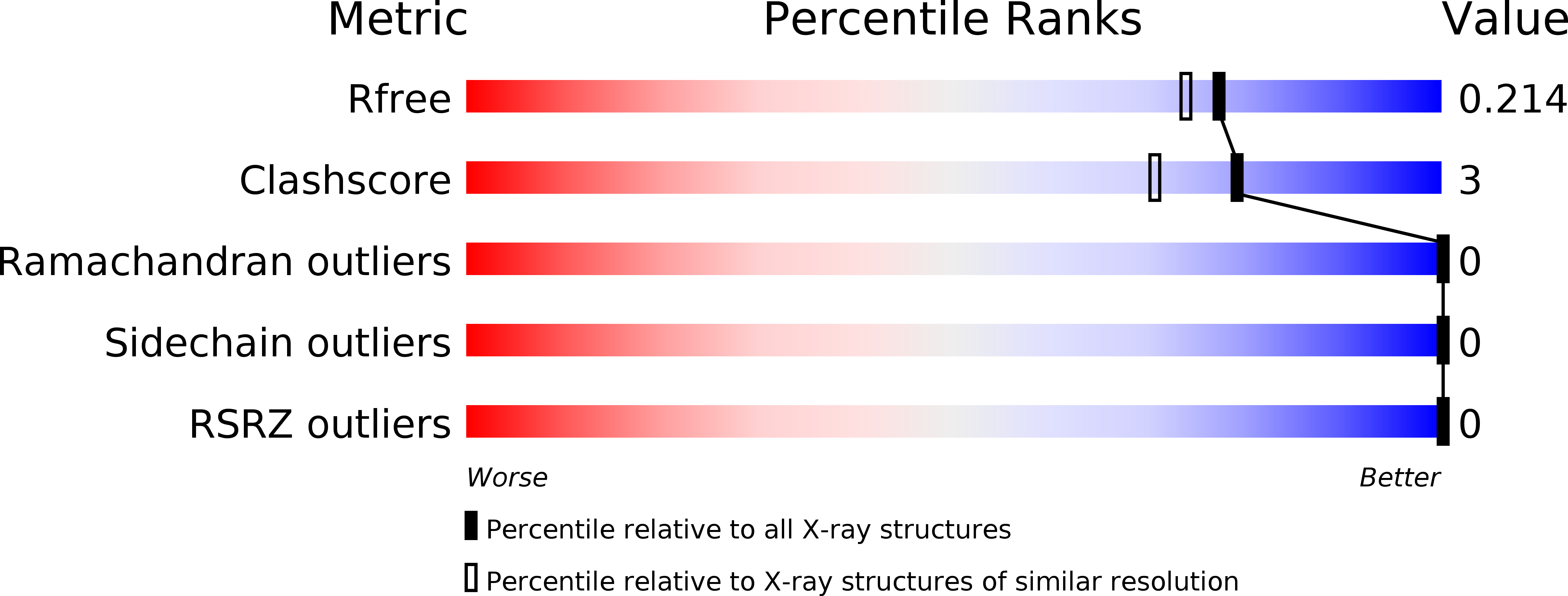
1.86 Å
R-Value Free:
0.21
R-Value Work:
0.16
R-Value Observed:
0.17
Space Group:
P 21 21 21
Macromolecular Entities
Structures with similar UniProt ID
Protein Blast
Polymer Type:polypeptide(L)
Molecule:Tankyrase-2
Gene (Uniprot):TNKS2
Chain IDs:A
Chain Length:155
Number of Molecules:1
Biological Source:Homo sapiens
Structures with similar UniProt ID
Protein Blast
Polymer Type:polypeptide(L)
Molecule:GLU-ILE-ARG-GLU-GLN-GLY-ASP-GLY-ALA-GLU-ASP-GLU
Chain IDs:B (auth: E)
Chain Length:12
Number of Molecules:1
Biological Source:Homo sapiens
Ligand Molecules
Primary Citation
Hybrid Structural Analysis of the Arp2/3 Regulator Arpin Identifies Its Acidic Tail as a Primary Binding Epitope.
Structure 24 252 260 (2016)
PMID: 26774128 DOI: 10.1016/j.str.2015.12.001

Abstact

Arpin is a newly discovered regulator of actin polymerization at the cell leading edge, which steers cell migration by exerting a negative control on the Arp2/3 complex. Arpin proteins have an acidic tail homologous to the acidic motif of the VCA domain of nucleation-promoting factors (NPFs). This tail is predicted to compete with the VCA of NPFs for binding to the Arp2/3 complex, thereby mitigating activation and/or tethering of the complex to sites of actin branching. Here, we investigated the structure of full-length Arpin using synchrotron small-angle X-ray scattering, and of its acidic tail in complex with an ankyrin repeats domain using X-ray crystallography. The data were combined in a hybrid model in which the acidic tail extends from the globular core as a linear peptide and forms a primary epitope that is readily accessible in unbound Arpin and suffices to tether Arpin to interacting proteins with high affinity.

Legend

Protein

Chemical

Disease

Primary Citation of related structures
Feedback Form
Name
Email
Institute
Feedback