4YYE image
Deposition Date 2015-03-23
Release Date 2016-01-06
Last Version Date 2023-09-27
Entry Detail
PDB ID:
4YYE
Keywords:
Title:
Crystal structure of the yeast mitochondrial threonyl-tRNA synthetase (MST1) in complex with the canonical tRNAThr and threonyl sulfamoyl adenylate
Biological Source:
Method Details:
Experimental Method:
Resolution:
2.30 Å
R-Value Free:
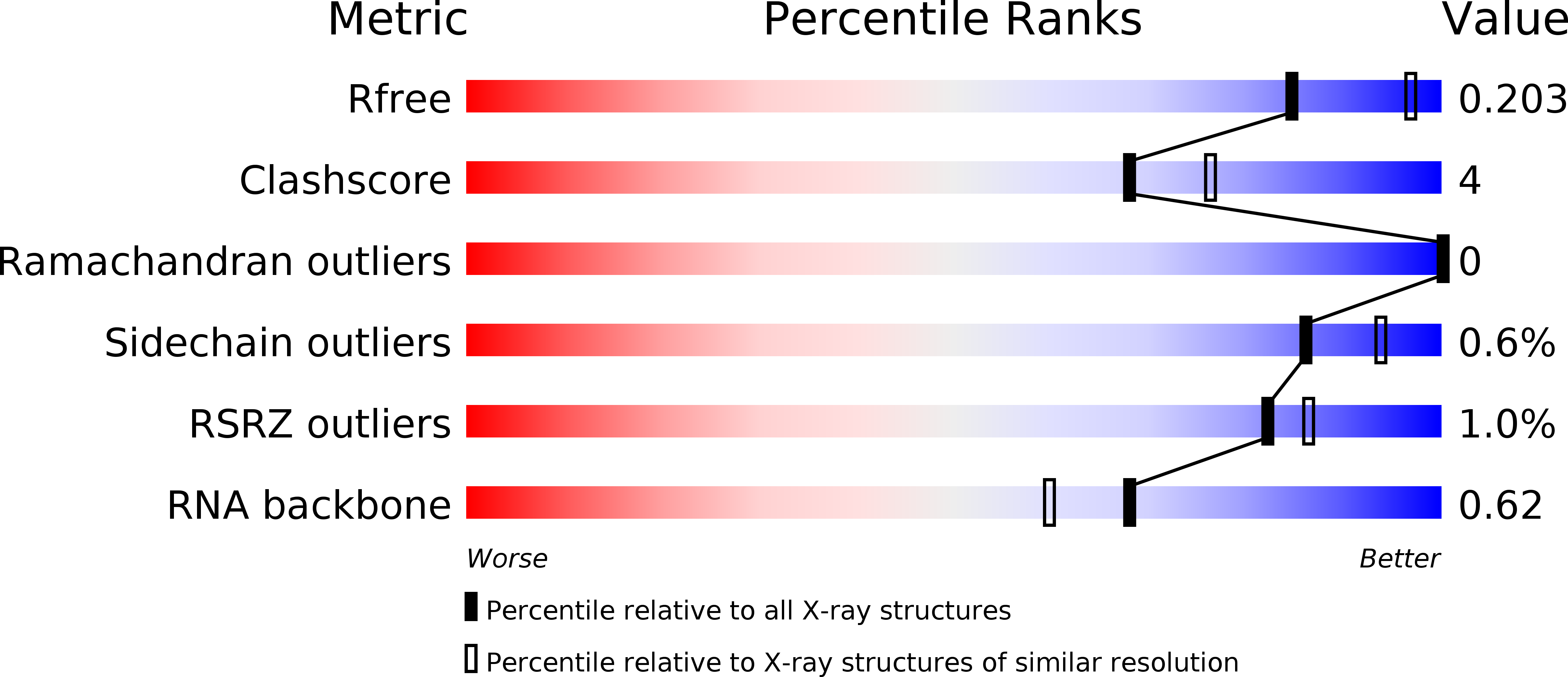
0.20
R-Value Work:
0.16
R-Value Observed:
0.16
Space Group:
P 1
Macromolecular Entities
Structures with similar UniProt ID
Protein Blast
Polymer Type:polypeptide(L)
Molecule:Threonine--tRNA ligase, mitochondrial
Gene (Uniprot):MST1
Chain IDs:A, B
Chain Length:460
Number of Molecules:2
Biological Source:Saccharomyces cerevisiae (strain ATCC 204508 / S288c)
Polymer Type:polyribonucleotide
Molecule:tRNA
Chain IDs:C, D
Chain Length:76
Number of Molecules:2
Biological Source:Saccharomyces cerevisiae
Primary Citation
The crystal structure of yeast mitochondrial ThrRS in complex with the canonical threonine tRNA.
Nucleic Acids Res. 44 1428 1439 (2016)
PMID: 26704982 DOI: 10.1093/nar/gkv1501

Abstact

In mitochondria of Saccharomyces cerevisiae, a single aminoacyl-tRNA synthetase (aaRS), MST1, aminoacylates two isoacceptor tRNAs, tRNA1(Thr) and tRNA2(Thr), that harbor anticodon loops of different size and sequence. As a result of this promiscuity, reassignment of the CUN codon box from leucine to threonine is facilitated. However, the mechanism by which a single aaRS binds distinct anticodon loops with high specificity is not well understood. Herein, we present the crystal structure of MST1 in complex with the canonical tRNA2(Thr) and non-hydrolyzable analog of threonyl adenylate. Our structure reveals that the dimeric arrangement of MST1 is essential for binding the 5'-phosphate, the second base pair of the acceptor stem, the first two base pairs of the anticodon stem and the first nucleotide of the variable arm. Further, in contrast to the bacterial ortholog that 'reads' the entire anticodon sequence, MST1 recognizes bases in the second and third position and the nucleotide upstream of the anticodon sequence. We speculate that a flexible loop linking strands β4 and β5 may be allosteric regulator that establishes cross-subunit communication between the aminoacylation and tRNA-binding sites. We also propose that structural features of the anticodon-binding domain in MST1 permit binding of the enlarged anticodon loop of tRNA1(Thr).

Legend

Protein

Chemical

Disease

Primary Citation of related structures
Feedback Form
Name
Email
Institute
Feedback