4YY3 image
Deposition Date 2015-03-23
Release Date 2016-07-06
Last Version Date 2023-09-27
Entry Detail
PDB ID:
4YY3
Keywords:
Title:
30S ribosomal subunit- HigB complex
Biological Source:
Source Organism(s):
Expression System(s):
Method Details:
Experimental Method:
Resolution:
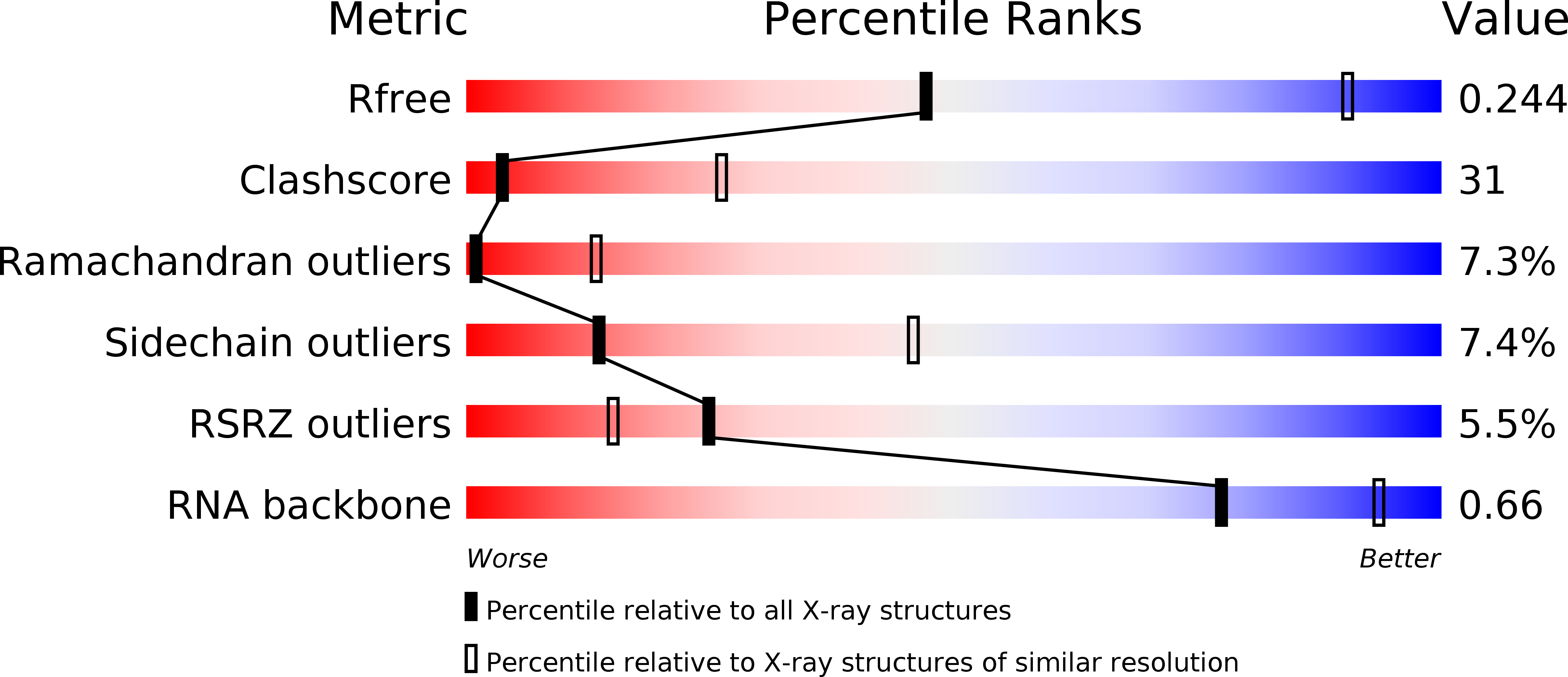
3.60 Å
R-Value Free:
0.23
R-Value Work:
0.21
R-Value Observed:
0.21
Space Group:
P 41 21 2
Macromolecular Entities
Polymer Type:polyribonucleotide
Molecule:16S rRNA
Chain IDs:A
Chain Length:1522
Number of Molecules:1
Biological Source:Thermus thermophilus HB8
Structures with similar UniProt ID
Protein Blast
Polymer Type:polypeptide(L)
Molecule:30S ribosomal protein S2
Gene (Uniprot):rpsB
Chain IDs:B
Chain Length:256
Number of Molecules:1
Biological Source:Thermus thermophilus HB8
Structures with similar UniProt ID
Protein Blast
Polymer Type:polypeptide(L)
Molecule:30S ribosomal protein S3
Gene (Uniprot):rpsC
Chain IDs:C
Chain Length:239
Number of Molecules:1
Biological Source:Thermus thermophilus HB8
Structures with similar UniProt ID
Protein Blast
Polymer Type:polypeptide(L)
Molecule:30S ribosomal protein S4
Gene (Uniprot):rpsD
Chain IDs:D
Chain Length:209
Number of Molecules:1
Biological Source:Thermus thermophilus HB8
Structures with similar UniProt ID
Protein Blast
Polymer Type:polypeptide(L)
Molecule:30S ribosomal protein S5
Gene (Uniprot):rpsE
Chain IDs:E
Chain Length:162
Number of Molecules:1
Biological Source:Thermus thermophilus HB8
Structures with similar UniProt ID
Protein Blast
Polymer Type:polypeptide(L)
Molecule:30S ribosomal protein S6
Gene (Uniprot):rpsF
Chain IDs:F
Chain Length:101
Number of Molecules:1
Biological Source:Thermus thermophilus HB8
Structures with similar UniProt ID
Protein Blast
Polymer Type:polypeptide(L)
Molecule:30S ribosomal protein S7
Gene (Uniprot):rpsG
Chain IDs:G
Chain Length:156
Number of Molecules:1
Biological Source:Thermus thermophilus HB8
Structures with similar UniProt ID
Protein Blast
Polymer Type:polypeptide(L)
Molecule:30S ribosomal protein S8
Chain IDs:H
Chain Length:138
Number of Molecules:1
Biological Source:Thermus thermophilus HB8
Structures with similar UniProt ID
Protein Blast
Polymer Type:polypeptide(L)
Molecule:30S ribosomal protein S9
Gene (Uniprot):rpsI
Chain IDs:I
Chain Length:128
Number of Molecules:1
Biological Source:Thermus thermophilus HB8
Structures with similar UniProt ID
Protein Blast
Polymer Type:polypeptide(L)
Molecule:30S ribosomal protein S10
Gene (Uniprot):rpsJ
Chain IDs:J
Chain Length:105
Number of Molecules:1
Biological Source:Thermus thermophilus HB8
Structures with similar UniProt ID
Protein Blast
Polymer Type:polypeptide(L)
Molecule:30S ribosomal protein S11
Gene (Uniprot):rpsK
Chain IDs:K
Chain Length:129
Number of Molecules:1
Biological Source:Thermus thermophilus HB8
Structures with similar UniProt ID
Protein Blast
Polymer Type:polypeptide(L)
Molecule:30S ribosomal protein S12
Gene (Uniprot):rpsL
Chain IDs:L
Chain Length:132
Number of Molecules:1
Biological Source:Thermus thermophilus HB8
Structures with similar UniProt ID
Protein Blast
Polymer Type:polypeptide(L)
Molecule:30S ribosomal protein S13
Gene (Uniprot):rpsM
Chain IDs:M
Chain Length:126
Number of Molecules:1
Biological Source:Thermus thermophilus HB8
Structures with similar UniProt ID
Protein Blast
Polymer Type:polypeptide(L)
Molecule:30S ribosomal protein S14 type Z
Chain IDs:N
Chain Length:61
Number of Molecules:1
Biological Source:Thermus thermophilus HB8
Structures with similar UniProt ID
Protein Blast
Polymer Type:polypeptide(L)
Molecule:30S ribosomal protein S15
Gene (Uniprot):rpsO
Chain IDs:O
Chain Length:89
Number of Molecules:1
Biological Source:Thermus thermophilus HB8
Structures with similar UniProt ID
Protein Blast
Polymer Type:polypeptide(L)
Molecule:30S ribosomal protein S16
Gene (Uniprot):rpsP
Chain IDs:P
Chain Length:88
Number of Molecules:1
Biological Source:Thermus thermophilus HB8
Structures with similar UniProt ID
Protein Blast
Polymer Type:polypeptide(L)
Molecule:30S ribosomal protein S17
Chain IDs:Q
Chain Length:105
Number of Molecules:1
Biological Source:Thermus thermophilus HB8
Structures with similar UniProt ID
Protein Blast
Polymer Type:polypeptide(L)
Molecule:30S ribosomal protein S18
Gene (Uniprot):rpsR
Chain IDs:R
Chain Length:88
Number of Molecules:1
Biological Source:Thermus thermophilus HB8
Structures with similar UniProt ID
Protein Blast
Polymer Type:polypeptide(L)
Molecule:30S ribosomal protein S19
Gene (Uniprot):rpsS
Chain IDs:S
Chain Length:93
Number of Molecules:1
Biological Source:Thermus thermophilus HB8
Structures with similar UniProt ID
Protein Blast
Polymer Type:polypeptide(L)
Molecule:30S ribosomal protein S20
Gene (Uniprot):rpsT
Chain IDs:T
Chain Length:106
Number of Molecules:1
Biological Source:Thermus thermophilus HB8
Structures with similar UniProt ID
Protein Blast
Polymer Type:polypeptide(L)
Molecule:30S ribosomal protein Thx
Gene (Uniprot):rpsU
Chain IDs:U (auth: V)
Chain Length:27
Number of Molecules:1
Biological Source:Thermus thermophilus HB8
Structures with similar UniProt ID
Protein Blast
Polymer Type:polypeptide(L)
Molecule:Killer protein
Gene (Uniprot):higB
Chain IDs:V (auth: Y)
Chain Length:118
Number of Molecules:1
Biological Source:Proteus vulgaris
Primary Citation
mRNA bound to the 30S subunit is a HigB toxin substrate.
Rna 22 1261 1270 (2016)
PMID: 27307497 DOI: 10.1261/rna.056218.116

Abstact

Activation of bacterial toxins during stress results in cleavage of mRNAs in the context of the ribosome. These toxins are thought to function as global translational inhibitors yet recent studies suggest each may have distinct mRNA specificities that result in selective translation for bacterial survival. Here we demonstrate that mRNA in the context of a bacterial 30S subunit is sufficient for ribosome-dependent toxin HigB endonucleolytic activity, suggesting that HigB interferes with the initiation step of translation. We determined the X-ray crystal structure of HigB bound to the 30S, revealing that two solvent-exposed clusters of HigB basic residues directly interact with 30S 16S rRNA helices 18, 30, and 31. We further show that these HigB residues are essential for ribosome recognition and function. Comparison with other ribosome-dependent toxins RelE and YoeB reveals that each interacts with similar features of the 30S aminoacyl (A) site yet does so through presentation of diverse structural motifs.

Legend

Protein

Chemical

Disease

Primary Citation of related structures
Feedback Form
Name
Email
Institute
Feedback