4YTA image
Deposition Date 2015-03-17
Release Date 2015-05-27
Last Version Date 2024-10-16
Entry Detail
PDB ID:
4YTA
Keywords:
Title:
BOND LENGTH ANALYSIS OF ASP, GLU AND HIS RESIDUES IN TRYPSIN AT 1.2A RESOLUTION
Biological Source:
Source Organism:
Bos taurus (Taxon ID: 9913)
Method Details:
Experimental Method:
Resolution:
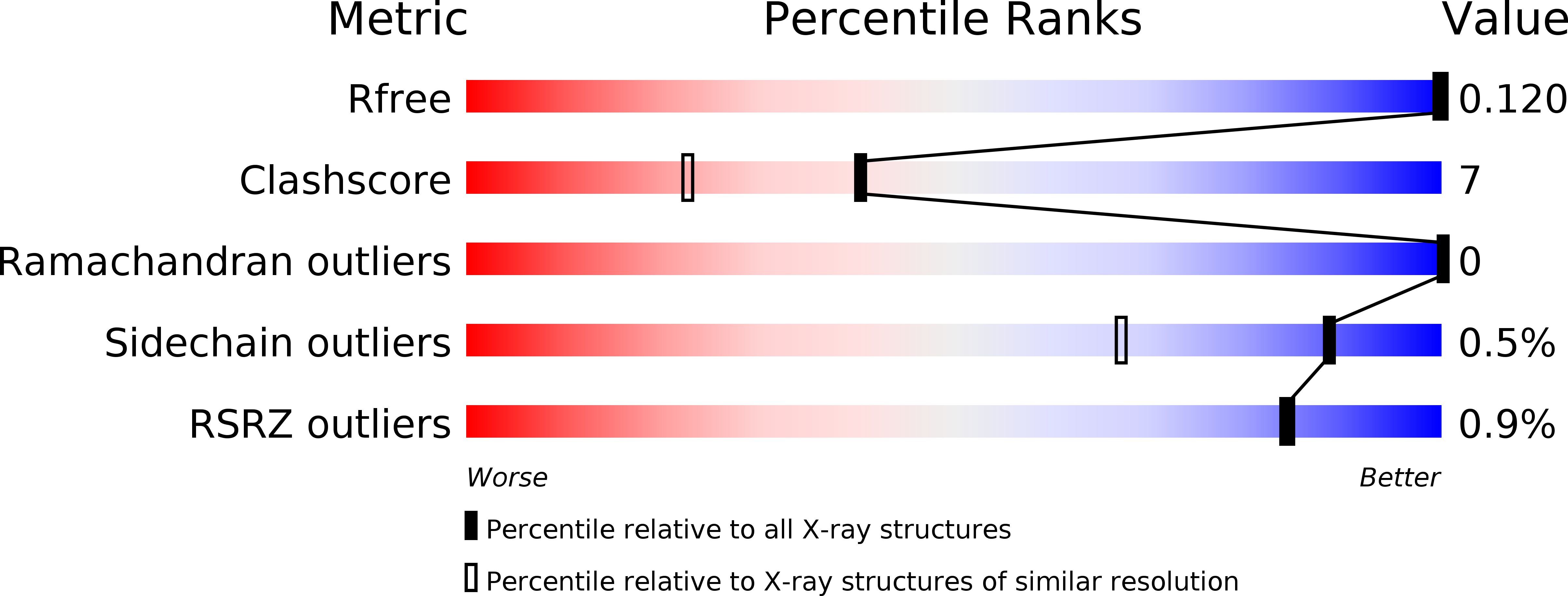
1.20 Å
R-Value Free:
0.12
R-Value Work:
0.10
R-Value Observed:
0.10
Space Group:
P 21 21 21
Macromolecular Entities
Structures with similar UniProt ID
Protein Blast
Polymer Type:polypeptide(L)
Molecule:Cationic trypsin
Gene (Uniprot):PRSS1
Chain IDs:A
Chain Length:223
Number of Molecules:1
Biological Source:Bos taurus
Primary Citation
Protonation-state determination in proteins using high-resolution X-ray crystallography: effects of resolution and completeness.
Acta Crystallogr. D Biol. Crystallogr. 68 800 809 (2012)
PMID: 22751665 DOI: 10.1107/S0907444912012589

Abstact

A bond-distance analysis has been undertaken to determine the protonation states of ionizable amino acids in trypsin, subtilisin and lysozyme. The diffraction resolutions were 1.2 Å for trypsin (97% complete, 12% H-atom visibility at 2.5σ), 1.26 Å for subtilisin (100% complete, 11% H-atom visibility at 2.5σ) and 0.65 Å for lysozyme (PDB entry 2vb1; 98% complete, 30% H-atom visibility at 3σ). These studies provide a wide diffraction resolution range for assessment. The bond-length e.s.d.s obtained are as small as 0.008 Å and thus provide an exceptional opportunity for bond-length analyses. The results indicate that useful information can be obtained from diffraction data at around 1.2-1.3 Å resolution and that minor increases in resolution can have significant effects on reducing the associated bond-length standard deviations. The protonation states in histidine residues were also considered; however, owing to the smaller differences between the protonated and deprotonated forms it is much more difficult to infer the protonation states of these residues. Not even the 0.65 Å resolution lysozyme structure provided the necessary accuracy to determine the protonation states of histidine.

Legend

Protein

Chemical

Disease

Primary Citation of related structures
Feedback Form
Name
Email
Institute
Feedback