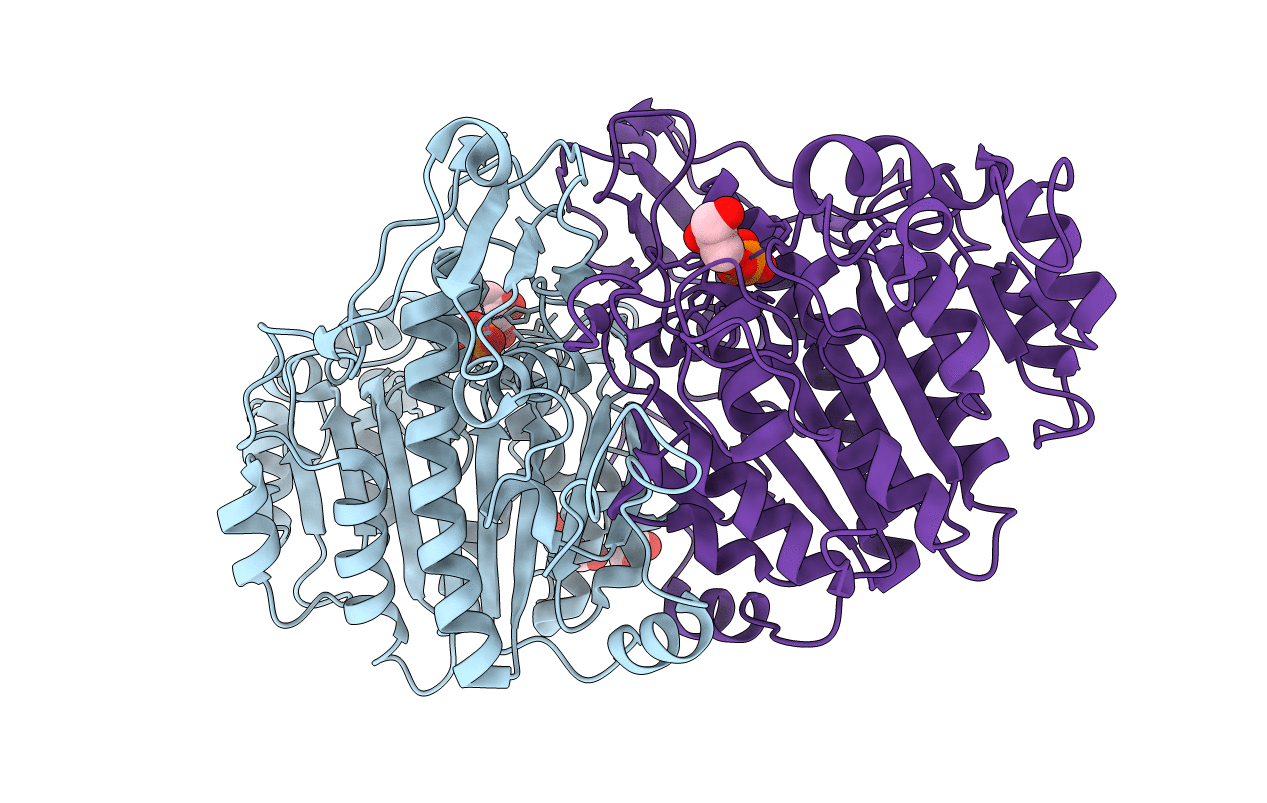
4YR1 image
Deposition Date 2015-03-13
Release Date 2015-04-29
Last Version Date 2024-11-06
Entry Detail
PDB ID:
4YR1
Keywords:
Title:
Crystal Structure of E. Coli Alkaline Phosphatase D101A/D153A in complex with inorganic phosphate
Biological Source:
Source Organism:
Host Organism:
Method Details:
Experimental Method:
Resolution:
2.24 Å
R-Value Free:
0.25
R-Value Work:
0.21
R-Value Observed:
0.21
Space Group:
P 63 2 2
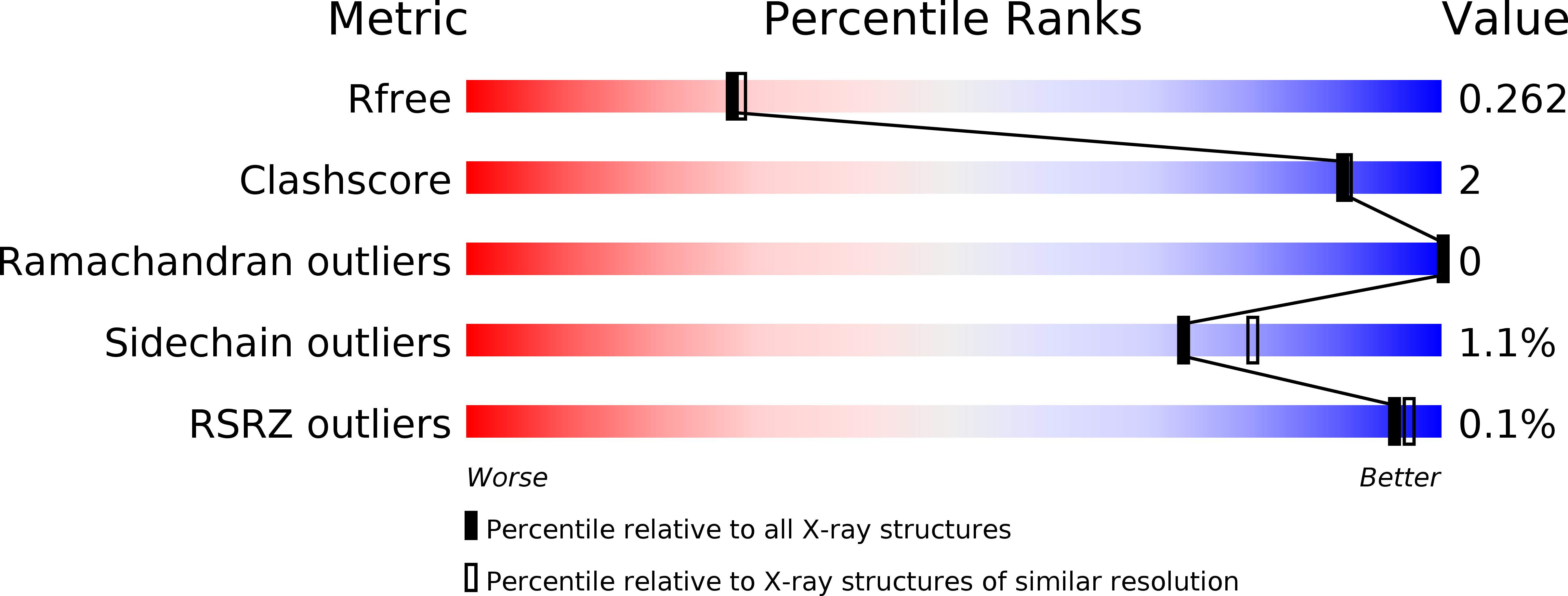
Macromolecular Entities
Structures with similar UniProt ID
Protein Blast
Polymer Type:polypeptide(L)
Molecule:Alkaline phosphatase
Gene (Uniprot):phoA
Mutagens:D101A D153A
Chain IDs:A, B
Chain Length:443
Number of Molecules:2
Biological Source:Escherichia coli (strain K12)
Primary Citation
Extensive site-directed mutagenesis reveals interconnected functional units in the Alkaline Phosphatase active site.
Elife 4 ? ? (2015)
PMID: 25902402 DOI: 10.7554/eLife.06181

Abstact

Enzymes enable life by accelerating reaction rates to biological timescales. Conventional studies have focused on identifying the residues that have a direct involvement in an enzymatic reaction, but these so-called 'catalytic residues' are embedded in extensive interaction networks. Although fundamental to our understanding of enzyme function, evolution, and engineering, the properties of these networks have yet to be quantitatively and systematically explored. We dissected an interaction network of five residues in the active site of Escherichia coli alkaline phosphatase. Analysis of the complex catalytic interdependence of specific residues identified three energetically independent but structurally interconnected functional units with distinct modes of cooperativity. From an evolutionary perspective, this network is orders of magnitude more probable to arise than a fully cooperative network. From a functional perspective, new catalytic insights emerge. Further, such comprehensive energetic characterization will be necessary to benchmark the algorithms required to rationally engineer highly efficient enzymes.

Legend

Protein

Chemical

Disease

Primary Citation of related structures
Feedback Form
Name
Email
Institute
Feedback