4YPG image
Deposition Date 2015-03-12
Release Date 2015-05-06
Last Version Date 2024-10-23
Entry Detail
PDB ID:
4YPG
Keywords:
Title:
Structural Insights Into the Neutralization Properties of a Human Anti-Interferon Monoclonal Antibody
Biological Source:
Source Organism:
Homo sapiens (Taxon ID: 9606)
Host Organism:
Method Details:
Experimental Method:
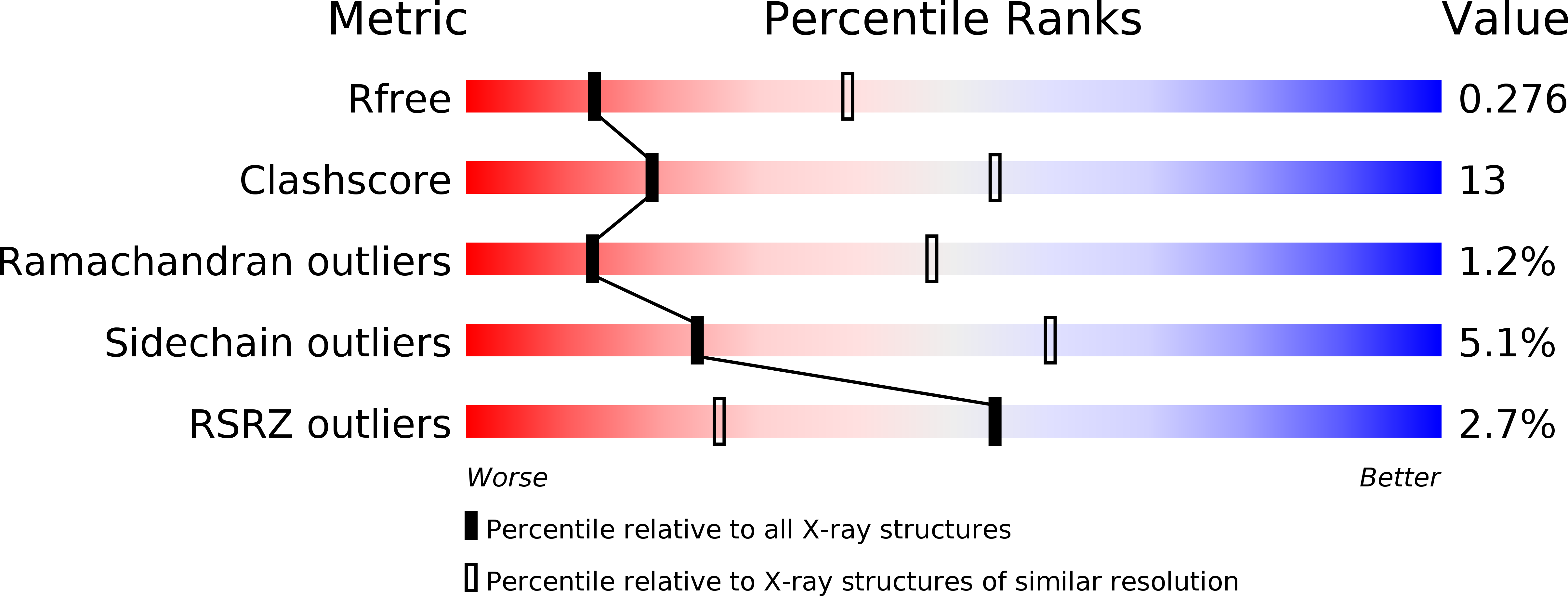
Resolution:
3.00 Å
R-Value Free:
0.27
R-Value Work:
0.20
R-Value Observed:
0.20
Space Group:
I 2 2 2
Macromolecular Entities
Structures with similar UniProt ID
Protein Blast
Polymer Type:polypeptide(L)
Molecule:Sifalimumab light chain
Gene (Uniprot):IGK@
Chain IDs:A, F (auth: L)
Chain Length:215
Number of Molecules:2
Biological Source:Homo sapiens
Polymer Type:polypeptide(L)
Molecule:Sifalimumab heavy chain
Chain IDs:B, E (auth: H)
Chain Length:219
Number of Molecules:2
Biological Source:Homo sapiens
Structures with similar UniProt ID
Protein Blast
Polymer Type:polypeptide(L)
Molecule:Interferon alpha-2
Gene (Uniprot):IFNA2
Chain IDs:C, D
Chain Length:161
Number of Molecules:2
Biological Source:Homo sapiens
Ligand Molecules
Primary Citation
Structural Insights into the Neutralization Properties of the Fully Human, Anti-interferon Monoclonal Antibody Sifalimumab.
J.Biol.Chem. 290 14979 14985 (2015)
PMID: 25925951 DOI: 10.1074/jbc.M115.652156

Abstact

We report the three-dimensional structure of human interferon α-2A (IFN-α2A) bound to the Fab fragment of a therapeutic monoclonal antibody (sifalimumab; IgG1/κ). The structure of the corresponding complex was solved at a resolution of 3.0 Å using molecular replacement and constitutes the first reported structure of a human type I IFN bound to a therapeutic antibody. This study revealed the major contribution made by the first complementarity-determining region in each of sifalimumab light and heavy chains. These data also provided the molecular basis for sifalimumab mechanism of action. We propose that its interferon-neutralizing properties are the result of direct competition for IFN-α2A binding to the IFN receptor subunit 1 (IFNAR1) and do not involve inhibiting IFN-α2A binding to the IFN receptor subunit 2 (IFNAR2).

Legend

Protein

Chemical

Disease

Primary Citation of related structures
Feedback Form
Name
Email
Institute
Feedback