4YK6 image
Deposition Date 2015-03-04
Release Date 2016-03-09
Last Version Date 2023-11-08
Entry Detail
PDB ID:
4YK6
Title:
Crystal structure of APC-ARM in complexed with Amer1-A4
Biological Source:
Source Organism:
Homo sapiens (Taxon ID: 9606)
Method Details:
Experimental Method:
Resolution:
1.70 Å
R-Value Free:
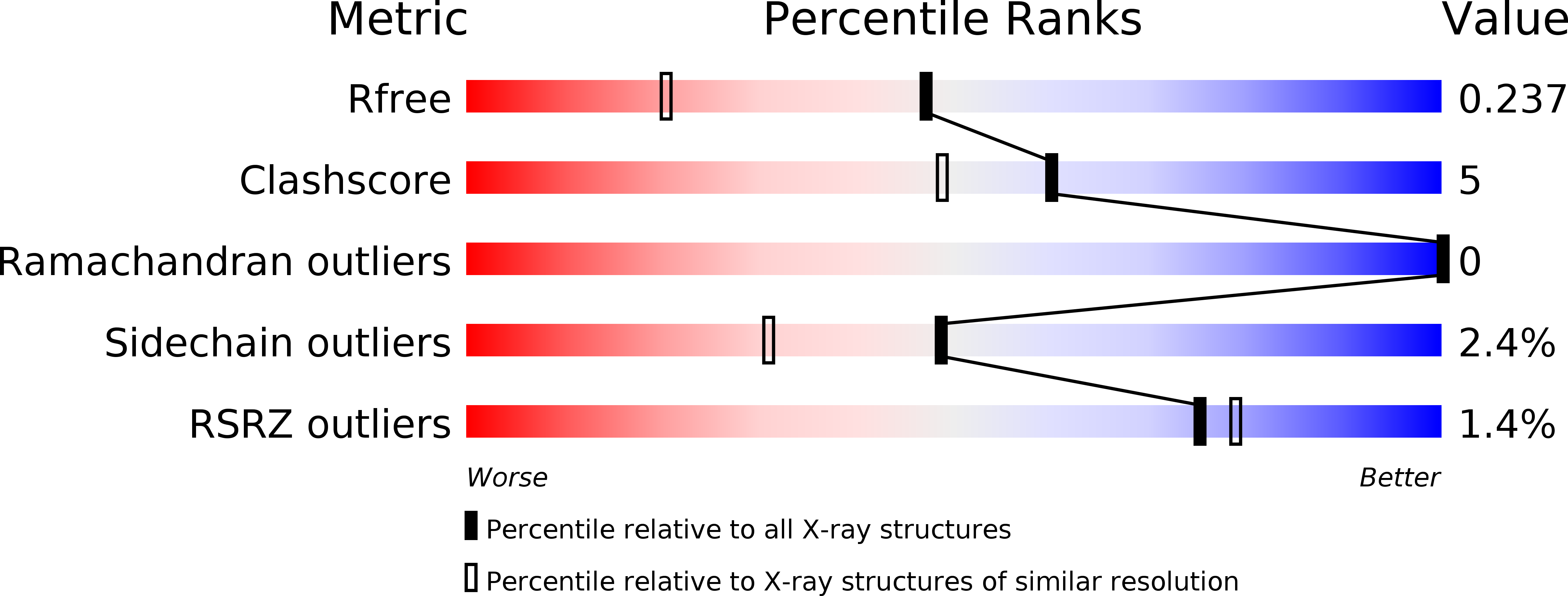
0.24
R-Value Work:
0.19
R-Value Observed:
0.19
Space Group:
P 21 21 21
Macromolecular Entities
Structures with similar UniProt ID
Protein Blast
Polymer Type:polypeptide(L)
Molecule:Adenomatous polyposis coli protein
Gene (Uniprot):APC
Chain IDs:B (auth: A)
Chain Length:354
Number of Molecules:1
Biological Source:Homo sapiens
Structures with similar UniProt ID
Protein Blast
Polymer Type:polypeptide(L)
Molecule:APC membrane recruitment protein 1
Gene (Uniprot):AMER1
Chain IDs:A (auth: B)
Chain Length:11
Number of Molecules:1
Biological Source:Homo sapiens
Primary Citation
Structures of the APC-ARM domain in complexes with discrete Amer1/WTX fragments reveal that it uses a consensus mode to recognize its binding partners
Cell Discov 1 15016 15016 (2015)
PMID: 27462415 DOI: 10.1038/celldisc.2015.16

Abstact

The tumor suppressor APC employs its conserved armadillo repeat (ARM) domain to recognize many of its binding partners, including Amer1/WTX, which is mutated in Wilms' tumor and bone overgrowth syndrome. The APC-Amer1 complex has important roles in regulating Wnt signaling and cell adhesion. Three sites A1, A2, and A3 of Amer1 have been reported to mediate its interaction with APC-ARM. In this study, crystal structures of APC-ARM in complexes with Amer1-A1, -A2, and -A4, which is newly identified in this work, were determined. Combined with our GST pull-down, yeast two-hybrid, and isothermal titration calorimetry (ITC) assay results using mutants of APC and Amer1 interface residues, our structures demonstrate that Amer1-A1, -A2, and -A4, as well as other APC-binding proteins such as Asef and Sam68, all employ a common recognition pattern to associate with APC-ARM. In contrast, Amer1-A3 binds to the C-terminal side of APC-ARM through a bipartite interaction mode. Composite mutations on either APC or Amer1 disrupting all four interfaces abrogated their association in cultured cells and impaired the membrane recruitment of APC by Amer1. Our study thus comprehensively elucidated the recognition mechanism between APC and Amer1, and revealed a consensus recognition sequence employed by various APC-ARM binding partners.

Legend

Protein

Chemical

Disease

Primary Citation of related structures
Feedback Form
Name
Email
Institute
Feedback