4YJ0 image
Deposition Date 2015-03-02
Release Date 2015-05-27
Last Version Date 2024-06-19
Entry Detail
PDB ID:
4YJ0
Keywords:
Title:
Crystal structure of the DM domain of human DMRT1 bound to 25mer target DNA
Biological Source:
Source Organism:
Homo sapiens (Taxon ID: 9606)
Method Details:
Experimental Method:
Resolution:
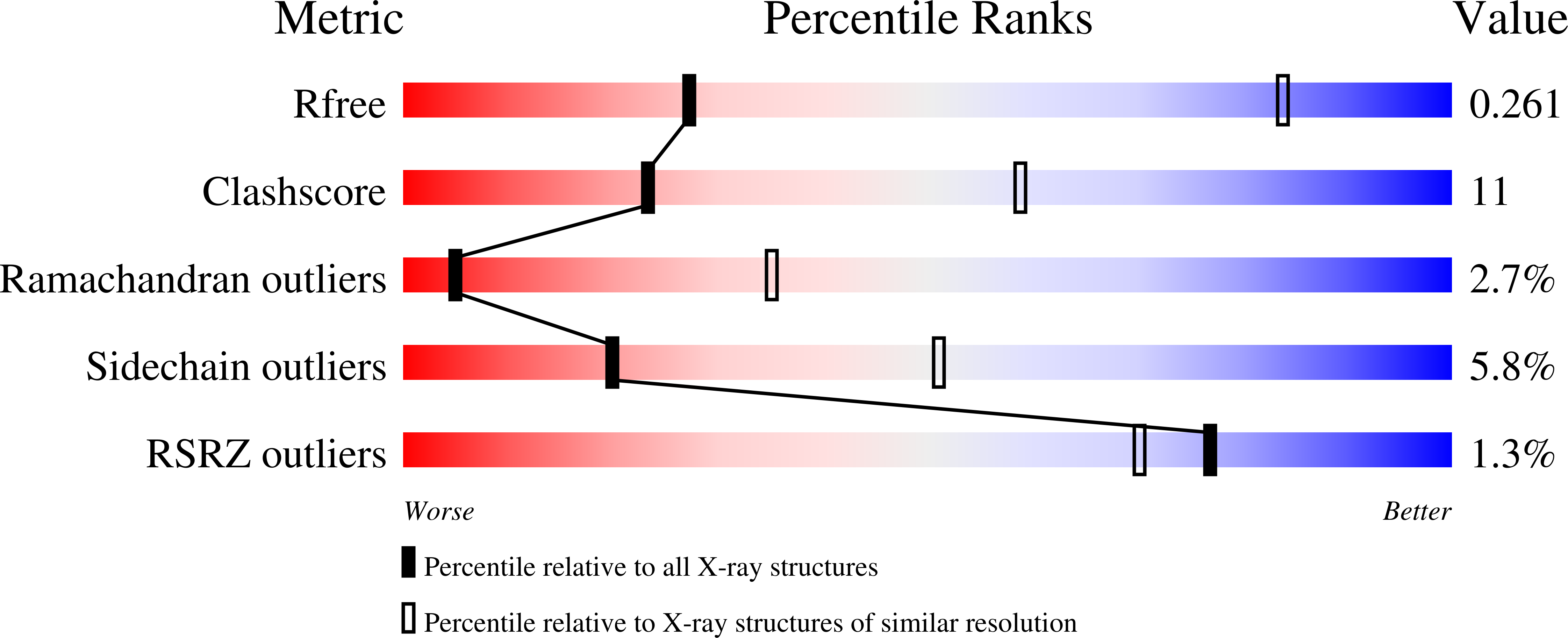
3.81 Å
R-Value Free:
0.26
R-Value Work:
0.22
R-Value Observed:
0.23
Space Group:
I 2 2 2
Macromolecular Entities
Structures with similar UniProt ID
Protein Blast
Polymer Type:polypeptide(L)
Molecule:Doublesex- and mab-3-related transcription factor 1
Gene (Uniprot):DMRT1
Chain IDs:A, B, C
Chain Length:70
Number of Molecules:3
Biological Source:Homo sapiens
Polymer Type:polydeoxyribonucleotide
Molecule:DNA (25-MER)
Chain IDs:D
Chain Length:25
Number of Molecules:1
Biological Source:Homo sapiens
Polymer Type:polydeoxyribonucleotide
Molecule:DNA (25-MER)
Chain IDs:E
Chain Length:25
Number of Molecules:1
Biological Source:Homo sapiens
Ligand Molecules
Primary Citation
An ancient protein-DNA interaction underlying metazoan sex determination.
Nat.Struct.Mol.Biol. 22 442 451 (2015)
PMID: 26005864 DOI: 10.1038/nsmb.3032

Abstact

DMRT transcription factors are deeply conserved regulators of metazoan sexual development. They share the DM DNA-binding domain, a unique intertwined double zinc-binding module followed by a C-terminal recognition helix, which binds a pseudopalindromic target DNA. Here we show that DMRT proteins use a unique binding interaction, inserting two adjacent antiparallel recognition helices into a widened DNA major groove to make base-specific contacts. Versatility in how specific base contacts are made allows human DMRT1 to use multiple DNA binding modes (tetramer, trimer and dimer). Chromatin immunoprecipitation with exonuclease treatment (ChIP-exo) indicates that multiple DNA binding modes also are used in vivo. We show that mutations affecting residues crucial for DNA recognition are associated with an intersex phenotype in flies and with male-to-female sex reversal in humans. Our results illuminate an ancient molecular interaction underlying much of metazoan sexual development.

Legend

Protein

Chemical

Disease

Primary Citation of related structures
Feedback Form
Name
Email
Institute
Feedback