4YCU image
Deposition Date 2015-02-20
Release Date 2015-06-10
Last Version Date 2024-11-20
Entry Detail
PDB ID:
4YCU
Title:
Crystal structure of cladosporin in complex with human lysyl-tRNA synthetase
Biological Source:
Source Organism:
Homo sapiens (Taxon ID: 9606)
Host Organism:
Method Details:
Experimental Method:
Resolution:
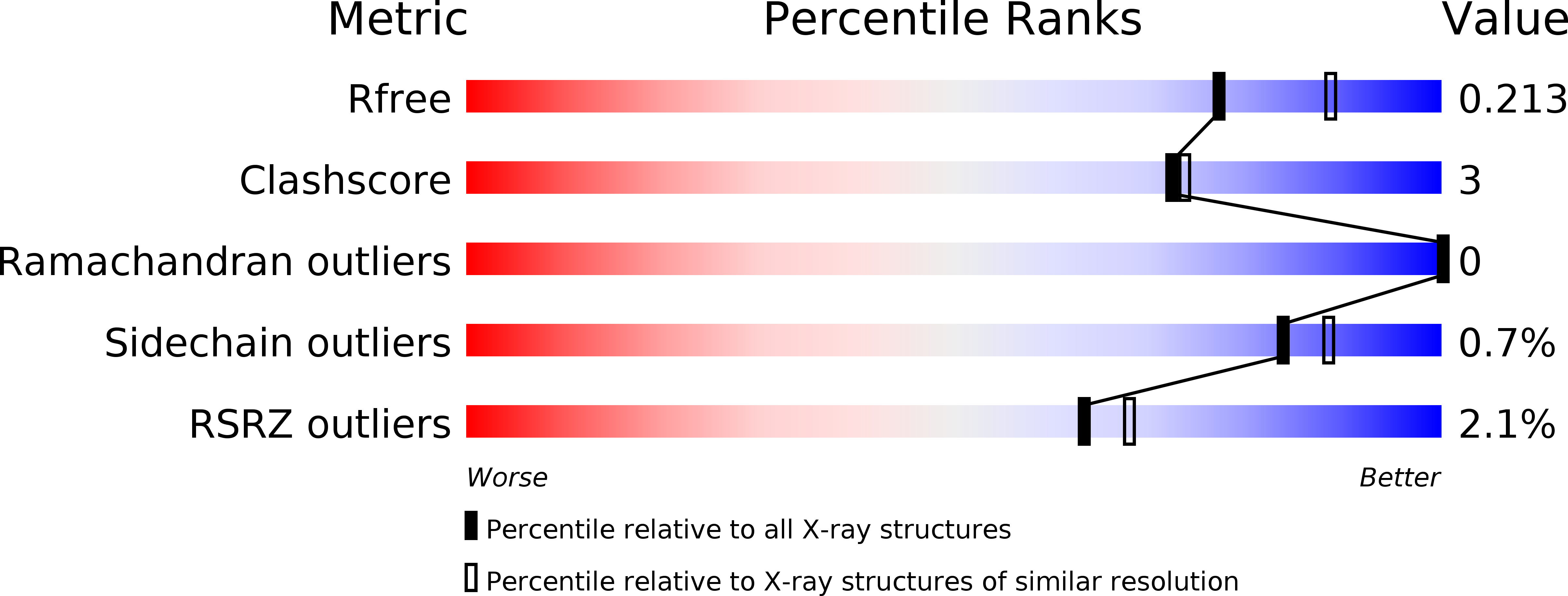
2.10 Å
R-Value Free:
0.21
R-Value Work:
0.19
R-Value Observed:
0.19
Space Group:
C 2 2 21
Macromolecular Entities
Structures with similar UniProt ID
Protein Blast
Polymer Type:polypeptide(L)
Molecule:Lysine--tRNA ligase
Gene (Uniprot):KARS1
Chain IDs:A, B
Chain Length:513
Number of Molecules:2
Biological Source:Homo sapiens
Structures with similar UniProt ID
Protein Blast
Polymer Type:polypeptide(L)
Molecule:Aminoacyl tRNA synthase complex-interacting multifunctional protein 2
Gene (Uniprot):AIMP2
Chain IDs:C
Chain Length:42
Number of Molecules:1
Biological Source:Homo sapiens
Primary Citation
Structural Basis for Specific Inhibition of tRNA Synthetase by an ATP Competitive Inhibitor.
Chem. Biol. 22 734 744 (2015)
PMID: 26074468 DOI: 10.1016/j.chembiol.2015.05.007

Abstact

Pharmaceutical inhibitors of aminoacyl-tRNA synthetases demand high species and family specificity. The antimalarial ATP-mimetic cladosporin selectively inhibits Plasmodium falciparum LysRS (PfLysRS). How the binding to a universal ATP site achieves the specificity is unknown. Here we report three crystal structures of cladosporin with human LysRS, PfLysRS, and a Pf-like human LysRS mutant. In all three structures, cladosporin occupies the class defining ATP-binding pocket, replacing the adenosine portion of ATP. Three residues holding the methyltetrahydropyran moiety of cladosporin are critical for the specificity of cladosporin against LysRS over other class II tRNA synthetase families. The species-exclusive inhibition of PfLysRS is linked to a structural divergence beyond the active site that mounts a lysine-specific stabilizing response to binding cladosporin. These analyses reveal that inherent divergence of tRNA synthetase structural assembly may allow for highly specific inhibition even through the otherwise universal substrate binding pocket and highlight the potential for structure-driven drug development.

Legend

Protein

Chemical

Disease

Primary Citation of related structures
Feedback Form
Name
Email
Institute
Feedback