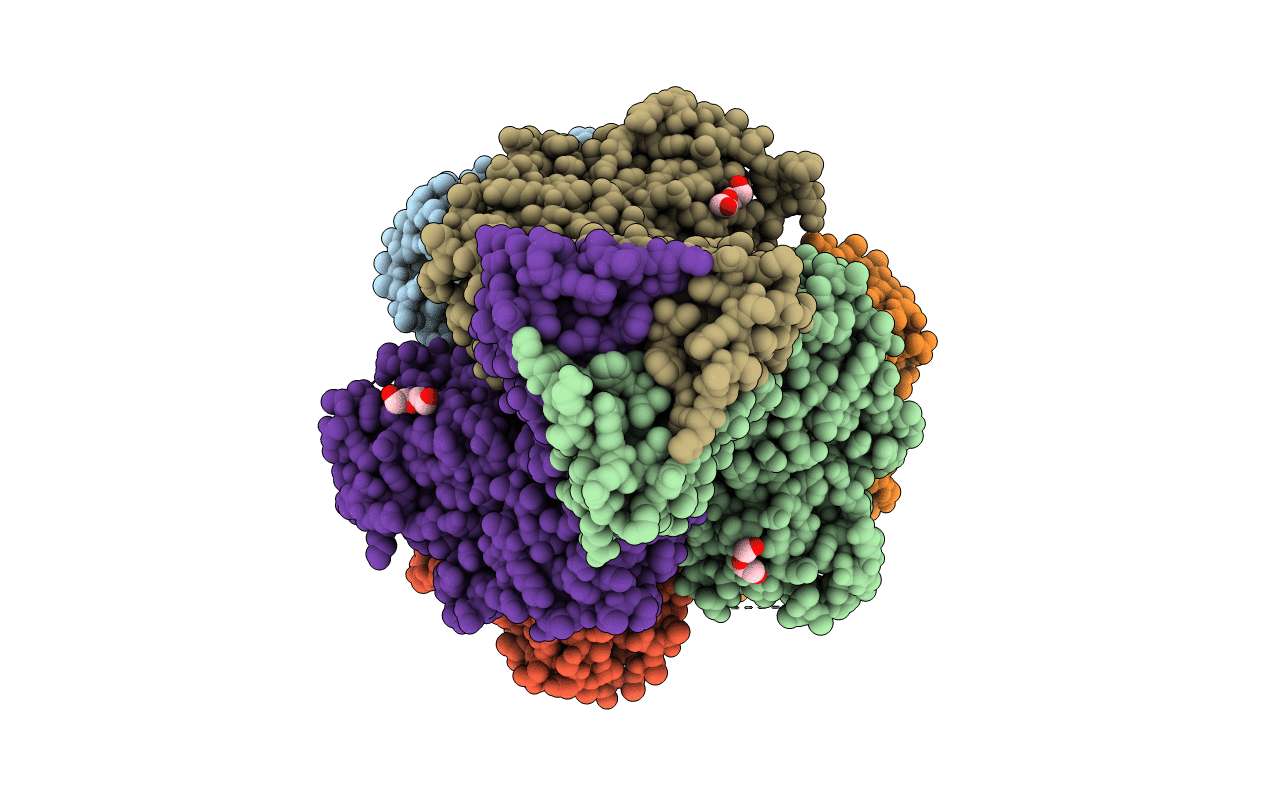
4YB6 image
Deposition Date 2015-02-18
Release Date 2016-03-09
Last Version Date 2023-09-27
Entry Detail
PDB ID:
4YB6
Keywords:
Title:
Adenosine triphosphate phosphoribosyltransferase from Campylobacter jejuni in complex with the inhibitors AMP and histidine
Biological Source:
Source Organism:
Host Organism:
Method Details:
Experimental Method:
Resolution:
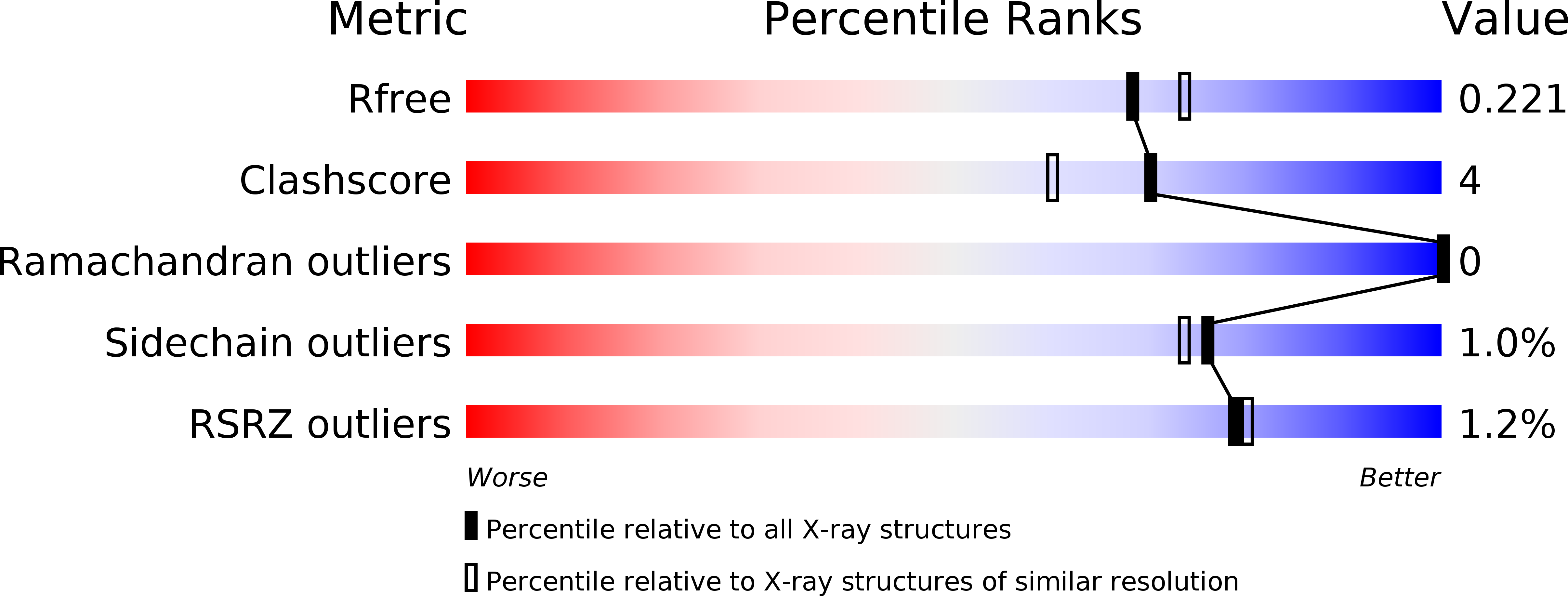
1.98 Å
R-Value Free:
0.21
R-Value Work:
0.19
R-Value Observed:
0.19
Space Group:
P 1 21 1
Macromolecular Entities
Structures with similar UniProt ID
Protein Blast
Polymer Type:polypeptide(L)
Molecule:ATP phosphoribosyltransferase
Gene (Uniprot):hisG
Chain IDs:A, B, C, D, E, F
Chain Length:300
Number of Molecules:6
Biological Source:Campylobacter jejuni (strain RM1221)
Primary Citation
Campylobacter jejuni adenosine triphosphate phosphoribosyltransferase is an active hexamer that is allosterically controlled by the twisting of a regulatory tail.
Protein Sci. 25 1492 1506 (2016)
PMID: 27191057 DOI: 10.1002/pro.2948

Abstact

Adenosine triphosphate phosphoribosyltransferase (ATP-PRT) catalyzes the first committed step of the histidine biosynthesis in plants and microorganisms. Here, we present the functional and structural characterization of the ATP-PRT from the pathogenic ε-proteobacteria Campylobacter jejuni (CjeATP-PRT). This enzyme is a member of the long form (HisGL) ATP-PRT and is allosterically inhibited by histidine, which binds to a remote regulatory domain, and competitively inhibited by AMP. In the crystalline form, CjeATP-PRT was found to adopt two distinctly different hexameric conformations, with an open homohexameric structure observed in the presence of substrate ATP, and a more compact closed form present when inhibitor histidine is bound. CjeATP-PRT was observed to adopt only a hexameric quaternary structure in solution, contradicting previous hypotheses favoring an allosteric mechanism driven by an oligomer equilibrium. Instead, this study supports the conclusion that the ATP-PRT long form hexamer is the active species; the tightening of this structure in response to remote histidine binding results in an inhibited enzyme.

Legend

Protein

Chemical

Disease

Primary Citation of related structures
Feedback Form
Name
Email
Institute
Feedback