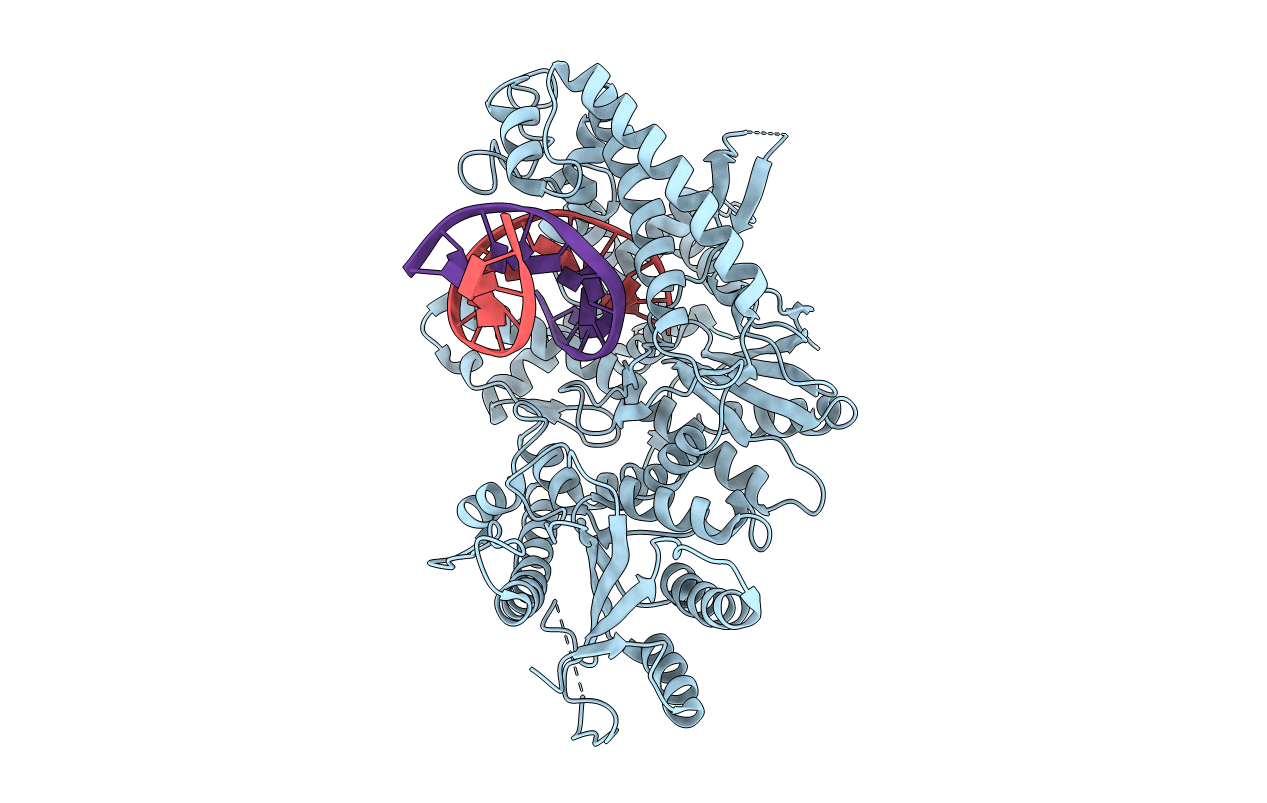
4XVI image
Deposition Date 2015-01-27
Release Date 2015-03-11
Last Version Date 2024-02-28
Entry Detail
PDB ID:
4XVI
Keywords:
Title:
Binary complex of human polymerase nu and DNA with the finger domain ajar
Biological Source:
Source Organism:
Homo sapiens (Taxon ID: 9606)
Host Organism:
Method Details:
Experimental Method:
Resolution:
3.10 Å
R-Value Free:
0.23
R-Value Work:
0.21
R-Value Observed:
0.21
Space Group:
H 3 2

Macromolecular Entities
Structures with similar UniProt ID
Protein Blast
Polymer Type:polypeptide(L)
Molecule:DNA polymerase nu
Gene (Uniprot):POLN
Chain IDs:A
Chain Length:666
Number of Molecules:1
Biological Source:Homo sapiens
Polymer Type:polydeoxyribonucleotide
Molecule:DNA (5'-D(*AP*CP*TP*CP*TP*GP*AP*CP*GP*CP*TP*AP*GP*G)-3')
Chain IDs:B (auth: P)
Chain Length:14
Number of Molecules:1
Biological Source:Homo sapiens
Polymer Type:polydeoxyribonucleotide
Molecule:DNA (5'-D(*CP*CP*TP*AP*GP*CP*GP*TP*CP*AP*G)-3')
Chain IDs:C (auth: T)
Chain Length:11
Number of Molecules:1
Biological Source:Homo sapiens
Ligand Molecules
Primary Citation
How a homolog of high-fidelity replicases conducts mutagenic DNA synthesis.
Nat.Struct.Mol.Biol. 22 298 303 (2015)
PMID: 25775266 DOI: 10.1038/nsmb.2985

Abstact

All DNA replicases achieve high fidelity by a conserved mechanism, but each translesion polymerase carries out mutagenic DNA synthesis in its own way. Here we report crystal structures of human DNA polymerase ν (Pol ν), which is homologous to high-fidelity replicases yet is error prone. Instead of a simple open-to-closed movement of the O helix upon binding of a correct incoming nucleotide, Pol ν has a different open state and requires the finger domain to swing sideways and undergo both opening and closing motions to accommodate the nascent base pair. A single-amino acid substitution in the O helix of the finger domain improves the fidelity of Pol ν nearly ten-fold. A unique cavity and the flexibility of the thumb domain allow Pol ν to generate and accommodate a looped-out primer strand. Primer loop-out may be a mechanism for DNA trinucloetide-repeat expansion.

Legend

Protein

Chemical

Disease

Primary Citation of related structures
Feedback Form
Name
Email
Institute
Feedback