4XST image
Deposition Date 2015-01-22
Release Date 2015-06-10
Last Version Date 2024-11-20
Entry Detail
PDB ID:
4XST
Title:
Structure of the endoglycosidase-H treated L1-CR domains of the human insulin receptor in complex with residues 697-719 of the human insulin receptor (A-isoform)
Biological Source:
Source Organism:
Homo sapiens (Taxon ID: 9606)
Rattus norvegicus (Taxon ID: 10116)
Host Organism:
Method Details:
Experimental Method:
Resolution:
3.00 Å
R-Value Free:
0.26
R-Value Work:
0.21
R-Value Observed:
0.21
Space Group:
P 63 2 2
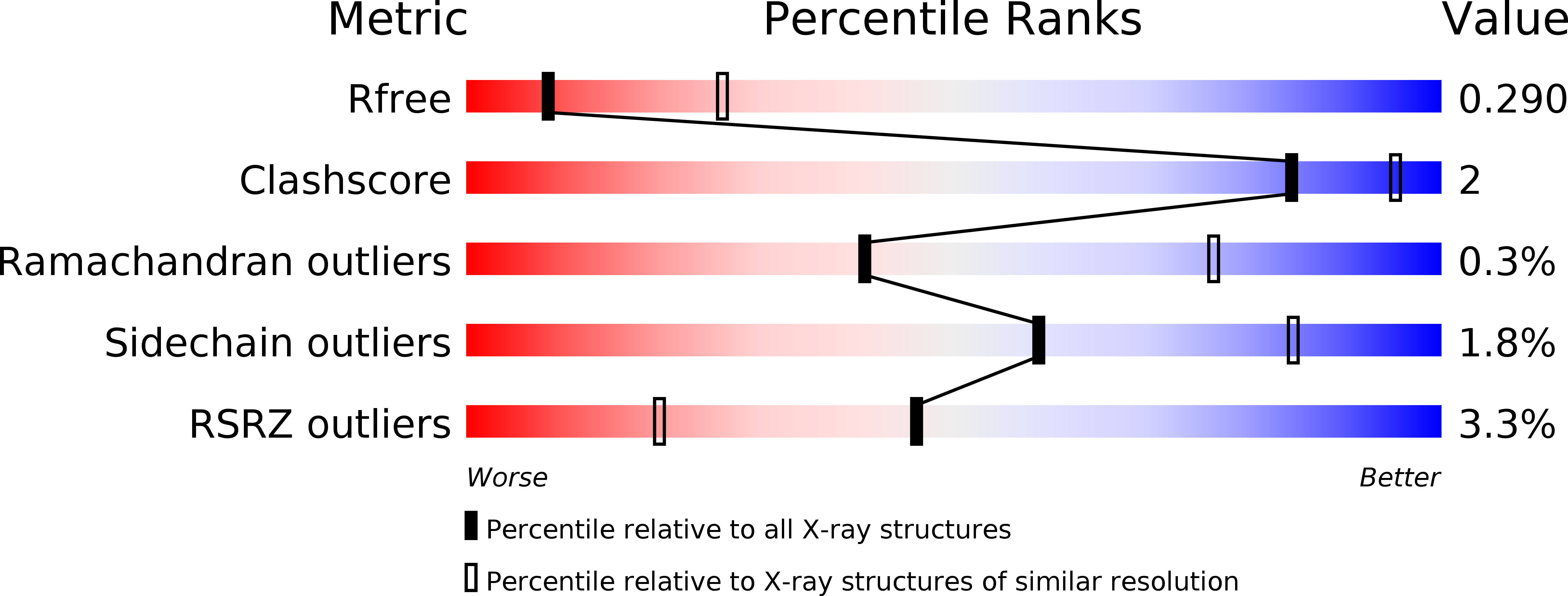
Macromolecular Entities
Structures with similar UniProt ID
Protein Blast
Polymer Type:polypeptide(L)
Molecule:Insulin receptor
Gene (Uniprot):INSR
Chain IDs:A (auth: E)
Chain Length:317
Number of Molecules:1
Biological Source:Homo sapiens
Structures with similar UniProt ID
Protein Blast
Polymer Type:polypeptide(L)
Molecule:Insulin receptor
Gene (Uniprot):Insr
Chain IDs:B (auth: F)
Chain Length:23
Number of Molecules:1
Biological Source:Rattus norvegicus
Primary Citation
Structural Congruency of Ligand Binding to the Insulin and Insulin/Type 1 Insulin-like Growth Factor Hybrid Receptors.
Structure 23 1271 1282 (2015)
PMID: 26027733 DOI: 10.1016/j.str.2015.04.016

Abstact

The homodimeric insulin and type 1 insulin-like growth factor receptors (IR and IGF-1R) share a common architecture and each can bind all three ligands within the family: insulin and insulin-like growth factors I and II (IGF-I and IFG-II). The receptor monomers also assemble as heterodimers, the primary ligand-binding sites of which each comprise the first leucine-rich repeat domain (L1) of one receptor type and an α-chain C-terminal segment (αCT) of the second receptor type. We present here crystal structures of IGF-I bound to such a hybrid primary binding site and of a ligand-free version of an IR αCT peptide bound to an IR L1 plus cysteine-rich domain construct (IR310.T). These structures, refined at 3.0-Å resolution, prove congruent to respective existing structures of insulin-complexed IR310.T and the intact apo-IR ectodomain. As such, they provide key missing links in the emerging, but sparse, repertoire of structures defining the receptor family.

Legend

Protein

Chemical

Disease

Primary Citation of related structures
Feedback Form
Name
Email
Institute
Feedback