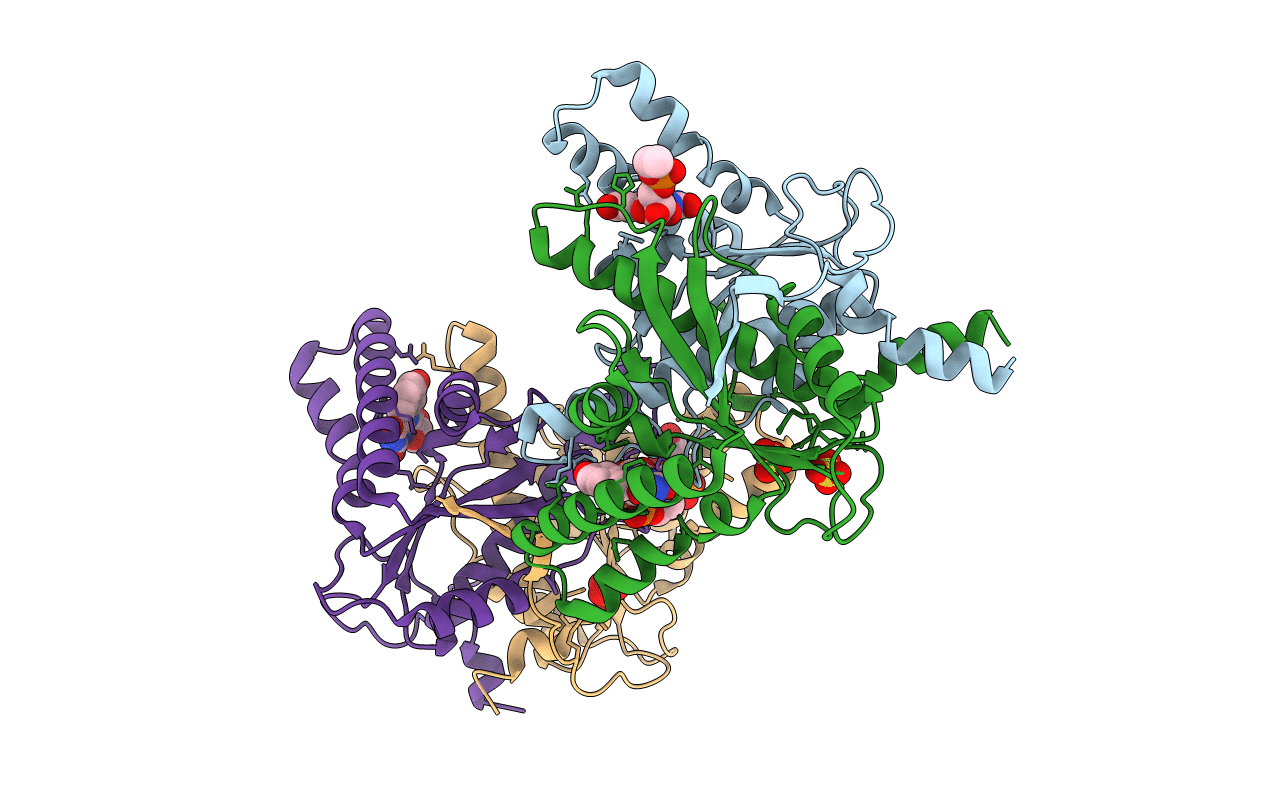
4XOQ image
Deposition Date 2015-01-16
Release Date 2016-02-17
Last Version Date 2023-09-27
Entry Detail
PDB ID:
4XOQ
Title:
F420 complex of coenzyme F420:L-glutamate ligase (FbiB) from Mycobacterium tuberculosis (C-terminal domain)
Biological Source:
Method Details:
Experimental Method:
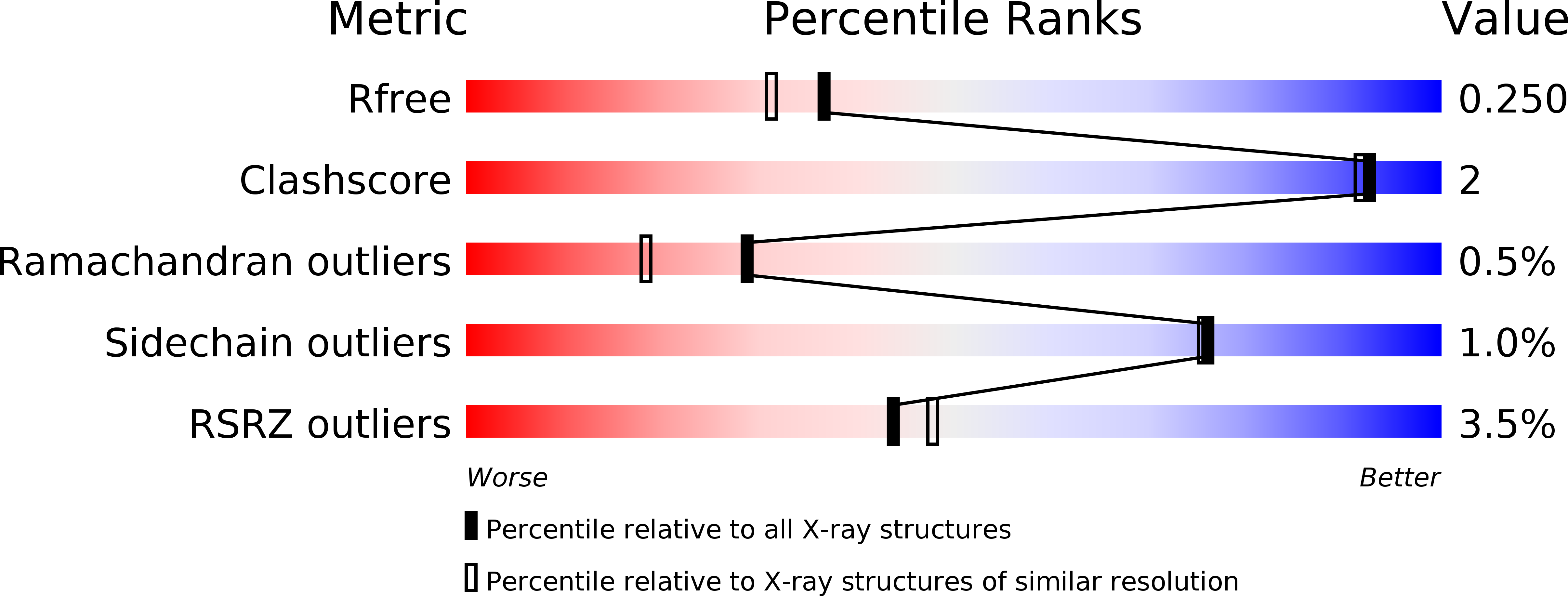
Resolution:
2.05 Å
R-Value Free:
0.24
R-Value Work:
0.21
R-Value Observed:
0.21
Space Group:
P 41 21 2
Macromolecular Entities
Structures with similar UniProt ID
Protein Blast
Polymer Type:polypeptide(L)
Molecule:Coenzyme F420:L-glutamate ligase
Gene (Uniprot):fbiB
Chain IDs:A, B, C, D
Chain Length:207
Number of Molecules:4
Biological Source:Mycobacterium tuberculosis (strain ATCC 25618 / H37Rv)
Primary Citation
Elongation of the Poly-gamma-glutamate Tail of F420 Requires Both Domains of the F420: gamma-Glutamyl Ligase (FbiB) of Mycobacterium tuberculosis.
J.Biol.Chem. 291 6882 6894 (2016)
PMID: 26861878 DOI: 10.1074/jbc.M115.689026

Abstact

Cofactor F420is an electron carrier with a major role in the oxidoreductive reactions ofMycobacterium tuberculosis, the causative agent of tuberculosis. A γ-glutamyl ligase catalyzes the final steps of the F420biosynthesis pathway by successive additions ofl-glutamate residues to F420-0, producing a poly-γ-glutamate tail. The enzyme responsible for this reaction in archaea (CofE) comprises a single domain and produces F420-2 as the major species. The homologousM. tuberculosisenzyme, FbiB, is a two-domain protein and produces F420with predominantly 5-7l-glutamate residues in the poly-γ-glutamate tail. The N-terminal domain of FbiB is homologous to CofE with an annotated γ-glutamyl ligase activity, whereas the C-terminal domain has sequence similarity to an FMN-dependent family of nitroreductase enzymes. Here we demonstrate that full-length FbiB adds multiplel-glutamate residues to F420-0in vitroto produce F420-5 after 24 h; communication between the two domains is critical for full γ-glutamyl ligase activity. We also present crystal structures of the C-terminal domain of FbiB in apo-, F420-0-, and FMN-bound states, displaying distinct sites for F420-0 and FMN ligands that partially overlap. Finally, we discuss the features of a full-length structural model produced by small angle x-ray scattering and its implications for the role of N- and C-terminal domains in catalysis.

Legend

Protein

Chemical

Disease

Primary Citation of related structures
Feedback Form
Name
Email
Institute
Feedback