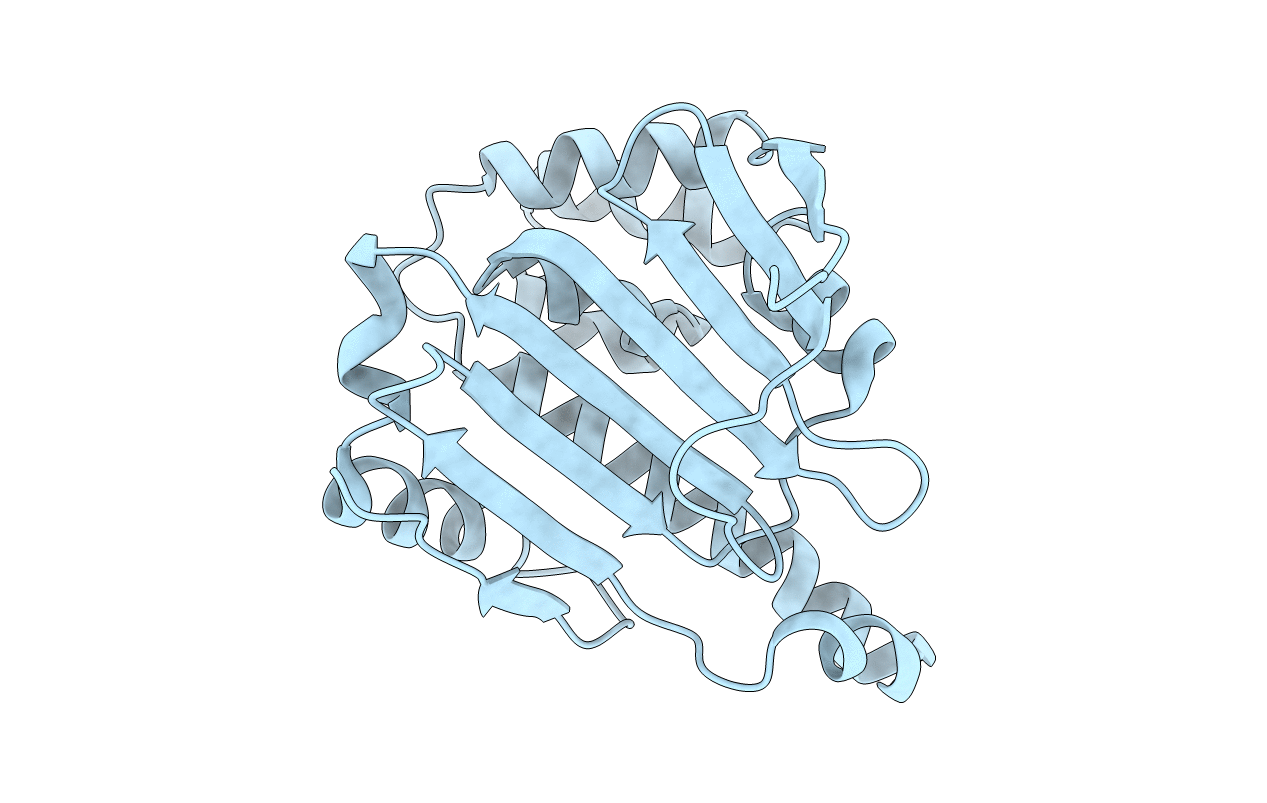
4XKK image
Deposition Date 2015-01-12
Release Date 2015-01-28
Last Version Date 2023-11-08
Entry Detail
PDB ID:
4XKK
Keywords:
Title:
Crystal structure of N-terminal domain of Hsp90 from Dictyostelium discoideum
Biological Source:
Source Organism:
Method Details:
Experimental Method:
Resolution:
2.70 Å
R-Value Free:
0.27
R-Value Work:
0.21
R-Value Observed:
0.22
Space Group:
P 1 21 1

Macromolecular Entities
Structures with similar UniProt ID
Protein Blast
Polymer Type:polypeptide(L)
Molecule:Heat shock cognate 90 kDa protein
Gene (Uniprot):hspD
Chain IDs:A
Chain Length:259
Number of Molecules:1
Biological Source:Dictyostelium discoideum
Primary Citation
Heat shock protein 90 regulates development in Dictyostelium discoideum
J. Mol. Biol. 383 24 35 (2008)
PMID: 18718841 DOI: 10.1016/j.jmb.2008.08.006

Abstact

Cytosolic heat shock protein 90 (Hsp90) has been implicated in diverse biological processes such as protein folding, cell cycle control, signal transduction, development, and morphological evolution. Model systems available for studying Hsp90 function either allow ease of manipulation for biochemical studies or facilitate a phenomenological study of its role in influencing phenotype. In this work, we have explored the use of the cellular slime mold Dictyostelium discoideum to examine cellular functions of Hsp90 in relation to its multicellular development. In addition to cloning, purification, biochemical characterization, and examination of its crystal structure, our studies, using a pharmacological inhibitor of Hsp90, demonstrate a role for the cytoplasmic isoform (HspD) in D. discoideum development. Inhibition of HspD function using geldanamycin (GA) resulted in delayed aggregation and arrest of D. discoideum development at the 'mound' stage. Crystal structure of the amino-terminal domain of HspD showed a binding pocket similar to that described for yeast Hsp90. Fluorescence spectroscopy, as well as GA-coupled beads affinity pulldown, confirmed a specific interaction between HspD and GA. The results presented here provide an important insight into the function of HspD in D. discoideum development and emphasize the potential of the cellular slime mold to serve as an effective model for studying the many roles of Hsp90 at cellular and organismal levels.

Legend

Protein

Chemical

Disease

Primary Citation of related structures
Feedback Form
Name
Email
Institute
Feedback