4X0K image
Deposition Date 2014-11-21
Release Date 2015-04-08
Last Version Date 2024-11-06
Entry Detail
PDB ID:
4X0K
Keywords:
Title:
Engineered Fab fragment specific for EYMPME (EE) peptide
Biological Source:
Source Organism:
Homo sapiens (Taxon ID: 9606)
Host Organism:
Method Details:
Experimental Method:
Resolution:
2.04 Å
R-Value Free:
0.20
R-Value Work:
0.16
R-Value Observed:
0.16
Space Group:
P 1
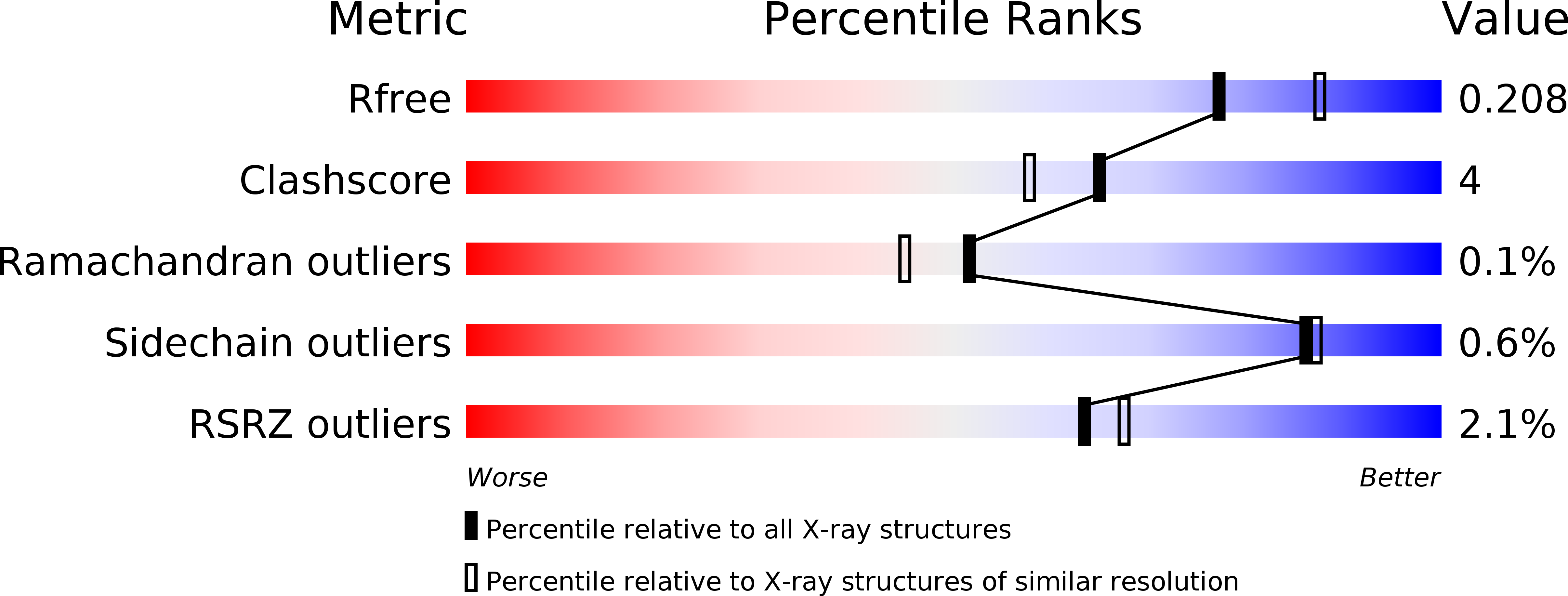
Macromolecular Entities
Polymer Type:polypeptide(L)
Molecule:Fab fragment heavy chain
Chain IDs:A (auth: H), C (auth: A)
Chain Length:242
Number of Molecules:2
Biological Source:Homo sapiens
Polymer Type:polypeptide(L)
Molecule:Fab fragment light chain
Chain IDs:B (auth: L), D (auth: B)
Chain Length:234
Number of Molecules:2
Biological Source:Homo sapiens
Primary Citation
Structural and biophysical characterization of an epitope-specific engineered Fab fragment and complexation with membrane proteins: implications for co-crystallization.
Acta Crystallogr.,Sect.D 71 896 906 (2015)
PMID: 25849400 DOI: 10.1107/S1399004715001856

Abstact

Crystallization chaperones are attracting increasing interest as a route to crystal growth and structure elucidation of difficult targets such as membrane proteins. While strategies to date have typically employed protein-specific chaperones, a peptide-specific chaperone to crystallize multiple cognate peptide epitope-containing client proteins is envisioned. This would eliminate the target-specific chaperone-production step and streamline the co-crystallization process. Previously, protein engineering and directed evolution were used to generate a single-chain variable (scFv) antibody fragment with affinity for the peptide sequence EYMPME (scFv/EE). This report details the conversion of scFv/EE to an anti-EE Fab format (Fab/EE) followed by its biophysical characterization. The addition of constant chains increased the overall stability and had a negligible impact on the antigen affinity. The 2.0 Å resolution crystal structure of Fab/EE reveals contacts with larger surface areas than those of scFv/EE. Surface plasmon resonance, an enzyme-linked immunosorbent assay, and size-exclusion chromatography were used to assess Fab/EE binding to EE-tagged soluble and membrane test proteins: namely, the β-barrel outer membrane protein intimin and α-helical A2a G protein-coupled receptor (A2aR). Molecular-dynamics simulation of the intimin constructs with and without Fab/EE provides insight into the energetic complexities of the co-crystallization approach.

Legend

Protein

Chemical

Disease

Primary Citation of related structures
Feedback Form
Name
Email
Institute
Feedback