4WZX image
Deposition Date 2014-11-20
Release Date 2015-06-03
Last Version Date 2024-02-28
Entry Detail
PDB ID:
4WZX
Keywords:
Title:
ULK3 regulates cytokinetic abscission by phosphorylating ESCRT-III proteins
Biological Source:
Source Organism:
Homo sapiens (Taxon ID: 9606)
Host Organism:
Method Details:
Experimental Method:
Resolution:
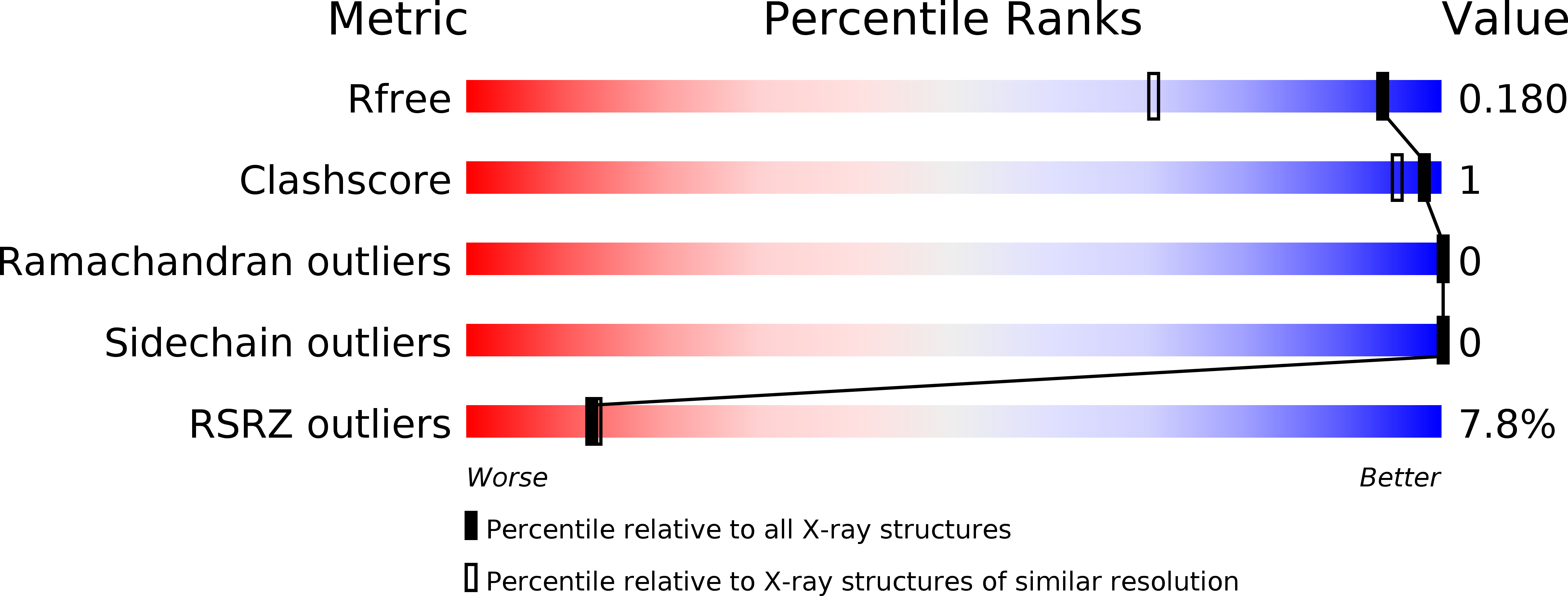
1.39 Å
R-Value Free:
0.18
R-Value Work:
0.15
R-Value Observed:
0.15
Space Group:
H 3 2
Macromolecular Entities
Structures with similar UniProt ID
Protein Blast
Polymer Type:polypeptide(L)
Molecule:Serine/threonine-protein kinase ULK3
Gene (Uniprot):ULK3
Chain IDs:A
Chain Length:95
Number of Molecules:1
Biological Source:Homo sapiens
Structures with similar UniProt ID
Protein Blast
Polymer Type:polypeptide(L)
Molecule:IST1 homolog
Gene (Uniprot):IST1
Chain IDs:B (auth: E)
Chain Length:23
Number of Molecules:1
Biological Source:Homo sapiens
Primary Citation
ULK3 regulates cytokinetic abscission by phosphorylating ESCRT-III proteins.
Elife 4 e06547 e06547 (2015)
PMID: 26011858 DOI: 10.7554/eLife.06547

Abstact

The endosomal sorting complexes required for transport (ESCRT) machinery mediates the physical separation between daughter cells during cytokinetic abscission. This process is regulated by the abscission checkpoint, a genome protection mechanism that relies on Aurora B and the ESCRT-III subunit CHMP4C to delay abscission in response to chromosome missegregation. In this study, we show that Unc-51-like kinase 3 (ULK3) phosphorylates and binds ESCRT-III subunits via tandem MIT domains, and thereby, delays abscission in response to lagging chromosomes, nuclear pore defects, and tension forces at the midbody. Our structural and biochemical studies reveal an unusually tight interaction between ULK3 and IST1, an ESCRT-III subunit required for abscission. We also demonstrate that IST1 phosphorylation by ULK3 is an essential signal required to sustain the abscission checkpoint and that ULK3 and CHMP4C are functionally linked components of the timer that controls abscission in multiple physiological situations.

Legend

Protein

Chemical

Disease

Primary Citation of related structures
Feedback Form
Name
Email
Institute
Feedback