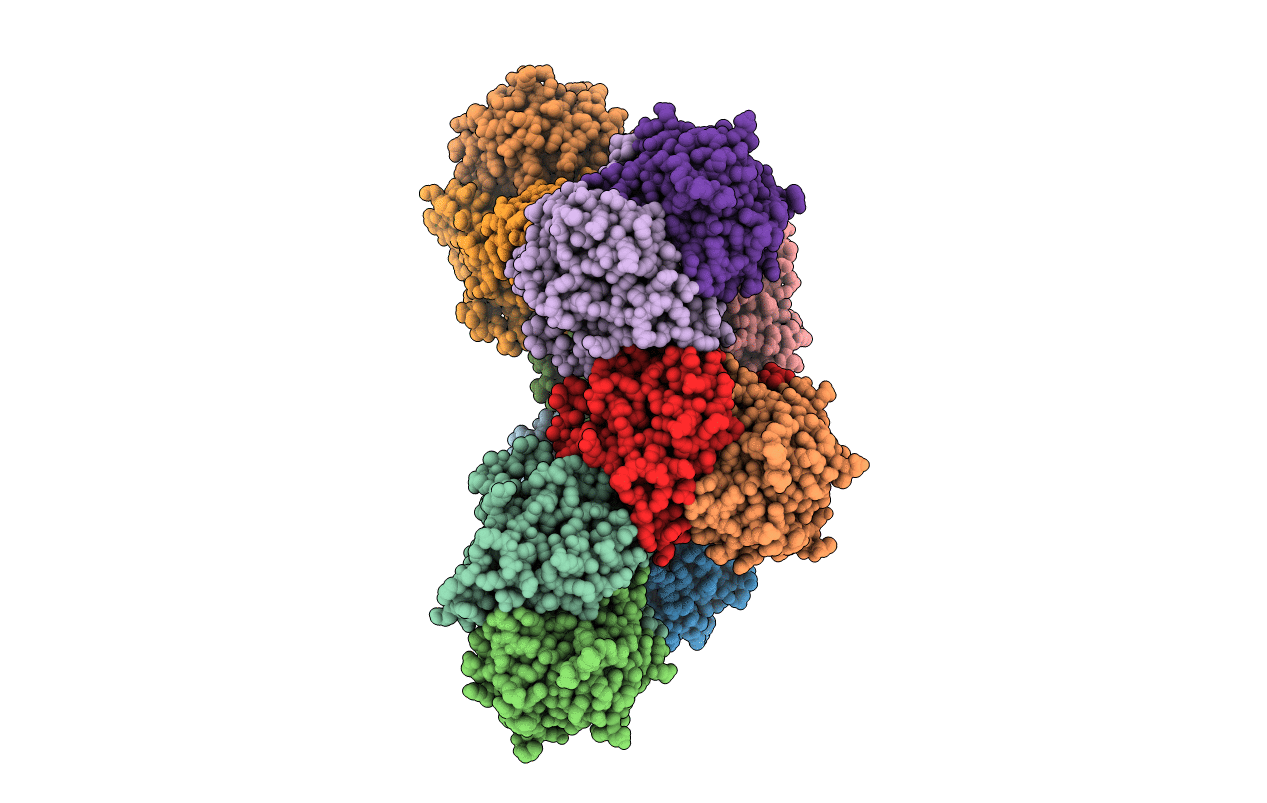
4WXY image
Deposition Date 2014-11-14
Release Date 2015-01-14
Last Version Date 2025-04-02
Entry Detail
PDB ID:
4WXY
Keywords:
Title:
PLPS (inactive glutaminase mutant) co-crystallized with glutamine and R5P.
Biological Source:
Source Organism(s):
Expression System(s):
Method Details:
Experimental Method:
Resolution:
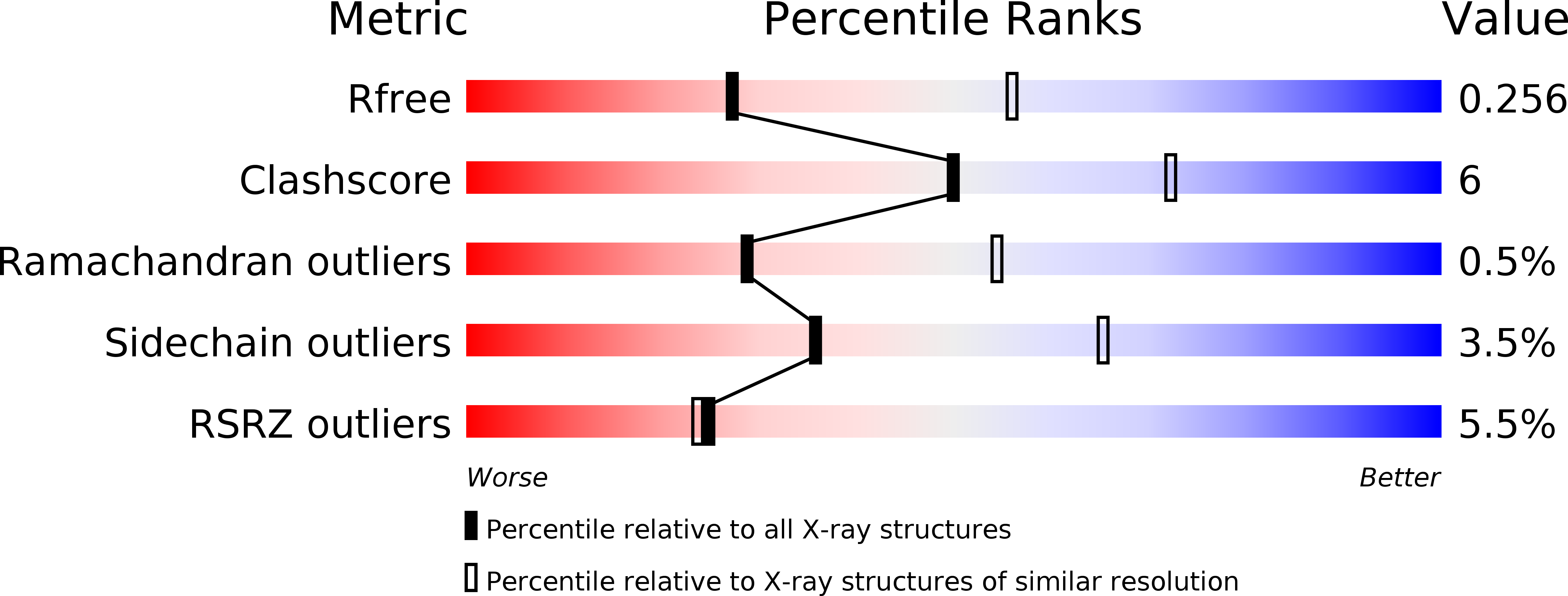
2.70 Å
R-Value Free:
0.25
R-Value Work:
0.20
R-Value Observed:
0.21
Space Group:
C 2 2 21
Macromolecular Entities
Structures with similar UniProt ID
Protein Blast
Polymer Type:polypeptide(L)
Molecule:Pyridoxal biosynthesis lyase PdxS
Gene (Uniprot):pdxS
Chain IDs:A, B (auth: C), C (auth: E), D (auth: G), E (auth: I), F (auth: K)
Chain Length:304
Number of Molecules:6
Biological Source:Geobacillus kaustophilus
Structures with similar UniProt ID
Protein Blast
Polymer Type:polypeptide(L)
Molecule:Glutamine amidotransferase subunit PdxT
Gene (Uniprot):pdxT
Mutagens:H169N
Chain IDs:G (auth: B), H (auth: D), I (auth: F), J (auth: H), K (auth: J), L
Chain Length:228
Number of Molecules:6
Biological Source:Geobacillus kaustophilus
Modified Residue
Compound ID Chain ID Parent Comp ID Details 2D Image
CYG G CYS modified residue
L5P A LYS modified residue
Primary Citation
Crystal structures capture three states in the catalytic cycle of a pyridoxal phosphate (PLP) synthase.
J.Biol.Chem. 290 5226 5239 (2015)
PMID: 25568319 DOI: 10.1074/jbc.M114.626382

Abstact

PLP synthase (PLPS) is a remarkable single-enzyme biosynthetic pathway that produces pyridoxal 5'-phosphate (PLP) from glutamine, ribose 5-phosphate, and glyceraldehyde 3-phosphate. The intact enzyme includes 12 synthase and 12 glutaminase subunits. PLP synthesis occurs in the synthase active site by a complicated mechanism involving at least two covalent intermediates at a catalytic lysine. The first intermediate forms with ribose 5-phosphate. The glutaminase subunit is a glutamine amidotransferase that hydrolyzes glutamine and channels ammonia to the synthase active site. Ammonia attack on the first covalent intermediate forms the second intermediate. Glyceraldehyde 3-phosphate reacts with the second intermediate to form PLP. To investigate the mechanism of the synthase subunit, crystal structures were obtained for three intermediate states of the Geobacillus stearothermophilus intact PLPS or its synthase subunit. The structures capture the synthase active site at three distinct steps in its complicated catalytic cycle, provide insights into the elusive mechanism, and illustrate the coordinated motions within the synthase subunit that separate the catalytic states. In the intact PLPS with a Michaelis-like intermediate in the glutaminase active site, the first covalent intermediate of the synthase is fully sequestered within the enzyme by the ordering of a generally disordered 20-residue C-terminal tail. Following addition of ammonia, the synthase active site opens and admits the Lys-149 side chain, which participates in formation of the second intermediate and PLP. Roles are identified for conserved Asp-24 in the formation of the first intermediate and for conserved Arg-147 in the conversion of the first to the second intermediate.

Legend

Protein

Chemical

Disease

Primary Citation of related structures
Feedback Form
Name
Email
Institute
Feedback