4WWX image
Deposition Date 2014-11-12
Release Date 2015-02-25
Last Version Date 2024-02-28
Entry Detail
PDB ID:
4WWX
Title:
Crystal structure of the core RAG1/2 recombinase
Biological Source:
Source Organism(s):
Mus musculus (Taxon ID: 10090)
Expression System(s):
Method Details:
Experimental Method:
Resolution:
3.20 Å
R-Value Free:
0.25
R-Value Work:
0.20
R-Value Observed:
0.20
Space Group:
C 2 2 21
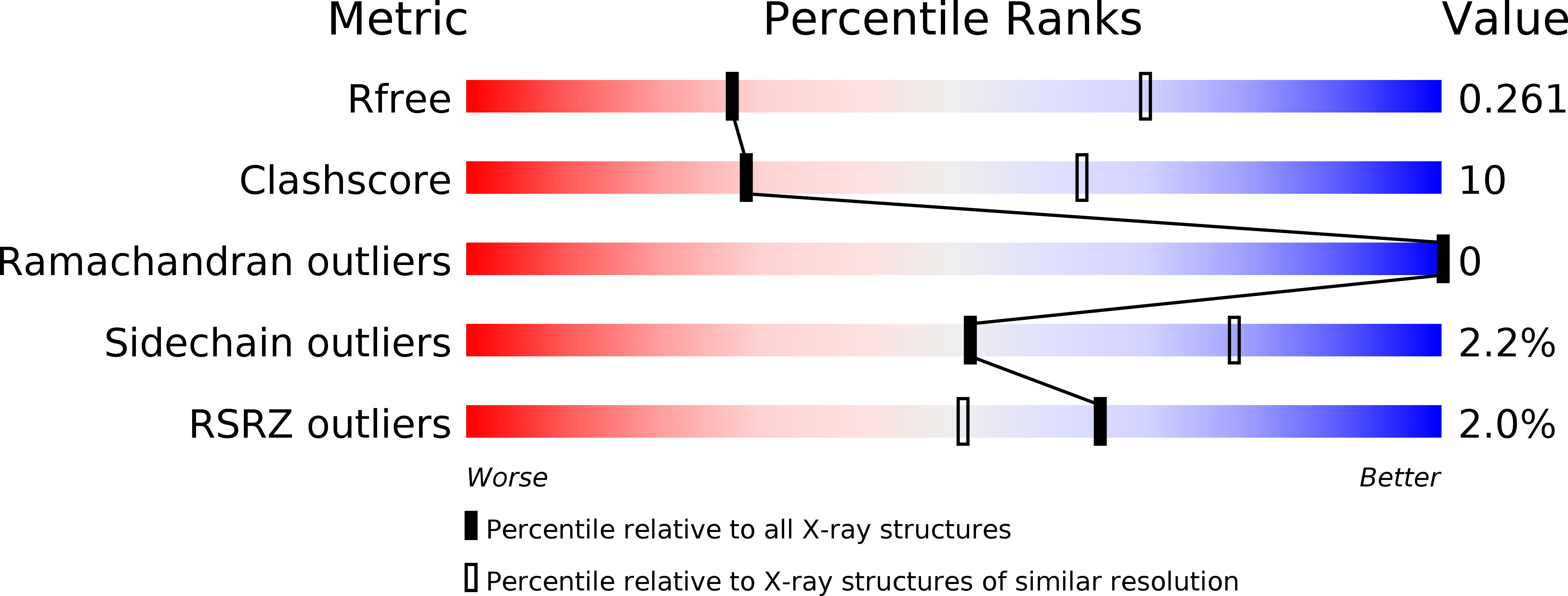
Macromolecular Entities
Structures with similar UniProt ID
Protein Blast
Polymer Type:polypeptide(L)
Molecule:V(D)J recombination-activating protein 1
Gene (Uniprot):Rag1
Chain IDs:A (auth: B), C (auth: E)
Chain Length:618
Number of Molecules:2
Biological Source:Mus musculus
Structures with similar UniProt ID
Protein Blast
Polymer Type:polypeptide(L)
Molecule:V(D)J recombination-activating protein 2
Gene (Uniprot):Rag2
Chain IDs:B (auth: X), D (auth: Y)
Chain Length:349
Number of Molecules:2
Biological Source:Mus musculus
Ligand Molecules
Primary Citation
Crystal structure of the V(D)J recombinase RAG1-RAG2.
Nature 518 507 511 (2015)
PMID: 25707801 DOI: 10.1038/nature14174

Abstact

V(D)J recombination in the vertebrate immune system generates a highly diverse population of immunoglobulins and T-cell receptors by combinatorial joining of segments of coding DNA. The RAG1-RAG2 protein complex initiates this site-specific recombination by cutting DNA at specific sites flanking the coding segments. Here we report the crystal structure of the mouse RAG1-RAG2 complex at 3.2 Å resolution. The 230-kilodalton RAG1-RAG2 heterotetramer is 'Y-shaped', with the amino-terminal domains of the two RAG1 chains forming an intertwined stalk. Each RAG1-RAG2 heterodimer composes one arm of the 'Y', with the active site in the middle and RAG2 at its tip. The RAG1-RAG2 structure rationalizes more than 60 mutations identified in immunodeficient patients, as well as a large body of genetic and biochemical data. The architectural similarity between RAG1 and the hairpin-forming transposases Hermes and Tn5 suggests the evolutionary conservation of these DNA rearrangements.

Legend

Protein

Chemical

Disease

Primary Citation of related structures
Feedback Form
Name
Email
Institute
Feedback