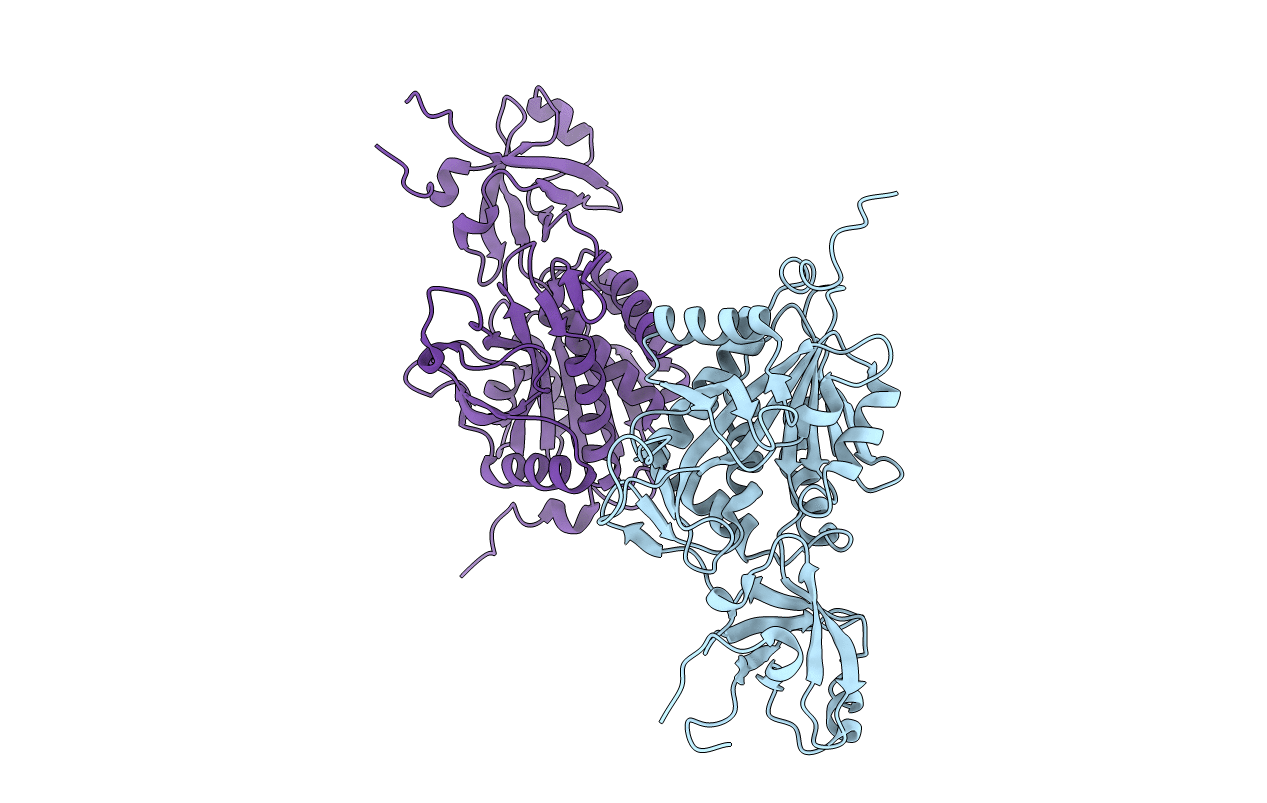
4WWV image
Deposition Date 2014-11-12
Release Date 2015-03-04
Last Version Date 2024-01-10
Entry Detail
PDB ID:
4WWV
Keywords:
Title:
Aminopeptidase APDkam598 from the archaeon Desulfurococcus kamchatkensis
Biological Source:
Method Details:
Experimental Method:
Resolution:
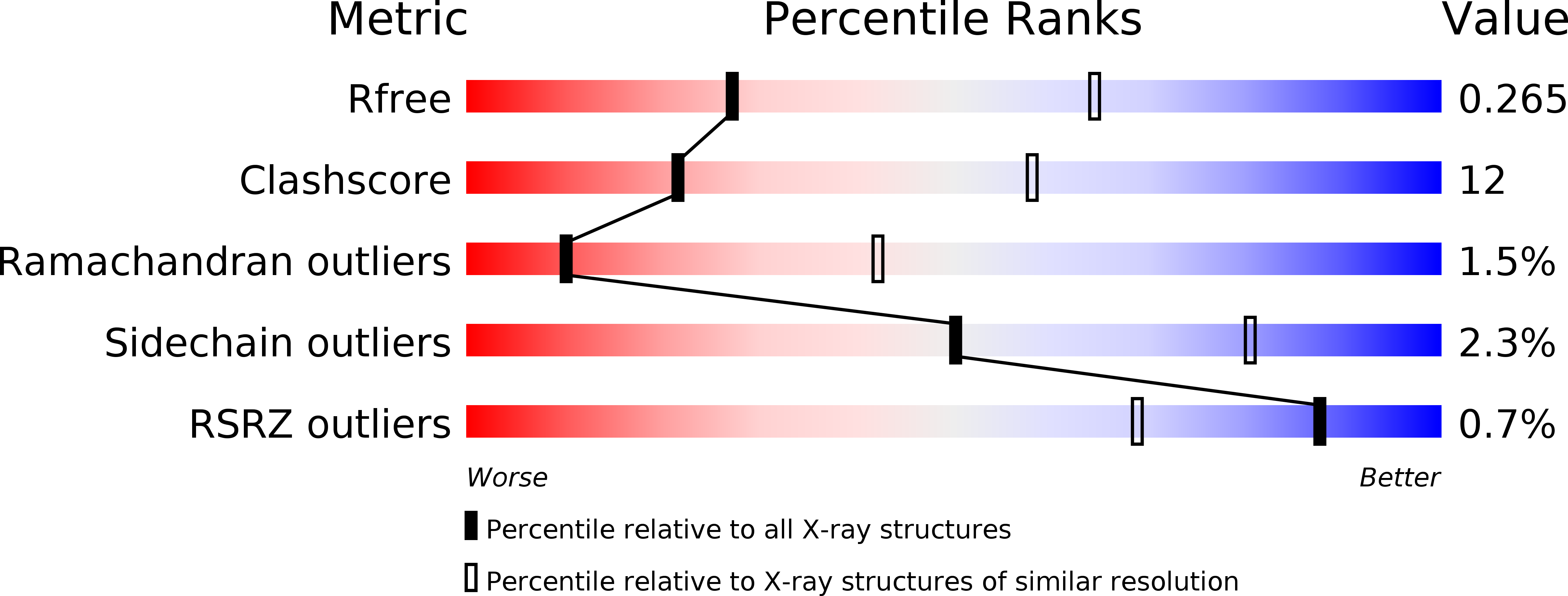
3.01 Å
R-Value Free:
0.26
R-Value Work:
0.20
R-Value Observed:
0.20
Space Group:
F 2 3
Macromolecular Entities
Structures with similar UniProt ID
Protein Blast
Polymer Type:polypeptide(L)
Molecule:Aminopeptidase from family M42
Gene (Uniprot):DKAM_0589
Mutagens:M26V
Chain IDs:A, B
Chain Length:394
Number of Molecules:2
Biological Source:Desulfurococcus kamchatkensis
Primary Citation
Structure of the dodecamer of the aminopeptidase APDkam598 from the archaeon Desulfurococcus kamchatkensis.
Acta Crystallogr.,Sect.F 71 277 285 (2015)
PMID: 25760701 DOI: 10.1107/S2053230X15000783

Abstact

The crystal structure of the aminopeptidase APDkam589 from the thermophilic crenarchaeon Desulfurococcus kamchatkensis was determined at a resolution of 3.0 Å. In the crystal, the monomer of APDkam589 and its symmetry-related monomers are densely packed to form a 12-subunit complex. Single-particle electron-microscopy analysis confirms that APDkam589 is present as a compact dodecamer in solution. The APDkam589 molecule is built similarly to the molecules of the PhTET peptidases, which have the highest sequence identity to APDkam589 among known structures and were isolated from the more thermostable archaeon Pyrococcus horikoshii. A comparison of the interactions of the subunits in APDkam589 with those in PhTET1, PhTET2 and PhTET3 reveals that APDkam589 has a much lower total number of salt bridges, which correlates with the lower thermostability of APDkam589. The monomer of APDkam589 has six Trp residues, five of which are on the external surface of the dodecamer. A superposition of the structure of APDkam589 with those having a high sequence similarity to APDkam589 reveals that, although the positions of Trp45, Trp252 and Trp358 are not conserved in the sequences, the spatial locations of the Trp residues in these models are similar.

Legend

Protein

Chemical

Disease

Primary Citation of related structures
Feedback Form
Name
Email
Institute
Feedback