4WG2 image
Deposition Date 2014-09-17
Release Date 2014-11-05
Last Version Date 2023-12-27
Entry Detail
PDB ID:
4WG2
Keywords:
Title:
P411BM3-CIS T438S I263F regioselective C-H amination catalyst
Biological Source:
Source Organism:
Host Organism:
Method Details:
Experimental Method:
Resolution:
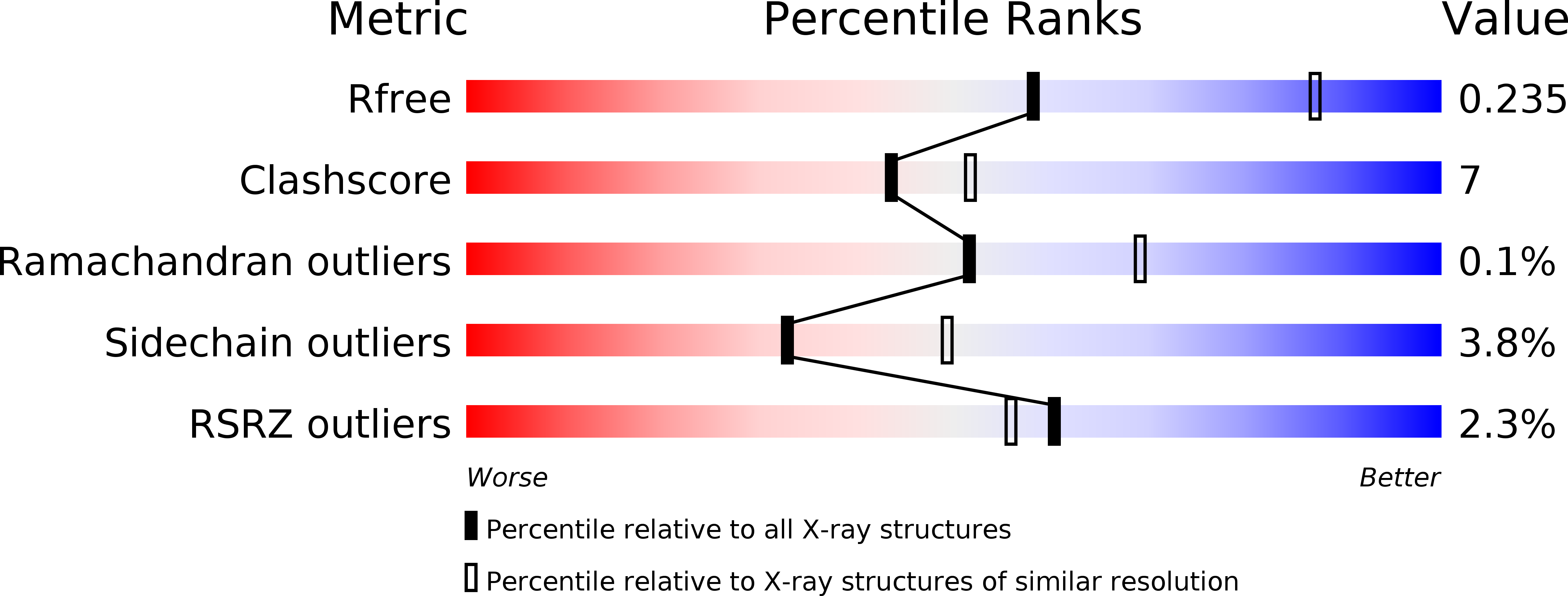
2.66 Å
R-Value Free:
0.23
R-Value Work:
0.19
R-Value Observed:
0.19
Space Group:
P 42 21 2
Macromolecular Entities
Structures with similar UniProt ID
Protein Blast
Polymer Type:polypeptide(L)
Molecule:Bifunctional P-450/NADPH-P450 reductase
Gene (Uniprot):cyp102A1
Mutagens:V78A, F87V, P142S, T175I, A184V, S226R, H236Q, E252G, I263F, T268A, A290V, L353V, I366V, C400S, T438S, E442K
Chain IDs:A, B, C
Chain Length:469
Number of Molecules:3
Biological Source:Bacillus megaterium
Primary Citation
Enzyme-controlled nitrogen-atom transfer enables regiodivergent C-h amination.
J.Am.Chem.Soc. 136 15505 15508 (2014)
PMID: 25325618 DOI: 10.1021/ja509308v

Abstact

We recently demonstrated that variants of cytochrome P450BM3 (CYP102A1) catalyze the insertion of nitrogen species into benzylic C-H bonds to form new C-N bonds. An outstanding challenge in the field of C-H amination is catalyst-controlled regioselectivity. Here, we report two engineered variants of P450BM3 that provide divergent regioselectivity for C-H amination-one favoring amination of benzylic C-H bonds and the other favoring homo-benzylic C-H bonds. The two variants provide nearly identical kinetic isotope effect values (2.8-3.0), suggesting that C-H abstraction is rate-limiting. The 2.66-Å crystal structure of the most active enzyme suggests that the engineered active site can preorganize the substrate for reactivity. We hypothesize that the enzyme controls regioselectivity through localization of a single C-H bond close to the iron nitrenoid.

Legend

Protein

Chemical

Disease

Primary Citation of related structures
Feedback Form
Name
Email
Institute
Feedback