4WCJ image
Deposition Date 2014-09-04
Release Date 2014-11-12
Last Version Date 2023-09-27
Entry Detail
PDB ID:
4WCJ
Keywords:
Title:
Structure of IcaB from Ammonifex degensii
Biological Source:
Source Organism:
Host Organism:
Method Details:
Experimental Method:
Resolution:
1.70 Å
R-Value Free:
0.23
R-Value Work:
0.20
R-Value Observed:
0.20
Space Group:
I 4
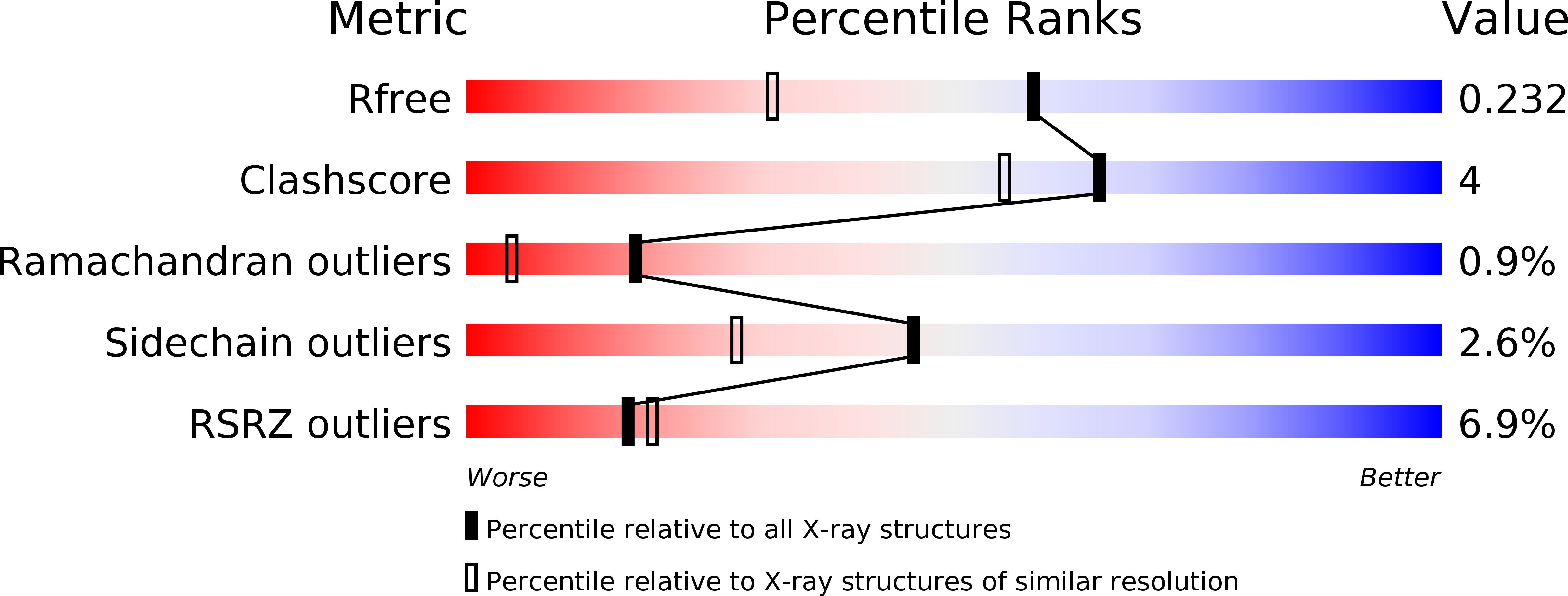
Macromolecular Entities
Structures with similar UniProt ID
Protein Blast
Polymer Type:polypeptide(L)
Molecule:Polysaccharide deacetylase
Gene (Uniprot):Adeg_0846
Chain IDs:A
Chain Length:264
Number of Molecules:1
Biological Source:Ammonifex degensii
Primary Citation
Structural Basis for the De-N-acetylation of Poly-beta-1,6-N-acetyl-d-glucosamine in Gram-positive Bacteria.
J.Biol.Chem. 289 35907 35917 (2014)
PMID: 25359777 DOI: 10.1074/jbc.M114.611400

Abstact

Exopolysaccharides are required for the development and integrity of biofilms produced by a wide variety of bacteria. In staphylococci, partial de-N-acetylation of the exopolysaccharide poly-β-1,6-N-acetyl-d-glucosamine (PNAG) by the extracellular protein IcaB is required for biofilm formation. To understand the molecular basis for PNAG de-N-acetylation, the structure of IcaB from Ammonifex degensii (IcaBAd) has been determined to 1.7 Å resolution. The structure of IcaBAd reveals a (β/α)7 barrel common to the family four carbohydrate esterases (CE4s) with the canonical motifs circularly permuted. The metal dependence of IcaBAd is similar to most CE4s showing the maximum rates of de-N-acetylation with Ni(2+), Co(2+), and Zn(2+). From docking studies with β-1,6-GlcNAc oligomers and structural comparison to PgaB from Escherichia coli, the Gram-negative homologue of IcaB, we identify Arg-45, Tyr-67, and Trp-180 as key residues for PNAG binding during catalysis. The absence of these residues in PgaB provides a rationale for the requirement of a C-terminal domain for efficient deacetylation of PNAG in Gram-negative species. Mutational analysis of conserved active site residues suggests that IcaB uses an altered catalytic mechanism in comparison to other characterized CE4 members. Furthermore, we identified a conserved surface-exposed hydrophobic loop found only in Gram-positive homologues of IcaB. Our data suggest that this loop is required for membrane association and likely anchors IcaB to the membrane during polysaccharide biosynthesis. The work presented herein will help guide the design of IcaB inhibitors to combat biofilm formation by staphylococci.

Legend

Protein

Chemical

Disease

Primary Citation of related structures
Feedback Form
Name
Email
Institute
Feedback