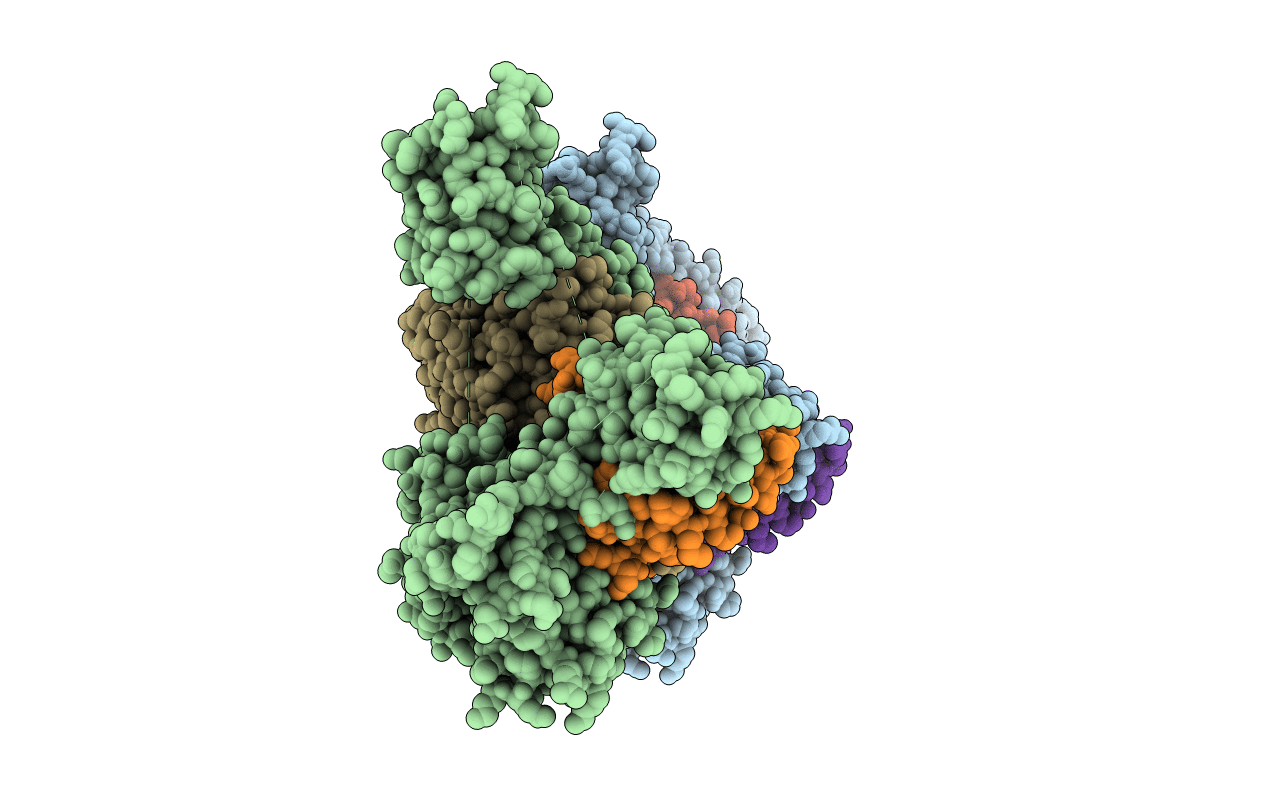
4W2R image
Deposition Date 2017-09-25
Release Date 2017-12-27
Last Version Date 2024-11-13
Entry Detail
PDB ID:
4W2R
Title:
Structure of Hs/AcPRC2 in complex with 5,8-dichloro-2-[(4-methoxy-6-methyl-2-oxo-1,2-dihydropyridin-3-yl)methyl]-7-[(R)-methoxy(oxetan-3-yl)methyl]-3,4-dihydroisoquinolin-1(2H)-one
Biological Source:
Source Organism:
Host Organism:
Method Details:
Experimental Method:
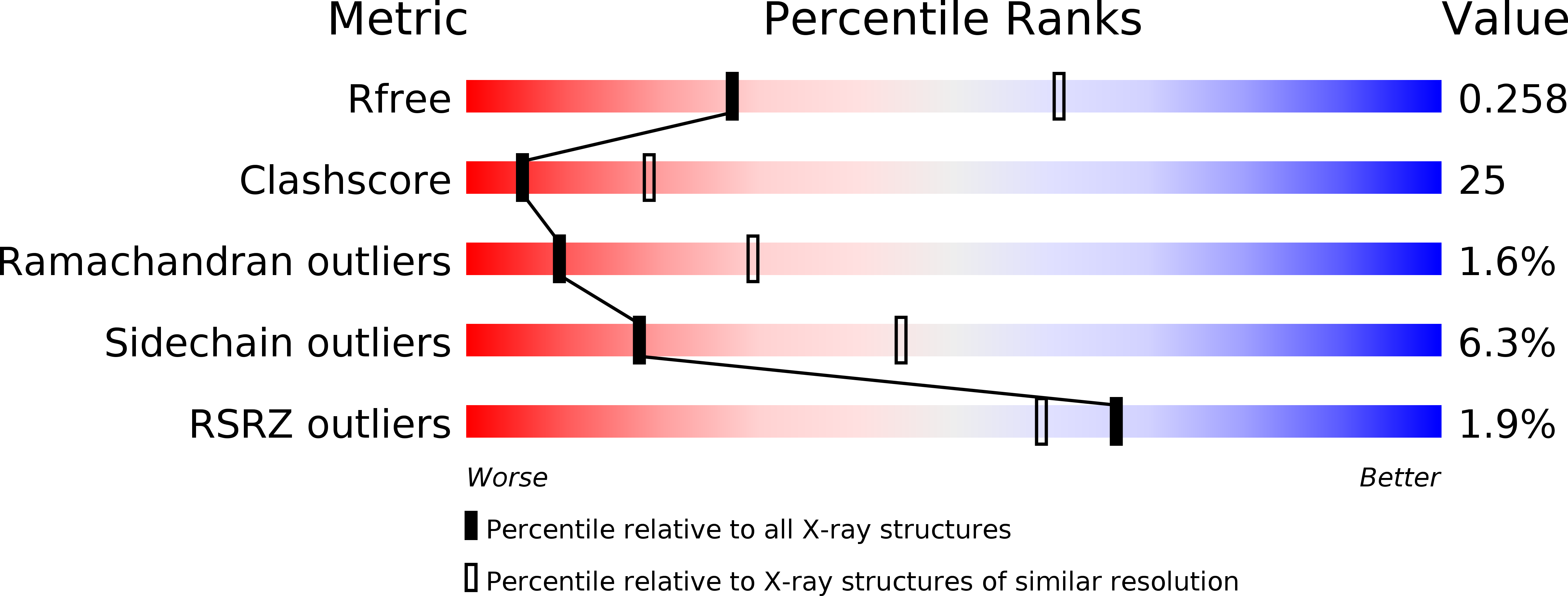
Resolution:
2.81 Å
R-Value Free:
0.26
R-Value Work:
0.21
R-Value Observed:
0.22
Space Group:
P 1 21 1
Macromolecular Entities
Structures with similar UniProt ID
Protein Blast
Polymer Type:polypeptide(L)
Molecule:Enhancer of zeste 2 polycomb repressive complex 2 subunit
Gene (Uniprot):ezh2
Chain IDs:A, B
Chain Length:643
Number of Molecules:2
Biological Source:Anolis carolinensis
Structures with similar UniProt ID
Protein Blast
Polymer Type:polypeptide(L)
Molecule:Polycomb protein EED
Gene (Uniprot):EED
Chain IDs:C (auth: E), D (auth: F)
Chain Length:362
Number of Molecules:2
Biological Source:Homo sapiens
Structures with similar UniProt ID
Protein Blast
Polymer Type:polypeptide(L)
Molecule:Polycomb protein SUZ12
Gene (Uniprot):SUZ12
Chain IDs:E (auth: S), F (auth: T)
Chain Length:191
Number of Molecules:2
Biological Source:Homo sapiens
Primary Citation
Optimization of Orally Bioavailable Enhancer of Zeste Homolog 2 (EZH2) Inhibitors Using Ligand and Property-Based Design Strategies: Identification of Development Candidate (R)-5,8-Dichloro-7-(methoxy(oxetan-3-yl)methyl)-2-((4-methoxy-6-methyl-2-oxo-1,2-dihydropyridin-3-yl)methyl)-3,4-dihydroisoquinolin-1(2H)-one (PF-06821497).
J. Med. Chem. 61 650 665 (2018)
PMID: 29211475 DOI: 10.1021/acs.jmedchem.7b01375

Abstact

A new series of lactam-derived EZH2 inhibitors was designed via ligand-based and physicochemical-property-based strategies to address metabolic stability and thermodynamic solubility issues associated with previous lead compound 1. The new inhibitors incorporated an sp3 hybridized carbon atom at the 7-position of the lactam moiety present in lead compound 1 as a replacement for a dimethylisoxazole group. This transformation enabled optimization of the physicochemical properties and potency compared to compound 1. Analysis of relationships between calculated log D (clogD) values and in vitro metabolic stability and permeability parameters identified a clogD range that afforded an increased probability of achieving favorable ADME data in a single molecule. Compound 23a exhibited the best overlap of potency and pharmaceutical properties as well as robust tumor growth inhibition in vivo and was therefore advanced as a development candidate (PF-06821497). A crystal structure of 23a in complex with the three-protein PRC2 complex enabled understanding of the key structural features required for optimal binding.

Legend

Protein

Chemical

Disease

Primary Citation of related structures
Feedback Form
Name
Email
Institute
Feedback