4UFG image
Deposition Date 2015-03-17
Release Date 2016-01-27
Last Version Date 2024-10-09
Entry Detail
PDB ID:
4UFG
Keywords:
Title:
Thrombin in complex with (2R)-2-(benzylsulfonylamino)-N-((1S)-2-((4- carbamimidoylphenyl)methylamino)-1-methyl-2-oxo-ethyl)-N-methyl-3- phenyl-propanamide ethane
Biological Source:
Source Organism:
HIRUDO MEDICINALIS (Taxon ID: 6421)
HOMO SAPIENS (Taxon ID: 9606)
Method Details:
Experimental Method:
Resolution:
1.65 Å
R-Value Free:
0.18
R-Value Work:
0.16
R-Value Observed:
0.16
Space Group:
C 1 2 1
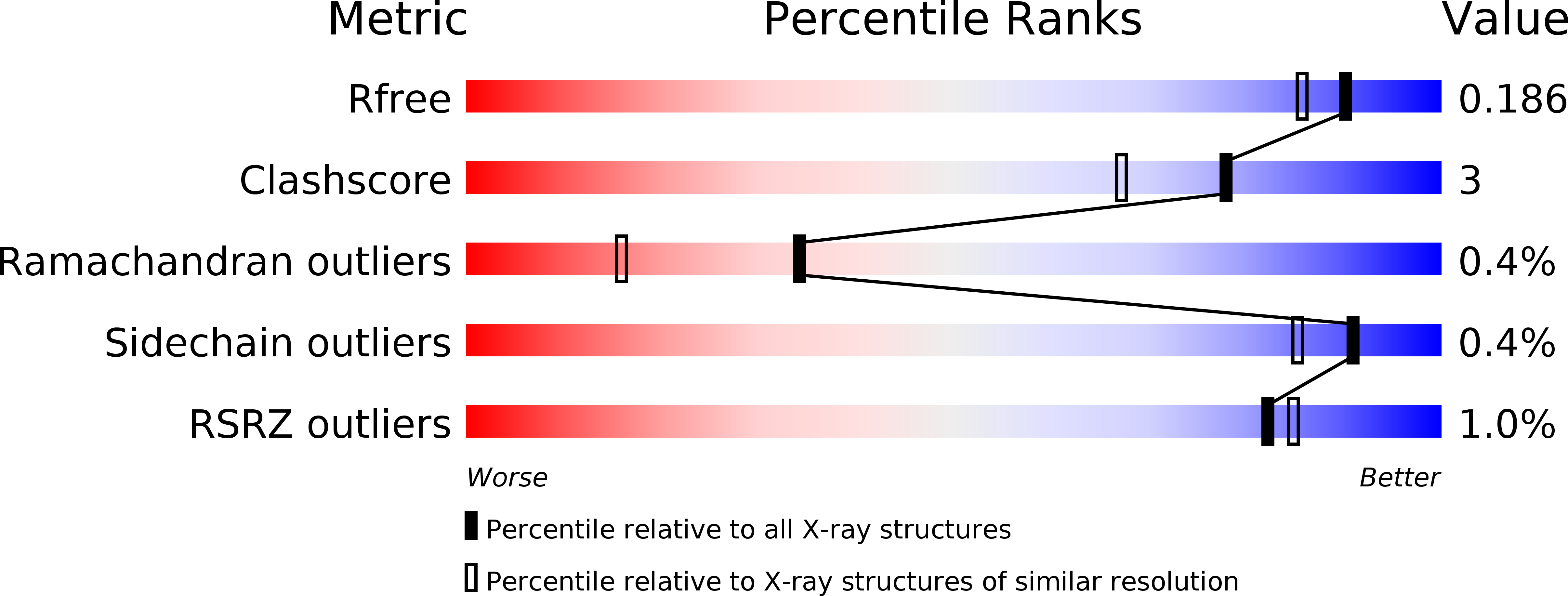
Macromolecular Entities
Structures with similar UniProt ID
Protein Blast
Polymer Type:polypeptide(L)
Molecule:THROMBIN HEAVY CHAIN
Gene (Uniprot):F2
Chain IDs:A (auth: H)
Chain Length:258
Number of Molecules:1
Biological Source:HOMO SAPIENS
Structures with similar UniProt ID
Protein Blast
Polymer Type:polypeptide(L)
Molecule:HIRUDIN VARIANT-2
Chain IDs:B (auth: I)
Chain Length:12
Number of Molecules:1
Biological Source:HIRUDO MEDICINALIS
Structures with similar UniProt ID
Protein Blast
Polymer Type:polypeptide(L)
Molecule:THROMBIN LIGHT CHAIN
Gene (Uniprot):F2
Chain IDs:C (auth: L)
Chain Length:29
Number of Molecules:1
Biological Source:HOMO SAPIENS
Modified Residue
Compound ID Chain ID Parent Comp ID Details 2D Image
ASN A ASN GLYCOSYLATION SITE
TYS B TYR O-SULFO-L-TYROSINE
Primary Citation
Boosting Affinity by Correct Ligand Preorganization for the S2 Pocket of Thrombin: A Study by Isothermal Titration Calorimetry, Molecular Dynamics, and High-Resolution Crystal Structures.
Chemmedchem 11 309 ? (2016)
PMID: 26762840 DOI: 10.1002/CMDC.201500531

Abstact

Structural preorganization to fix bioactive conformations at protein binding sites is a popular strategy to enhance binding affinity during late-stage optimization. The rationale for this enhancement relates to entropic advantages assigned to rigidified versus flexible ligands. We analyzed a narrow series of peptidomimetics binding to thrombin. The individual ligands exhibit at P2 a conformationally flexible glycine, more restricted alanine, N-methylglycine, N-methylhomoalanine, and largely rigidified proline moiety. Overall, affinity was found to increase by a factor of 1000, explained partly by an entropic advantage. All ligands adopt the same binding mode with small deviations. The residual mobility of the bound ligands is decreased across the series, and a protein side chain differs in its order/disorder behavior along with changes in the surface-water network pattern established across the newly generated protein-ligand surfaces. The enthalpy/entropy inventory displays a rather complex picture and emphasizes that thermodynamics can only be compared in terms of relative differences within a structurally similar ligand series.

Legend

Protein

Chemical

Disease

Primary Citation of related structures
Feedback Form
Name
Email
Institute
Feedback