4UD5 image
Deposition Date 2014-12-07
Release Date 2015-03-18
Last Version Date 2023-12-20
Entry Detail
PDB ID:
4UD5
Keywords:
Title:
Structural Plasticity of Cid1 Provides a Basis for its RNA Terminal Uridylyl Transferase Activity
Biological Source:
Source Organism:
Host Organism:
Method Details:
Experimental Method:
Resolution:
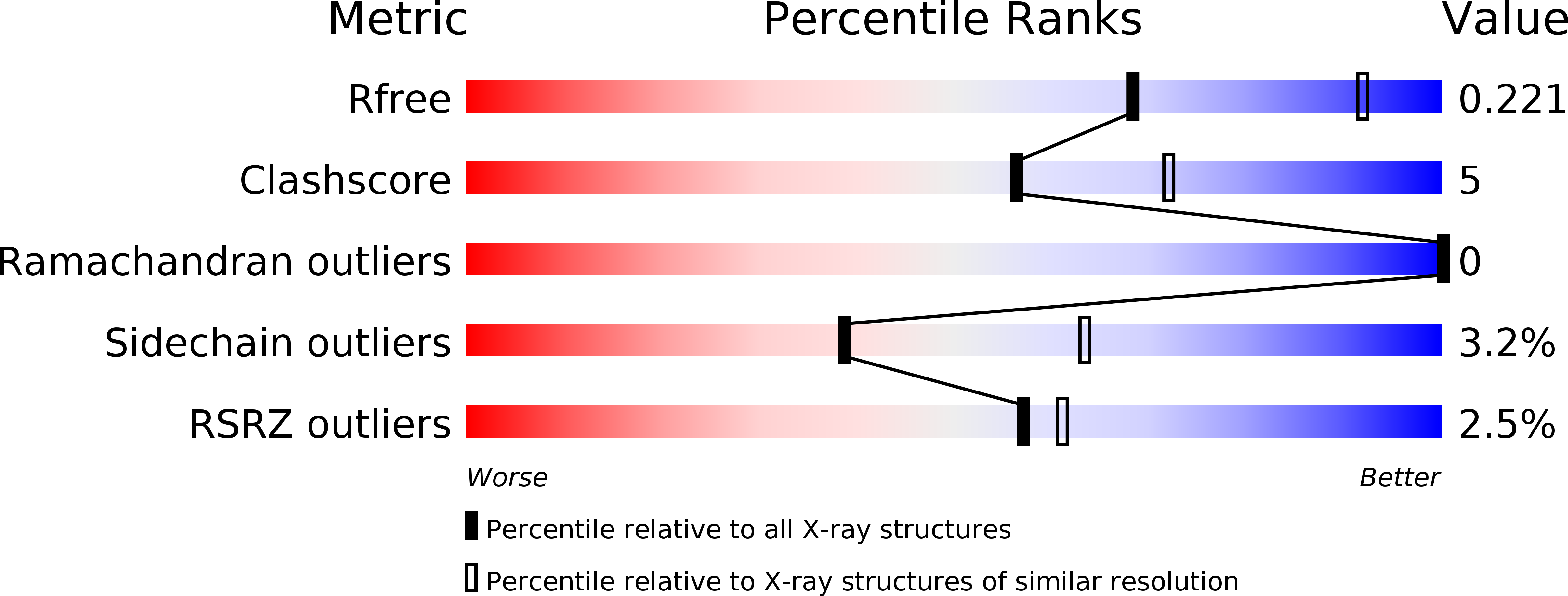
2.52 Å
R-Value Free:
0.21
R-Value Work:
0.17
R-Value Observed:
0.17
Space Group:
P 1 21 1
Macromolecular Entities
Structures with similar UniProt ID
Protein Blast
Polymer Type:polypeptide(L)
Molecule:POLY(A) RNA POLYMERASE PROTEIN CID1
Gene (Uniprot):cid1
Mutagens:YES
Chain IDs:A, B
Chain Length:366
Number of Molecules:2
Biological Source:SCHIZOSACCHAROMYCES POMBE
Primary Citation
Structural Plasticity of Cid1 Provides a Basis for its Distributive RNA Terminal Uridylyl Transferase Activity.
Nucleic Acids Res. 43 2968 ? (2015)
PMID: 25712096 DOI: 10.1093/NAR/GKV122

Abstact

Terminal uridylyl transferases (TUTs) are responsible for the post-transcriptional addition of uridyl residues to RNA 3' ends, leading in some cases to altered stability. The Schizosaccharomyces pombe TUT Cid1 is a model enzyme that has been characterized structurally at moderate resolution and provides insights into the larger and more complex mammalian TUTs, ZCCHC6 and ZCCHC11. Here, we report a higher resolution (1.74 Å) crystal structure of Cid1 that provides detailed evidence for uracil selection via the dynamic flipping of a single histidine residue. We also describe a novel closed conformation of the enzyme that may represent an intermediate stage in a proposed product ejection mechanism. The structural insights gained, combined with normal mode analysis and biochemical studies, demonstrate that the plasticity of Cid1, particularly about a hinge region (N164-N165), is essential for catalytic activity, and provide an explanation for its distributive uridylyl transferase activity. We propose a model clarifying observed differences between the in vitro apparently processive activity and in vivo distributive monouridylylation activity of Cid1. We suggest that modulating the flexibility of such enzymes-for example by the binding of protein co-factors-may allow them alternatively to add single or multiple uridyl residues to the 3' termini of RNA molecules.

Legend

Protein

Chemical

Disease

Primary Citation of related structures
Feedback Form
Name
Email
Institute
Feedback