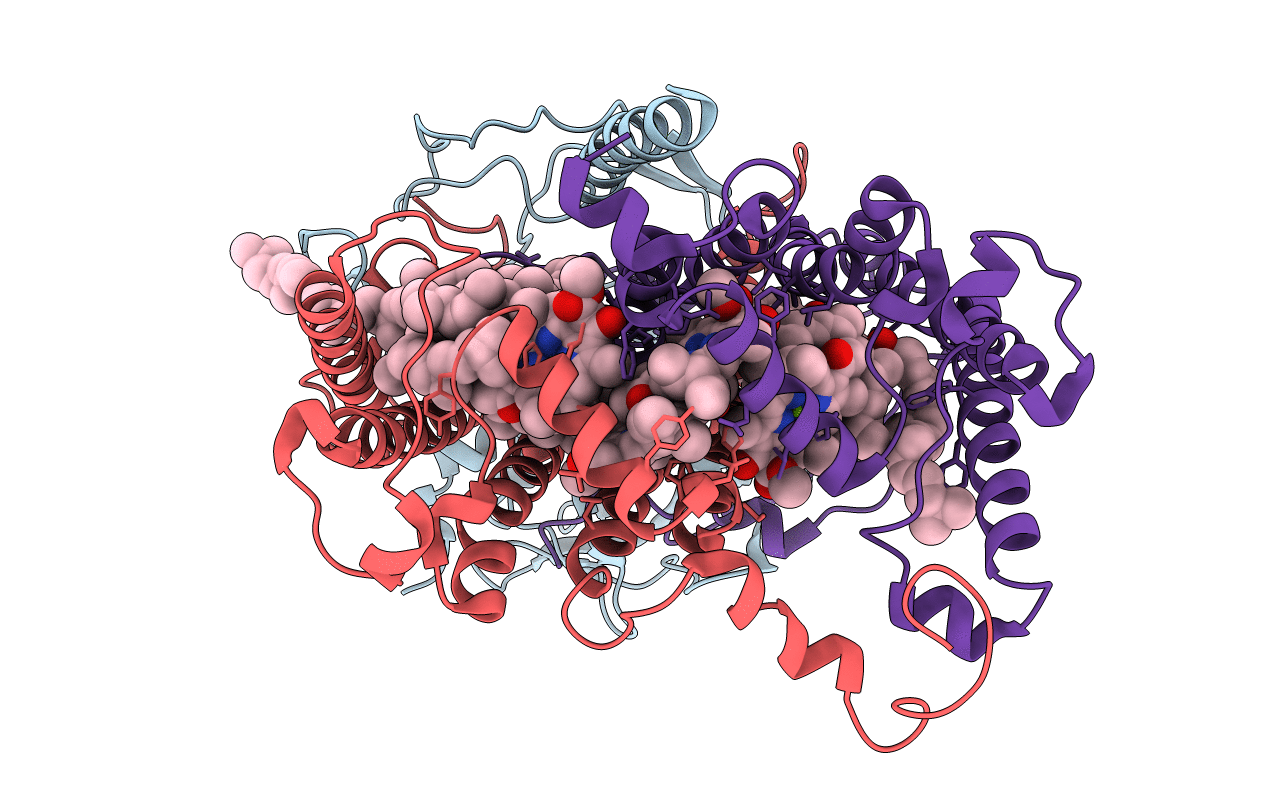
4TQQ image
Deposition Date 2014-06-11
Release Date 2014-07-16
Last Version Date 2023-09-27
Entry Detail
PDB ID:
4TQQ
Keywords:
Title:
Photosynthetic Reaction Center from R. sphaeroides Analyzed at Room Temperature on an X-ray Transparent Microfluidic Chip
Biological Source:
Source Organism(s):
Method Details:
Experimental Method:
Resolution:
2.50 Å
R-Value Free:
0.21
R-Value Work:
0.16
R-Value Observed:
0.16
Space Group:
P 42 21 2
Macromolecular Entities
Structures with similar UniProt ID
Protein Blast
Polymer Type:polypeptide(L)
Molecule:Reaction center protein H chain
Gene (Uniprot):puhA
Chain IDs:A (auth: H)
Chain Length:240
Number of Molecules:1
Biological Source:Rhodobacter sphaeroides
Structures with similar UniProt ID
Protein Blast
Polymer Type:polypeptide(L)
Molecule:Reaction center protein L chain
Gene (Uniprot):pufL
Chain IDs:B (auth: L)
Chain Length:281
Number of Molecules:1
Biological Source:Rhodobacter sphaeroides
Structures with similar UniProt ID
Protein Blast
Polymer Type:polypeptide(L)
Molecule:Reaction center protein M chain
Gene (Uniprot):pufM
Chain IDs:C (auth: M)
Chain Length:302
Number of Molecules:1
Biological Source:Rhodobacter sphaeroides
Primary Citation
X-ray Transparent Microfluidic Chip for Mesophase-Based Crystallization of Membrane Proteins and On-Chip Structure Determination.
Cryst.Growth Des. 14 4886 4890 (2014)
PMID: 25285049 DOI: 10.1021/cg5011488

Abstact

Crystallization from lipidic mesophase matrices is a promising route to diffraction-quality crystals and structures of membrane proteins. The microfluidic approach reported here eliminates two bottlenecks of the standard mesophase-based crystallization protocols: (i) manual preparation of viscous mesophases and (ii) manual harvesting of often small and fragile protein crystals. In the approach reported here, protein-loaded mesophases are formulated in an X-ray transparent microfluidic chip using only 60 nL of the protein solution per crystallization trial. The X-ray transparency of the chip enables diffraction data collection from multiple crystals residing in microfluidic wells, eliminating the normally required manual harvesting and mounting of individual crystals. We validated our approach by on-chip crystallization of photosynthetic reaction center, a membrane protein from Rhodobacter sphaeroides, followed by solving its structure to a resolution of 2.5 Å using X-ray diffraction data collected on-chip under ambient conditions. A moderate conformational change in hydrophilic chains of the protein was observed when comparing the on-chip, room temperature structure with known structures for which data were acquired under cryogenic conditions.

Legend

Protein

Chemical

Disease

Primary Citation of related structures
Feedback Form
Name
Email
Institute
Feedback